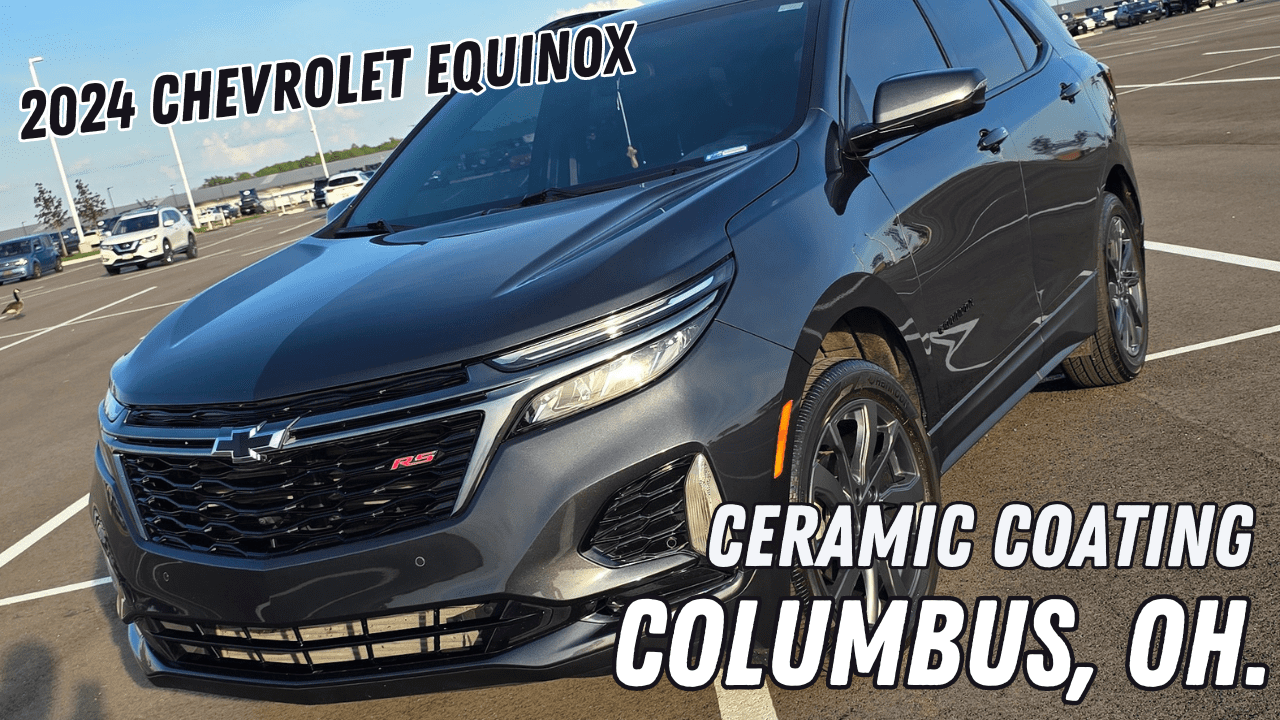
You've just washed your white car in Columbus, and it looks perfect until the sun hits the hood. A few hours later, dried sprinkler water leaves faint rings, road film darkens the lower doors, and small orange specks appear around the rear quarter panels. By winter, salt and slush can make that clean white finish look gray even when the paint itself is still in good condition.
That's where ceramic coating can help, but it isn't a magic shield. Ceramic coating for white cars in Columbus works best when the paint is properly prepared, the coating is applied in a controlled environment, and the owner follows a realistic maintenance routine. It can make washing easier, improve water behavior, and help protect gloss from UV exposure and chemical contamination. It won't correct scratches, prevent rock chips, or make water spots impossible.
Table of Contents
- Why White Cars Face Unique Challenges in Columbus
- The Three Prep Stages Before Coating a White Finish
- Applying Ceramic Coating Section by Section
- The Water Spot Misconception Every White Car Owner Needs to Hear
- Ceramic Coating vs Paint Protection Film for White Cars
- Seasonal Maintenance for Your Ceramic Coated White Car
- Getting Professional Help for Your Columbus White Car
Why White Cars Face Unique Challenges in Columbus
A white car leaving Hilliard on a bright summer morning can look clean at the driveway and dirty by the end of the commute. Bugs collect on the front bumper, pollen settles on the hood, and industrial fallout bonds to the clear coat. From several feet away, the contamination may seem minor. Up close, the finish loses its crisp white appearance and takes on a dull, gray cast.
White paint hides light swirls and wash marks better than black paint. It shows contamination more clearly, though, because road grime, iron fallout, tar, salt residue, and mineral deposits create a strong contrast against the lighter finish. A basic wash may remove loose dirt while leaving behind the speckled residue that makes the vehicle look unclean.
Columbus has a humid continental climate, with hot, humid summers and cold winters. The published maximum UV index reaches 8 in May, 9 in June and July, and 8 in August. That level of exposure matters when the goal is to preserve gloss and limit oxidation on lighter paint colors (Columbus climate summary).
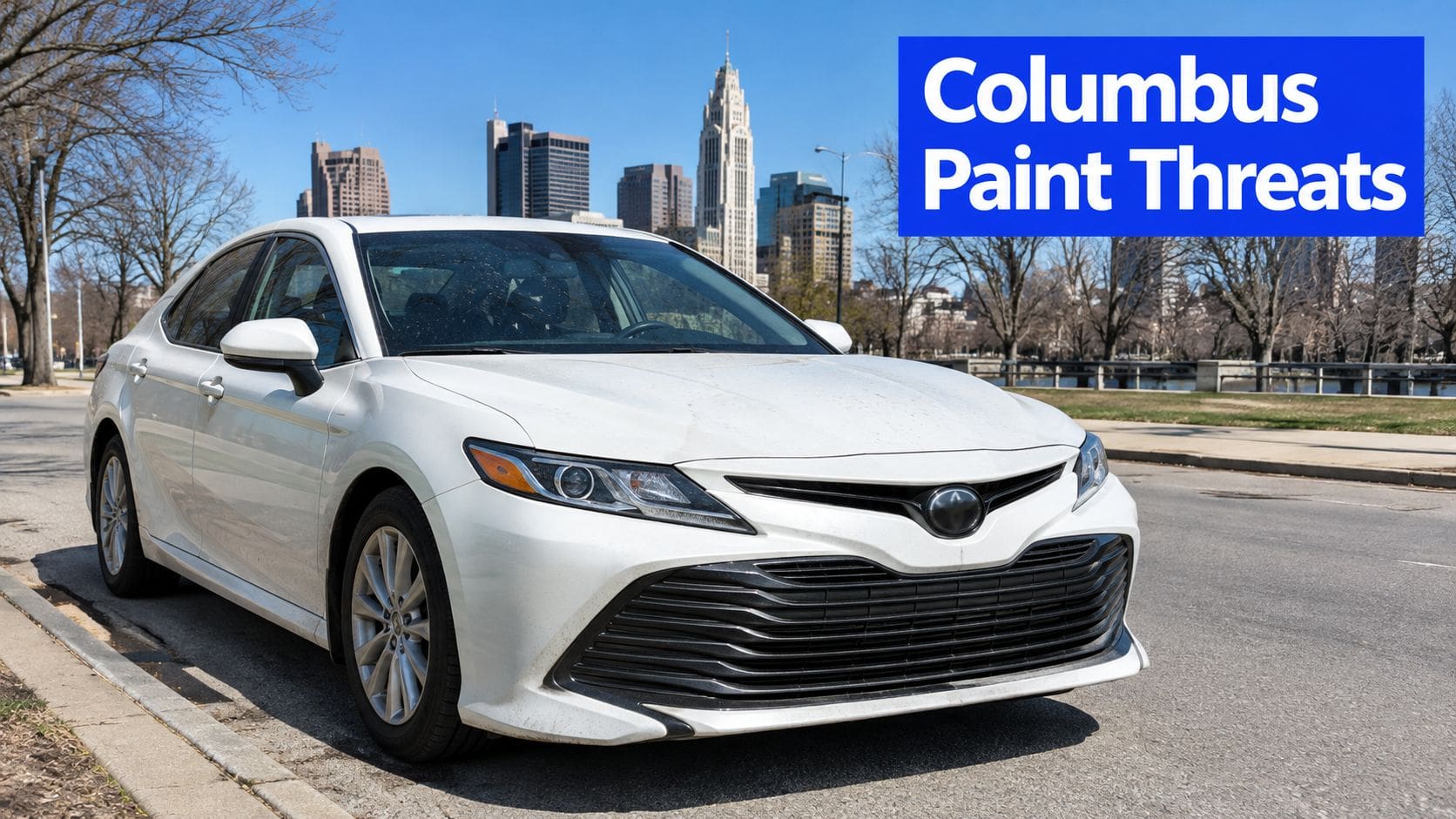
Winter salt and summer fallout
Winter contamination collects where cleaning is hardest: behind the wheels, along rocker panels, and around badges and emblems. Road salt, de-icing chemicals, and wet grime can remain in those areas for weeks. Ceramic coating can make rinsing easier, but it cannot remove contamination that has already etched neglected paint or replace proper paint correction.
Water spots create another common problem. Rain, hose water, sprinklers, and morning moisture leave minerals behind as they evaporate. A ceramic coating changes water behavior, but it does not remove the minerals from the water. Proper drying and timely removal still matter, and a coating does not make water spots impossible.
Columbus has a crowded detailing market. One 2026 city listing index tracked 186 car detailing and window-tinting businesses, including 169 detailing providers and 49 mobile services, while another tracker identified 30 dedicated detail shops and found that detailing represented about 38% of 79 car-wash locations (Columbus detailing market listing). Compare preparation standards, coating specifications, maintenance requirements, and warranty terms rather than choosing the service promising the most shine.
Practical rule: For a white vehicle, preparation quality usually matters more than the color of the bottle or the number of layers advertised.
A properly prepared and coated vehicle is easier to maintain through Columbus winters and summers. It still needs regular washing, careful drying, and inspection, but contamination is less likely to become a persistent cleaning problem. This guide to how Columbus, Ohio weather affects car paint provides further local context.
The Three Prep Stages Before Coating a White Finish
Ceramic coating preserves the condition of the paint beneath it. It does not repair scratches, remove oxidation, or hide contamination. Any remaining oil, bonded road film, swirl, or haze can affect how the coating bonds and how the white finish looks afterward.
That matters in Columbus, where road salt and winter grime can remain embedded after an ordinary wash. Humid continental weather also brings changing temperatures and moisture, while summer UV exposure can make oxidation more noticeable on neglected paint. A reliable Hilliard ceramic coating installation therefore uses three distinct preparation stages.
Stage one, wash and decontaminate
The initial wash removes loose dirt without dragging grit across the finish. Work from the roof downward, rinse often, and keep separate wash media for the wheels and painted panels. Brake dust, wheel cleaner, and winter salt should not be transferred onto white bodywork.
A clean-looking panel can still feel rough because iron particles, tar, and road film remain bonded to the clear coat. Iron remover helps release metallic contamination. A paint-safe tar remover handles asphalt residue, while a clay bar or synthetic clay towel removes what remains after chemical treatment and rinsing.
Use this sequence:
- Rinse thoroughly: Flush grit from wheel arches, seams, badges, and panel gaps before touching the paint.
- Clean the wheels separately: Keep brake dust and strong wheel chemicals away from paint-washing equipment.
- Apply iron remover: Let the product react according to its label, then rinse it completely.
- Remove tar carefully: Treat only affected areas with a paint-safe product, then wash again.
- Clay the paint: Use plenty of lubricant and light pressure. Smoothness comes from controlled removal, not forceful scrubbing.
The white-car ceramic coating preparation guide emphasizes decontamination, inspection, and at least a single-stage polish before application. It also explains that used or neglected vehicles may need multi-stage correction because a coating can preserve existing swirls and oxidation rather than erase them.
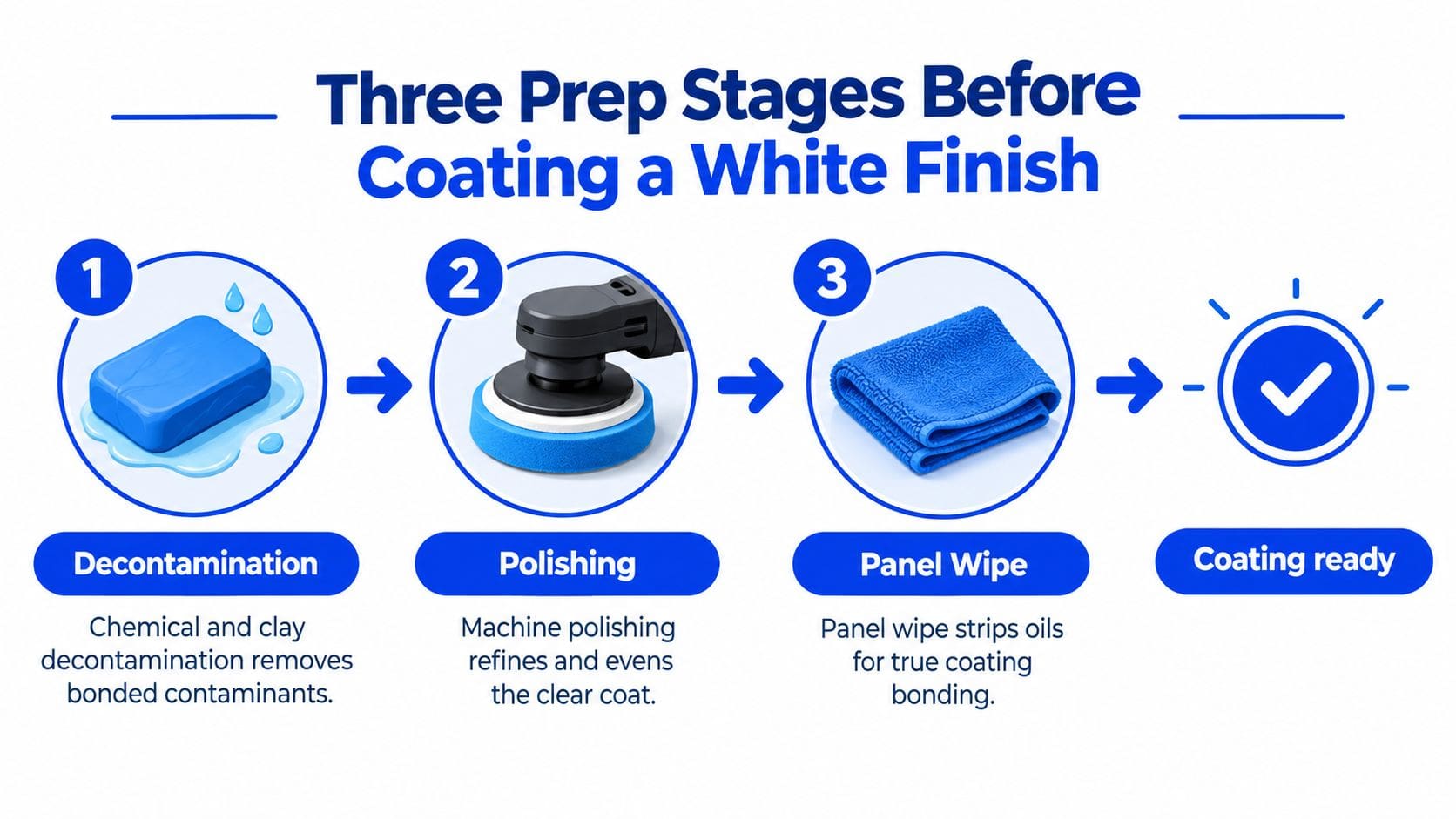
Stage two, inspect and correct
White paint can conceal fine wash marks in ordinary shade, then show haze, staining, oxidation, or uneven gloss under an LED lamp or direct sunlight. Inspect the vehicle under more than one light source before choosing a polishing plan.
A newer car with clean paint may need only a light one-step polish. That service refines the clear coat, improves clarity, and reduces light wash marks without removing unnecessary material to chase every deeper defect. A neglected car may need multi-stage correction, but the scope should follow paint condition and the owner's expectations. Perfect correction is not always the right trade-off for available paint thickness, time, or budget.
Stage three, panel wipe
Polishing oils can make paint look glossy while interfering with coating adhesion. A dedicated panel wipe removes that residue and reveals the surface the coating will bond to. The technician should inspect each panel again, then correct any remaining high spots, residue, or missed contamination.
The finished surface should feel clean, smooth, and visually even. If the paint isn't ready before the bottle opens, the coating step is premature.
Applying Ceramic Coating Section by Section
A ceramic coating should be applied in small, controlled areas. Spreading product across an entire hood makes it harder to track flash time, coverage, and residue. The coating begins reacting with air immediately, while the correct wipe timing changes with the formula, temperature, humidity, and panel size.
Standard application benchmarks use sections of about 2 feet by 3 feet, or 60 cm by 90 cm. Spread the product in a cross-hatch pattern, working horizontally and then vertically. This keeps coverage even and makes the treated area easier to identify on white paint.
A controlled application sequence
- Confirm the panel is ready. The surface must be cool, dry, dust-free, and free of polishing oils.
- Load the applicator lightly. Excess product wastes material and makes leveling harder.
- Apply in straight passes. Move across the section in one direction, then cross the same area in the other direction.
- Watch the flash. As the coating changes appearance, follow the product's stated working time. Do not leave it until it has hardened.
- Level with the first towel. Use a clean, short-pile microfiber towel to spread the coating and remove excess.
- Refine with a second towel. A fresh towel removes remaining residue and lowers the chance of leaving a high spot.
- Inspect from several angles. Strong lighting can reveal streaks, darker patches, rainbowing, or an oily haze that may be difficult to see on white paint.
The installer should finish and inspect one section before moving to the next. A high spot forms when excess coating dries unevenly. It may look minor during application but become a visible patch after curing. Removing it usually requires more than a damp cloth, so every panel needs a final inspection before the work continues.
A second coat can be used when the selected system allows it. The first layer must be leveled properly, and the product instructions determine the interval between coats. Extra layers do not automatically improve the result.
Cure timing matters in Columbus
Most professional guidance calls for at least 24 hours before rain exposure and approximately 7 to 14 days for full cross-link cure, depending on the coating system and conditions (Columbus ceramic coating service specifications). Plan the installation when the vehicle can stay protected from rain, dew, dust, and washing during the early cure period.
Columbus weather makes that planning practical rather than optional. Humidity, sudden rain, and overnight dew can interfere with a fresh coating before it has stabilized. Road dust can also settle onto exposed panels. A garage or controlled shop gives the coating a cleaner, more consistent environment while it bonds and cures.
The Water Spot Misconception Every White Car Owner Needs to Hear
Ceramic coating doesn't make a white car immune to water spots. It makes the surface more hydrophobic and usually makes many deposits easier to remove, but the water can still dry and leave minerals behind.
Water spots form when water evaporates and leaves dissolved minerals on the surface. Calcium and magnesium are common contributors, especially when water comes from a hose or sprinkler system. A coating can't cause those minerals to disappear.
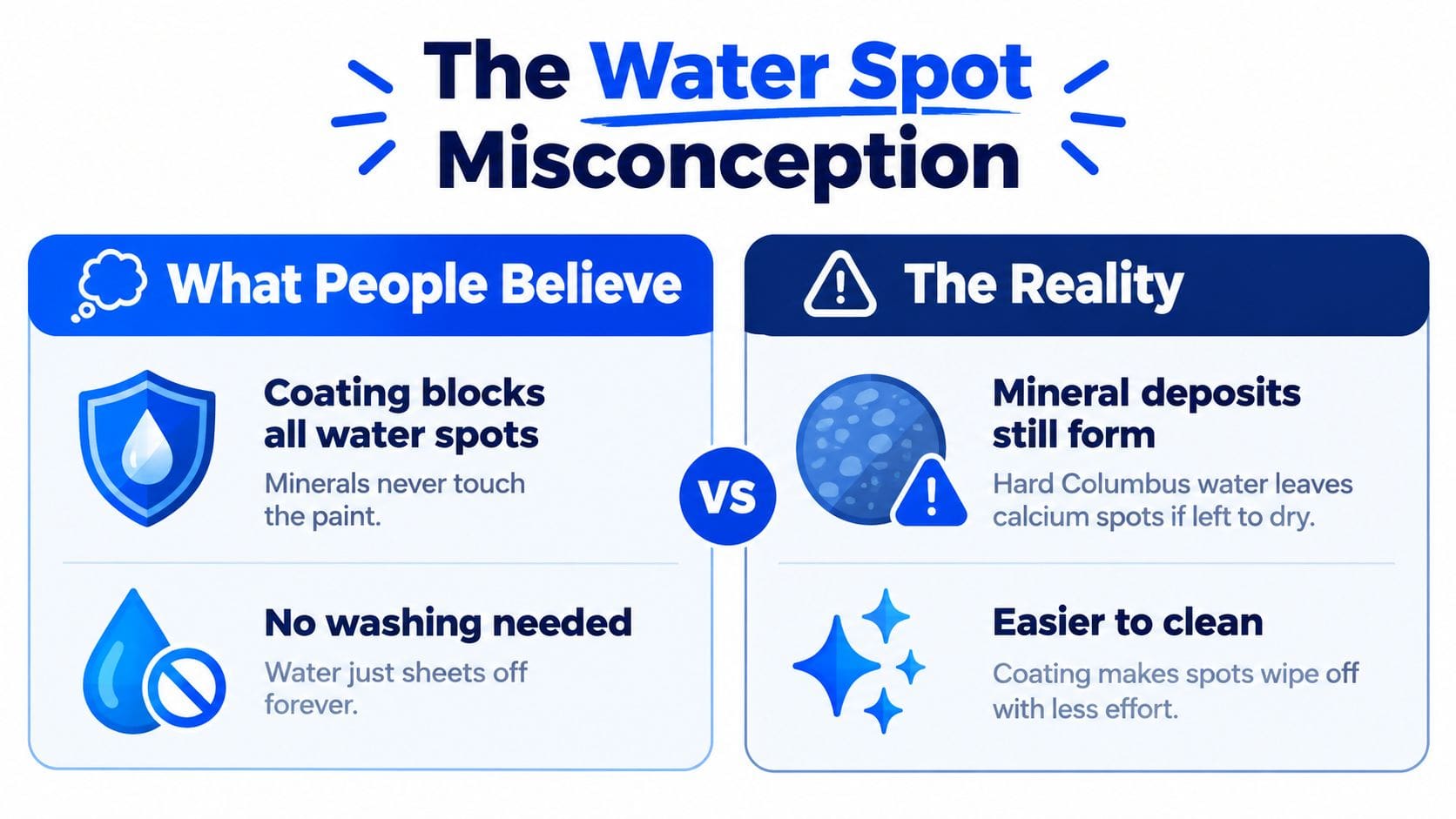
What coating changes
Untreated paint may hold onto road film and wash residue more stubbornly. A quality coating can improve water behavior and reduce the effort required to clean contamination. Independent testing cited in a 3M ceramic coating technical document reports water-contact-angle improvement from about 60 degrees untreated to about 110 degrees after coating, illustrating why coated surfaces can shed water and residue differently.
That doesn't mean every bead rolls away cleanly. A tight cluster of beads can sit on the panel, and once those droplets evaporate, the minerals remain.
How to prevent spots
- Dry after washing: Use a clean drying towel or filtered air rather than allowing the vehicle to air-dry in direct sun.
- Rinse promptly: Remove sprinkler water, road spray, and bird contamination before they sit on the finish.
- Wash in shade: Cooler panels give you more working time and reduce premature drying.
- Use clean wash water: Filtered or softened water can reduce mineral residue where available.
- Keep a drying aid nearby: A compatible quick-detail product can help remove fresh moisture and light residue, but it shouldn't replace a proper wash.
- Avoid harsh automatic washes: Brushes and poorly maintained equipment can add marring, while recycled or hard water may leave deposits.
Automotive aftercare guidance also stresses that coated cars still need prompt rinsing and drying because rain, sprinklers, and fog can create spotting (water spot and ceramic coating guidance). The honest promise is easier cleanup and better water behavior, not a spot-free finish without maintenance.
Ceramic Coating vs Paint Protection Film for White Cars
Ceramic coating and paint protection film solve different problems. Ceramic coating is a liquid-applied surface layer designed to improve hydrophobic behavior, gloss retention, UV resistance, and resistance to some chemical contamination. PPF is a physical polyurethane or TPU film that absorbs much of the energy from rock chips, scratches, and road debris before it reaches the paint (paint protection film comparison guide).
| Feature | Ceramic Coating | Paint Protection Film |
|---|---|---|
| Main purpose | Easier cleaning, water repellency, gloss retention, and light chemical resistance | Physical protection from chips, abrasions, and road debris |
| Material | Liquid coating bonded to the prepared surface | Sacrificial polyurethane or TPU film |
| Best coverage | Full exterior paint, trim, and other compatible surfaces | High-impact areas such as the front bumper, hood, mirrors, and fenders |
| Water behavior | Strongly hydrophobic when maintained | Can have hydrophobic topcoat properties, depending on the film |
| Rock-chip protection | Limited. It doesn't stop impact damage | Stronger protection against ordinary road debris |
| Maintenance | Requires careful washing and drying | Requires safe washing and inspection of film edges |
| Main limitation | Doesn't correct defects or prevent chips | Doesn't make the vehicle damage-proof |
Where each product makes sense
For a white commuter that spends most of its time dealing with road film, salt, pollen, and frequent washing, coating may deliver the more noticeable daily benefit. It reduces the effort needed to keep large panels clean and supports consistent gloss through changing weather.
For a vehicle that regularly travels on highways, follows gravel trucks, or carries a valuable factory finish, PPF may be the more important first investment. The front bumper and leading hood area usually face the most direct impact.
Combining both can be practical. A shop may install PPF on impact zones, then apply ceramic coating over the film and the remaining painted surfaces if the products are compatible. That arrangement gives the front end a physical barrier while making the rest of the car easier to wash.
PPF still has limits. It can reduce the frequency and severity of ordinary chips and abrasions, but heavy impacts, keying, and deep gouges can mark or penetrate the film and possibly reach the paint (PPF damage limitations). For a detailed decision between both systems, review this PPF versus ceramic coating comparison.
Seasonal Maintenance for Your Ceramic Coated White Car
A coating performs best when maintenance follows Columbus's humid continental climate rather than ignoring seasonal exposure.
Winter: Rinse road salt and de-icing residue from rocker panels, wheel arches, and the rear of the vehicle. Use a pH-balanced car shampoo, soft wash media, and separate equipment for the wheels. Salt film left in place for months makes later cleaning harder and can leave contamination around trim and seams.
Spring: Schedule a thorough wash and decontamination to remove iron, tar, and winter residue. If the paint still feels rough after washing, inspect it before applying more protection. The correct remedy may be an iron remover, clay treatment, or light polishing.
Summer: Strong UV exposure and hot panels make prompt washing important. Work in the shade, dry the vehicle quickly, and remove bug residue or sprinkler water before it bakes onto the finish.
Fall: Clear leaves and organic debris from drains, emblems, and panel gaps. Check whether water still forms a consistent pattern and whether the surface remains easy to clean. Beading alone does not prove that the coating is healthy, and a coating does not eliminate water spots. Minerals left behind after evaporation still require prompt removal and proper washing.
A compatible maintenance or boost spray can refresh water behavior when the vehicle sees frequent winter spray or outdoor parking. Follow the product guidance in these Columbus ceramic coating maintenance tips to confirm which cleaners and toppers suit the coating.
Avoid abrasive compounds, household cleaners, stiff brushes, and automatic wash brushes. If contamination has bonded to the surface or the coating has worn unevenly, more spray will not correct it. Professional cleaning, light polishing, or reapplication may be necessary.
Getting Professional Help for Your Columbus White Car
A good coating job is mostly preparation and control. The liquid product matters, but it can't compensate for embedded iron, polishing oils, uncorrected oxidation, poor lighting, or a dusty application area.
DIY kits can be useful for owners who enjoy learning the process, but they leave little room for error. A missed high spot, uneven wipe, or contaminated towel can create a patch that needs machine polishing to remove. White paint can disguise some defects, but it won't disguise every haze, stain, or uneven reflection.
What to ask before booking
A credible Columbus or Hilliard detailing provider should explain:
- Paint condition: Ask whether the vehicle needs decontamination, a one-step polish, or multi-stage correction.
- Product specifications: Confirm the expected service life, cure requirements, chemical resistance, and maintenance instructions.
- Application environment: Find out whether the work is performed in a controlled shop or at a mobile location with suitable protection from weather and dust.
- Coverage: Ask whether the package includes paint only or also trim, headlights, wheels, and other compatible surfaces.
- Aftercare: Get clear instructions for washing, drying, water-spot prevention, and maintenance products.
- Realistic limitations: The provider should explain that coating doesn't stop rock chips, repair scratches, or eliminate water spots.
The local provider named in this guide offers ceramic coating, paint correction, PPF, window tinting, mobile detailing, and in-shop appointments. Its Hilliard shop is located at 4402 Weaver Court North, Suite 204, and mobile appointments are available across the Columbus metro, including Dublin, Powell, Upper Arlington, New Albany, Westerville, and Worthington.
For a new Tesla, BMW, truck, or daily-driven family vehicle, the right package depends on condition and use. A new white car may need light preparation before coating. A used vehicle that has spent several Columbus winters outdoors may benefit more from decontamination and paint correction before protection. If front-end chips are the concern, consider paint protection film options. If cabin heat and glare are also problems during summer, professional window tinting in Hilliard can address those separate concerns.
Ceramic coating is worth considering when you want easier washing, stronger water repellency, UV resistance, and a cleaner-looking white finish between services. It isn't worth the investment if you expect it to replace washing, paint correction, or physical protection from road debris. The best result comes from matching the product to the vehicle, preparing the paint thoroughly, allowing the coating to cure properly, and maintaining it through every Columbus season.
Lionheart Detailing offers professional ceramic coating, paint correction, paint protection film, and full detailing for white cars across Columbus and Hilliard. If you want a realistic recommendation based on your vehicle's paint condition, driving habits, and winter exposure, visit Lionheart Detailing to discuss the right protection plan.