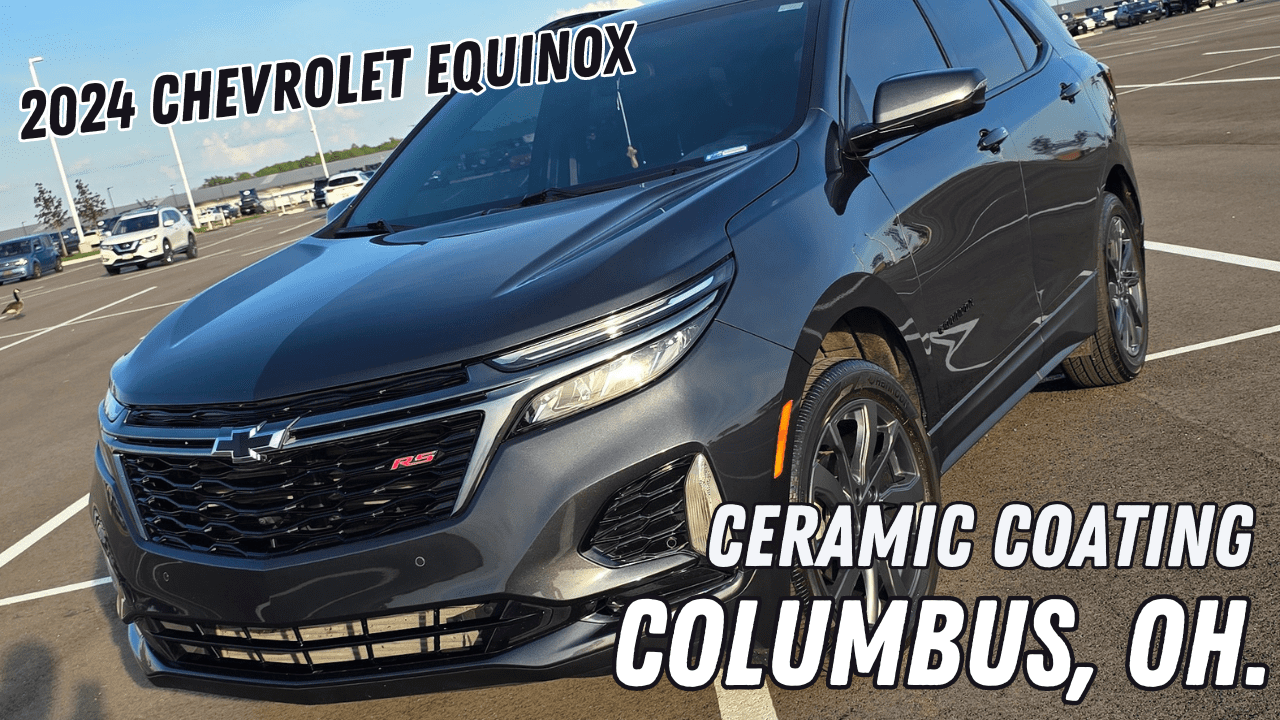
You just bought a car, or maybe you finally decided to fix up the one you already love. The paint looks sharp, the panels are clean, and for a little while it feels like you can keep it that way forever. Then real life in Columbus shows up. Highway miles on I-270, construction zones, winter grime, bug splatter, bird droppings, automatic car washes, and the random shopping cart that gets a little too close.
That's usually when people start searching for PPF vs Ceramic Coating, or typing things like ceramic coating near me, Columbus PPF, or Hilliard ceramic coating and trying to figure out what any of it means. The confusion is understandable because both products protect paint, but they do it in completely different ways.
I talk through this choice with new customers all the time. Some want to stop rock chips on a brand-new SUV. Some want their black sedan to stay glossy and easier to wash. Some want the smartest protection setup without paying for something they don't need. If you've been wondering which option makes sense for your car, your budget, and the way you drive around Hilliard and the greater Columbus area, this guide will make that decision a lot easier.
If you're also wondering how everyday washing habits affect your finish, this quick read on whether car washes ruin paint is worth your time before you choose any protection package.
Table of Contents
- Protecting Your Investment from Day One
- Understanding Paint Protection Film PPF The Bodyguard for Your Paint
- Understanding Ceramic Coating The Glossy Forcefield
- PPF vs Ceramic Coating Head-to-Head Comparison
- The Best of Both Worlds The Professional Strategy
- Making the Right Choice for Your Vehicle in Columbus
Protecting Your Investment from Day One
A lot of car owners come in during that first week of ownership. The temporary tags are still on the car, and they're already seeing the risk. The front bumper is low, the hood is clean, and they know one rough highway commute can change that. That instinct is right.
Around Columbus, the question usually isn't whether your paint will face abuse. It's what kind of abuse you're trying to defend against. Road debris and gravel are one category. Sun, water spots, bird droppings, bug acids, and wash-induced grime are another.
That's why PPF and ceramic coating aren't interchangeable products. One is built to take a hit. The other is built to make the surface slicker, glossier, and easier to maintain. If you treat them like they do the same job, you'll almost always spend money in the wrong place.
Practical rule: If your biggest fear is a rock chip, think PPF first. If your biggest frustration is keeping the car clean and glossy, think ceramic coating first.
For anyone looking into Hilliard auto detailing, Hilliard paint protection film, or Columbus ceramic coating, the smartest starting point is to match the product to your daily use. A garage-kept weekend car has different needs than a family SUV doing school drop-offs and outer-belt miles every day.
Understanding Paint Protection Film PPF The Bodyguard for Your Paint
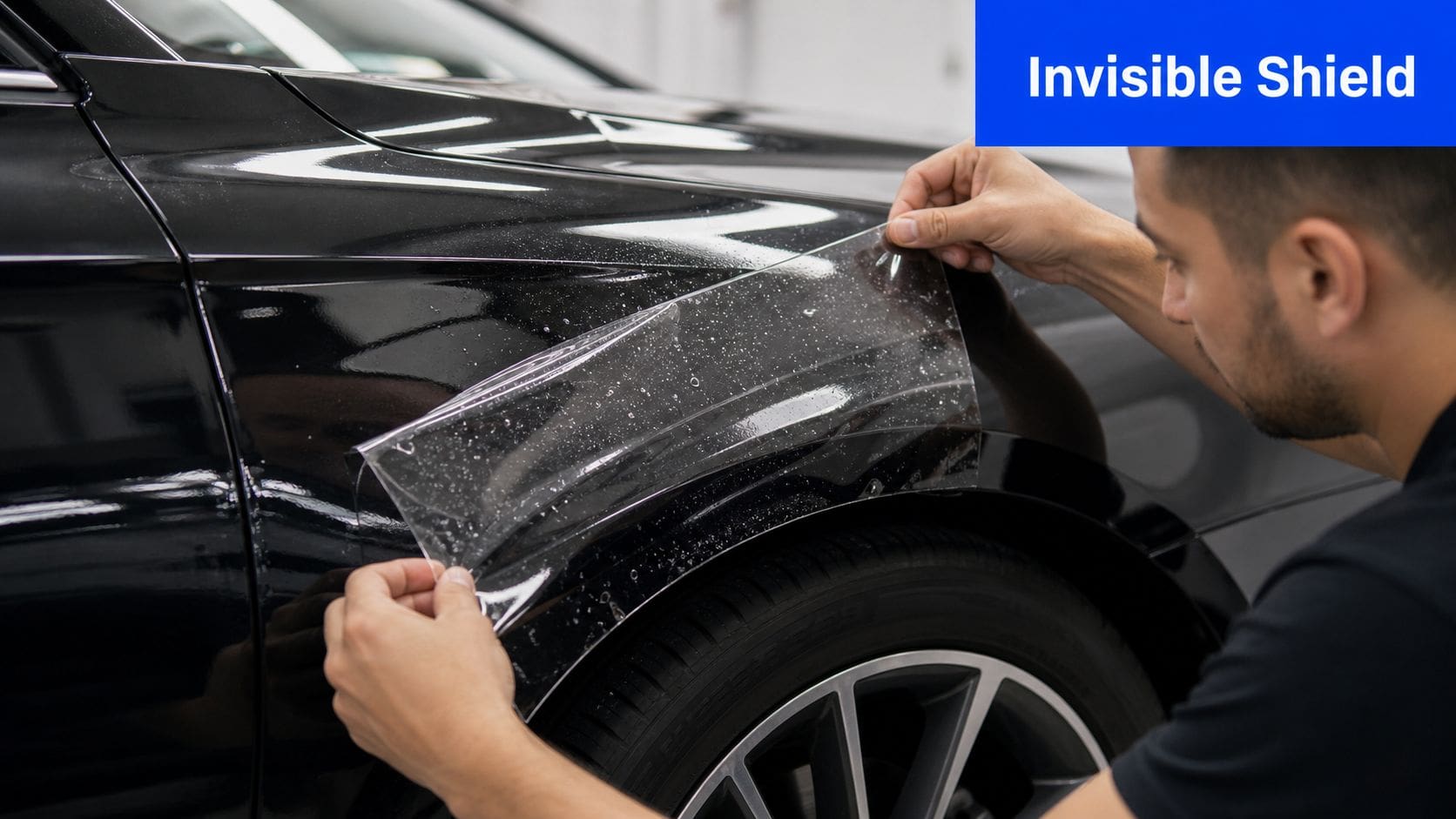
Paint Protection Film is the closest thing your car has to a heavy-duty screen protector. It's clear, professionally fitted to the panel, and designed to take abuse so the paint underneath doesn't have to.
Why PPF works when rocks hit paint
This is the biggest dividing line in the whole PPF vs Ceramic Coating conversation. Paint Protection Film is physically engineered as an 8–12 mil thick urethane barrier specifically designed to absorb and deflect high-impact road debris, whereas ceramic coating is a chemically bonded liquid polymer averaging only 1–2 microns in thickness. This massive disparity, where 1 mil equals approximately 25 microns, makes PPF roughly 320 to 480 times thicker than ceramic coating and establishes PPF as the sole solution for preventing rock chips and deep scratches according to this PPF and ceramic coating thickness breakdown.
That thickness difference is why I tell customers to stop thinking of PPF as a “coating.” It isn't. It's a film. A physical barrier. A sacrificial layer.
If a pebble flies up at highway speed, ceramic coating doesn't have the mass to absorb that impact. PPF does. That doesn't mean film makes your car indestructible. It means the product is built for the exact type of threat that causes chips, abrasion, and edge damage on high-impact panels.
Where PPF makes the most sense
Most drivers don't need every painted panel wrapped in film. Many get the most value by protecting the areas that get hit first and hardest.
Common high-impact zones include:
- Front bumper: This is usually the first panel to get peppered by road debris.
- Front edge of the hood: A small area that often takes repeated chip damage.
- Fenders and mirrors: These pick up splash, grit, and side-thrown debris.
- Rocker panels: These catch lower-body grit kicked up from the road.
- Door edges: Helpful for tight garages and daily-use vehicles.
That's why partial or panel-targeted film packages are so common for Columbus PPF clients. They put the budget where the punishment happens.
PPF's job is simple. It sacrifices itself so your factory paint doesn't have to.
Another reason people like film is that many products have minor self-healing behavior for small scratches over time, which helps keep the surface looking cleaner during normal use. If you want a deeper explanation of how that works on real vehicles, this page on self-healing PPF is a useful companion.
A few honest trade-offs matter here too:
- It costs more upfront than ceramic coating.
- Installation quality matters a lot because edges, patterns, and stretch all affect the result.
- It protects against impact, but it's not what people choose first for maximum slickness or easiest maintenance.
If your car sees frequent highway use, winter commuting, or long trips outside Hilliard and around the Columbus belt, PPF usually makes the strongest case on the front half of the vehicle.
Understanding Ceramic Coating The Glossy Forcefield
Ceramic coating is a very different tool. If PPF is armor, ceramic is more like a slick, hardened shell that bonds to the surface and changes how water, grime, and contaminants behave on the paint.
What ceramic coating is actually doing
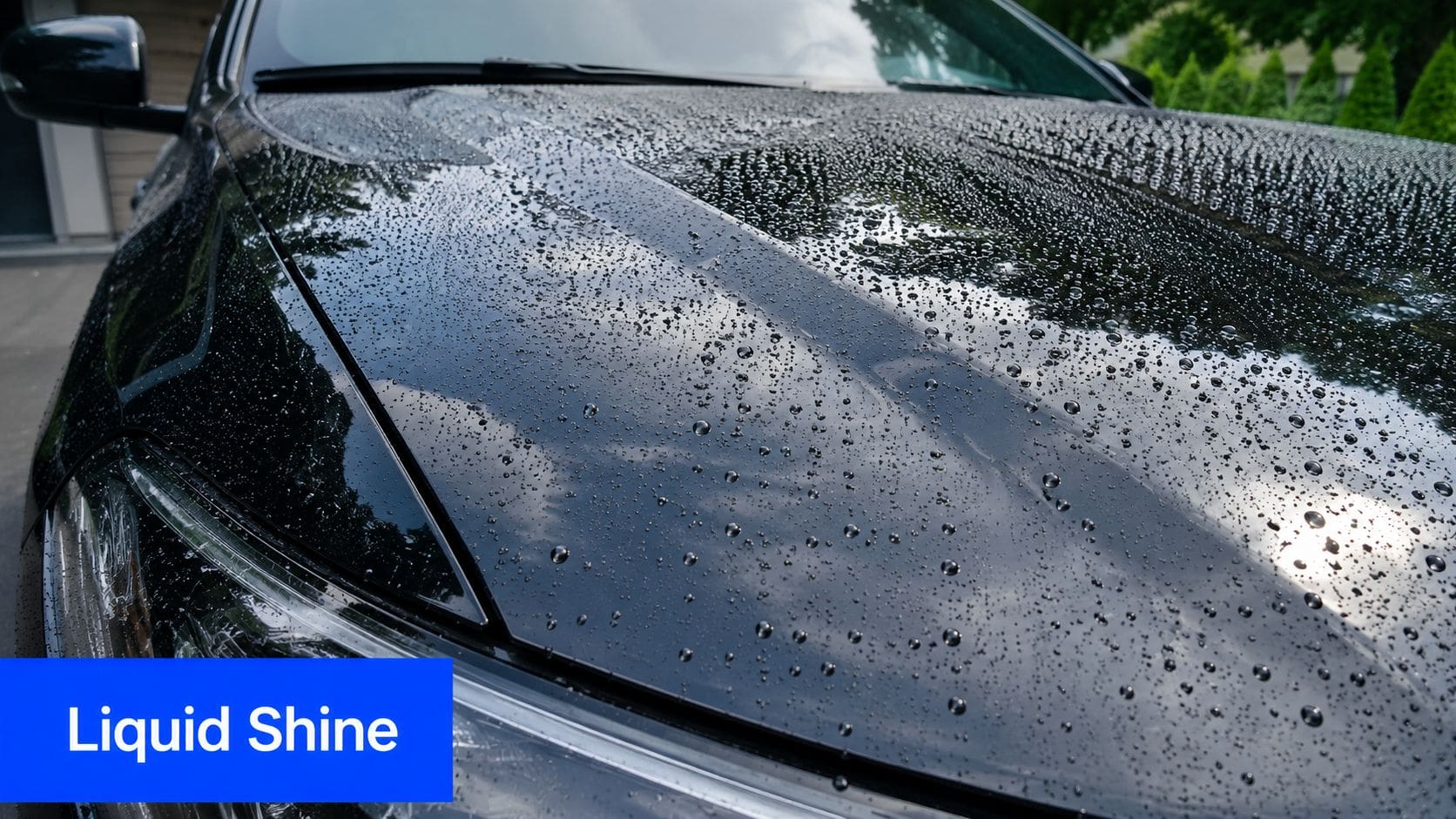
A lot of first-time customers think ceramic coating is a harder version of wax. That's a decent starting analogy, but it undersells what makes it useful. A true coating chemically bonds to the paint and creates a surface that's slick, glossy, and more resistant to environmental mess.
Its biggest strengths are chemical resistance, UV support, gloss, and washability. It helps against things like bird droppings, bug residue, water spotting tendencies, road film, and sunlight exposure. It doesn't stop impact damage, but it does make routine care much easier.
The hydrophobic behavior is immediately noticeable. Ceramic coating delivers superior hydrophobic performance with water beading angles ranging from 105 to 115 degrees, compared to modern PPF at 95 to 105 degrees, and that stronger beading reduces dirt adhesion and water spot formation, allowing owners to wash their vehicles far less frequently according to this guide on ceramic coating and hydrophobic performance.
Why people love coated cars
The day-to-day payoff of ceramic coating is simple. Dirt sticks less. Water doesn't sit as stubbornly. Drying gets easier. The car stays closer to “just washed” for longer, especially if you maintain it properly.
That's a big reason why people searching ceramic coating near me, Hilliard ceramic coating, or Columbus ceramic coating are usually thinking about one of these goals:
- They want easier washes: Less scrubbing means less frustration and less chance of marring the paint.
- They want better gloss: Coatings often make the finish look sharper and more reflective.
- They want help against the elements: Sun, droppings, bug remains, and road contamination are everyday paint killers.
- They're tired of short-term products: They want something more durable than off-the-shelf spray protection.
A ceramic-coated car still gets dirty. It just doesn't hold onto dirt the same way an unprotected car does.
There's also an important limitation to be honest about. Ceramic coating can't hide poor paint. If the finish already has swirls, haze, or wash marks, the coating will lock that look in place unless the paint is corrected first. That's why prep matters so much. If you want a realistic look at durability and maintenance expectations, this article on how long ceramic coating lasts is worth reading before booking service.
Ceramic coating is usually the better fit when the owner cares most about appearance, easier upkeep, and broad environmental protection across the whole car.
PPF vs Ceramic Coating Head-to-Head Comparison
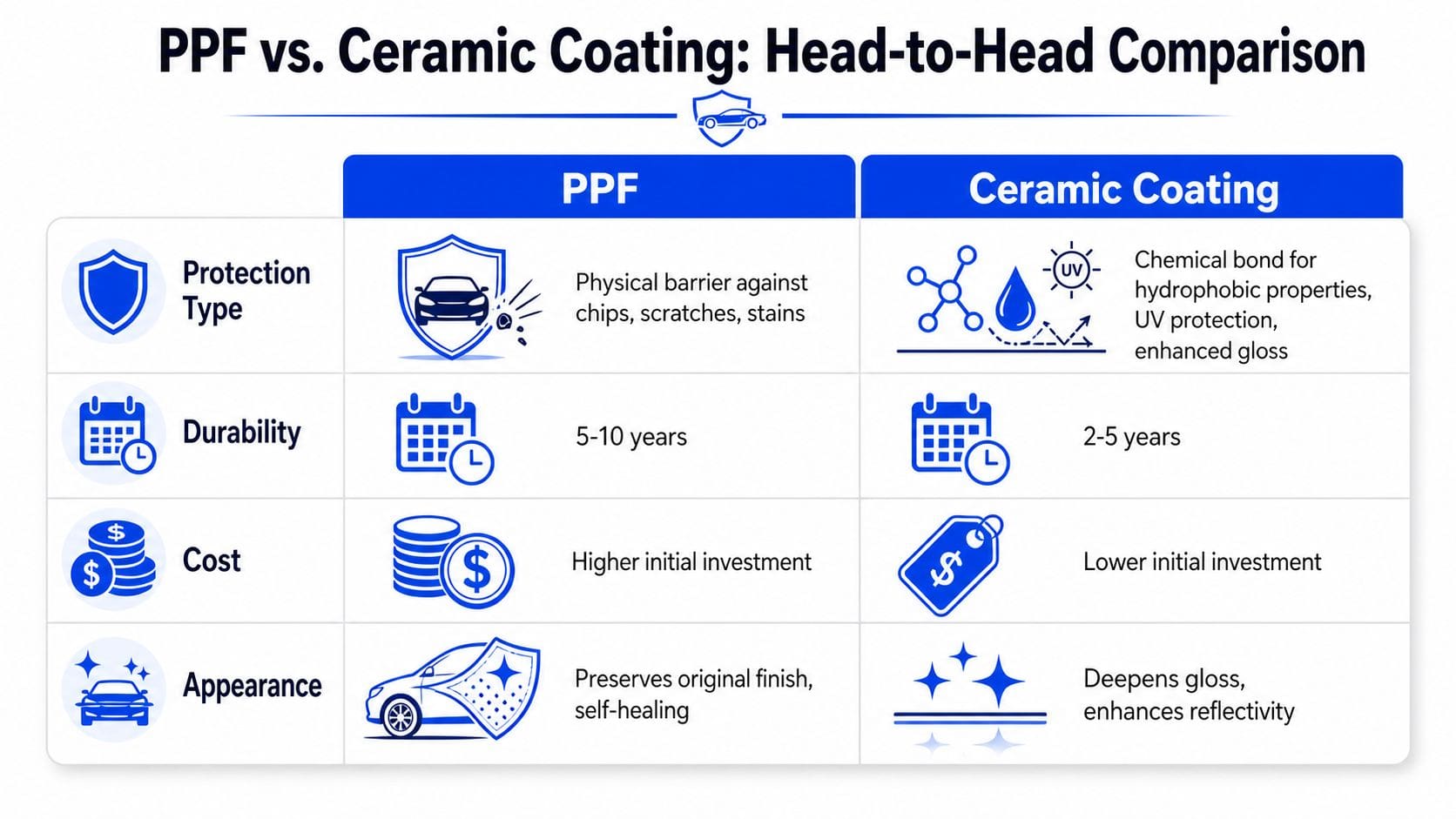
When customers ask me to simplify the choice, I boil it down to this. PPF protects against impact. Ceramic coating protects against contamination and maintenance headaches. Once you separate those jobs, the decision gets easier.
To make that comparison visual, here's a quick chart.
Quick comparison by real-world priority
If your biggest concern is rock chips and road rash
- PPF wins: It's the product designed for this job.
- Ceramic coating loses: It has zero impact resistance, even though it performs very well for water behavior and contamination control.
If your biggest concern is easy washing
- Ceramic coating wins: It's slicker and more hydrophobic.
- PPF does well, but not as well on its own: Many owners add ceramic on top of the film to improve this exact area.
Here's another useful benchmark. Expert benchmark data indicates PPF delivers 7–10 years of service life with minor self-healing capabilities for small scratches, while ceramic coating typically lasts 2–5 years with superior hydrophobic water beading but zero impact resistance, based on this durability comparison of PPF and ceramic coating.
A short video can also help if you prefer to see the topic explained visually.
PPF vs. Ceramic Coating At a Glance
| Feature | Paint Protection Film (PPF) | Ceramic Coating |
|---|---|---|
| Protection Type | Physical barrier against chips, scratches, and abrasion | Chemical layer that improves slickness, gloss, UV defense, and contaminant resistance |
| Rock Chip Resistance | Excellent | Poor |
| Deep Scratch Resistance | Stronger choice for real contact damage | Not built for impact |
| Gloss and Shine | Preserves the finish well | Usually gives the sharper, slicker look |
| Ease of Cleaning | Good, better when coated on top | Excellent |
| UV and Chemical Resistance | Helpful, especially as part of a layered setup | One of its strongest advantages |
| Self-Healing | Minor self-healing for small scratches on many films | No self-healing function |
| Service Life | 7–10 years | 2–5 years |
| Best Use Case | High-impact zones and daily drivers that see rough roads | Whole-vehicle appearance, maintenance, and environmental protection |
| Typical Cost | Higher initial investment | Lower initial investment |
A few practical takeaways matter more than the chart:
- Don't buy ceramic coating expecting chip protection. That's the wrong product for that job.
- Don't buy bare PPF expecting the slickest maintenance experience. It protects, but it isn't the finish most owners imagine when they think “coated.”
- Don't compare them as direct substitutes. They overlap a little, but their primary purpose is different.
For most first-time buyers, this is the section where the confusion finally clears up.
The Best of Both Worlds The Professional Strategy
The setup many professionals recommend isn't PPF or ceramic coating. It's PPF in the danger zones, then ceramic coating over the vehicle, including over the film where appropriate.
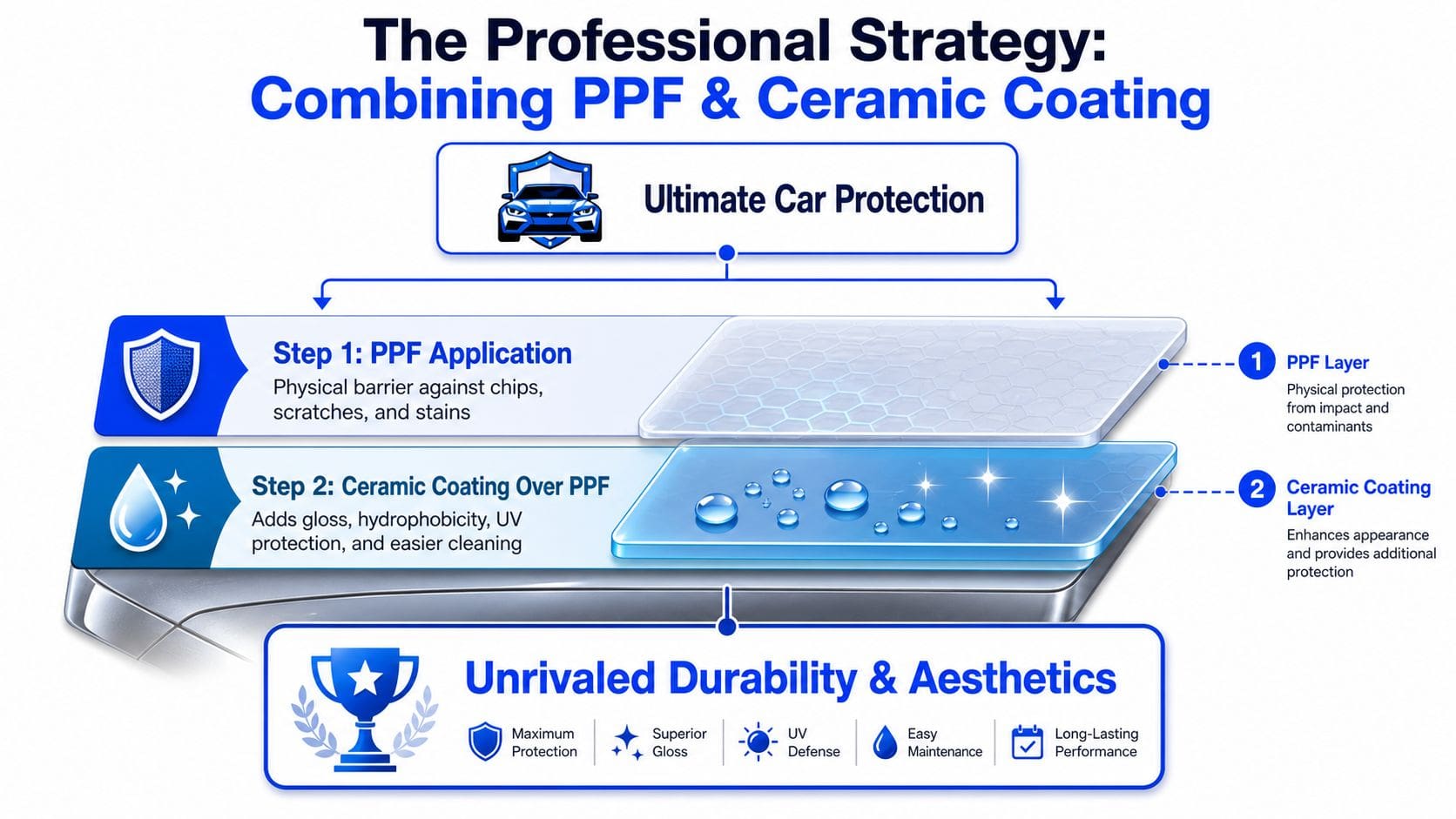
How pros stack protection
This strategy works because each product covers the other product's weak spot.
PPF goes on the panels most likely to get hit. Ceramic coating goes over the broader exterior to add slickness, visual pop, and easier maintenance. When that combination is done correctly, the car is easier to keep clean and better protected where physical abuse is most likely.
The process before ceramic matters just as much as the product itself. Professional ceramic coating application requires thorough decontamination, multi-stage paint correction to remove swirls, sectional application, and a two-phase curing process. A major pitfall is skipping paint correction, because that permanently traps imperfections under the semi-permanent bond, as outlined in this ceramic coating application workflow.
That one point saves people a lot of disappointment. Coating isn't magic. If the paint is swirled, hazy, or scratched before application, the coating won't erase that. It will preserve it.
The final appearance depends on the prep under the protection. Good film and good coating can't rescue rushed correction work.
Which setup fits your driving habits
Not every car needs the same package. The right answer usually depends on how you use the vehicle, how long you plan to keep it, and how much the condition of the paint matters to you.
Consider these common scenarios:
Daily highway commuter
This owner sees repeated exposure to gravel, construction debris, and year-round road grime. Front-end PPF is usually the smartest starting point. Ceramic coating over the rest of the vehicle makes cleaning easier and helps keep the car looking cared for between washes.
Weekend enthusiast car
If the car stays mostly clean, sees fair-weather driving, and the owner is focused on gloss and finish quality, ceramic coating may be the better first move. If the car still does regular highway trips, adding selective film on the front end is often worth it.
Family SUV or minivan
These vehicles live hard lives. Grocery runs, school pickup, trips, and parking lot exposure all add up. PPF on high-impact areas and door edges makes sense, and coating helps with easier maintenance for a vehicle that doesn't always get pampered.
Leased vehicle
A coating may be enough if the goal is easier upkeep during the lease term. If the lease vehicle is expensive or sees heavy highway use, partial PPF can still be a smart move to avoid visible front-end damage.
Long-term ownership
If you plan to keep the car for years and care about preserving the finish, the combined approach is usually the most balanced route.
For owners comparing local options, one available route is a combined protection service through Lionheart Detailing, which offers both PPF installation and ceramic coating for Columbus-area vehicles.
Making the Right Choice for Your Vehicle in Columbus
The smartest answer in the PPF vs Ceramic Coating debate depends on one thing. What problem are you trying to solve first?
A simple way to decide
Choose PPF first if these sound like you:
- You drive highways often: Rock chips are your main concern.
- You bought a new vehicle: You want to preserve factory paint in the areas that get hammered first.
- You hate seeing front-end damage: Even small chips bother you.
- You plan to keep the vehicle long-term: Paint preservation matters to you.
Choose ceramic coating first if these sound like you:
- You want easier maintenance: You'd rather spend less effort washing and drying.
- You care about gloss: Appearance is the main goal.
- Your vehicle doesn't see harsh road abuse often: The threat is more environmental than impact-related.
- You want broad whole-car protection: Especially against grime, UV exposure, and surface contamination.
Choose both if these sound like you:
- You want the most complete setup available
- You drive regularly and still care about appearance
- You're protecting a newer car, truck, or SUV in the Columbus area
- You don't want to choose between chip defense and easier maintenance
If you commute around Columbus every week, the front of the car lives a different life than the doors and roof. Protect it accordingly.
What to expect after installation
No product eliminates maintenance. That's one of the most important things to understand before spending money on protection.
With either system, you still need proper washes, safe drying, and decent habits. You can still create swirl marks with bad wash tools. You can still stain a surface if contamination sits too long. And no product makes a neglected car look permanently fresh.
What good protection does is buy you margin. It gives the vehicle a better chance against daily use. It helps preserve appearance. It makes cleaning less frustrating. It lowers the chances that one bad week on the road turns into visible, lasting damage.
For many local drivers searching Hilliard paint protection film, Columbus PPF, or Hilliard ceramic coating, the most practical answer is a short conversation with a shop that can look at the actual vehicle, hear how it's driven, and recommend a setup that fits real use rather than a generic package.
If you're weighing ceramic coating, PPF, or a combination of both for your vehicle in Hilliard or the greater Columbus area, Lionheart Detailing can help you sort through the options and choose a protection plan that fits how you drive and maintain your car.