Partial-front PPF typically costs $600 to $1,500, full-front coverage usually runs $1,500 to $3,500, and full-body protection can reach $5,000 to $8,500 or more. A 2026 survey found a broader typical range of $1,199 to $3,800 per vehicle, with a median price of $1,999, but your exact quote depends heavily on coverage, vehicle shape, film chemistry, preparation, and installation quality.
You've probably landed on this question after buying a new car, ordering a Tesla, or noticing how quickly highway miles can mark a clean front bumper. A quote from one Columbus shop may look reasonable until you realize it covers only the leading edge of the hood, while another quote includes the entire hood, fenders, mirrors, bumper, headlights, and wrapped edges.
That's why the cheapest PPF quote isn't always the best value, and the most expensive package isn't automatically necessary. After years of working around Hilliard and the greater Columbus area, the practical way to compare auto paint protection film cost is to ask what you're protecting, what the installer is doing, and what the estimate leaves out.
This guide breaks down the coverage tiers, the material and labor behind the price, what drivers in Hilliard, Dublin, Powell, Upper Arlington, and nearby communities should look for, and how PPF compares with ceramic coating. The goal is simple. You should be able to look at a Columbus PPF estimate and understand exactly why it costs what it does.
Table of Contents
- Introduction to Auto Paint Protection Film Cost
- What Paint Protection Film Is and How Coverage Tiers Work
- What Determines Your Auto Paint Protection Film Cost
- Typical Price Ranges by Coverage and Columbus Area Expectations
- PPF vs Ceramic Coating Cost and Protection Compared
- Installation Warranty Maintenance and ROI You Should Expect
- Conclusion and Next Steps with Lionheart Detailing
Introduction to Auto Paint Protection Film Cost
A new-car owner often starts with a straightforward question: “Is protecting the paint really worth spending thousands of dollars?” That question makes sense, especially when the vehicle already has factory paint and the film itself can be difficult to notice once installed.
The answer depends on how you drive and which panels bother you when they get damaged. A commuter who spends most of the week on local streets may be satisfied with targeted front-end protection. Someone who travels Ohio highways regularly, owns a BMW or Tesla, or plans to keep a vehicle for years may care more about preserving the original finish across the areas that collect the most abuse.
PPF is a physical barrier. It can help absorb rock impacts, reduce light abrasion, and preserve painted surfaces. It won't make the vehicle invulnerable, and it won't repair deep damage that already exists. The value comes from reducing exposure before the paint takes the hit.
A 2026 survey aggregating 343 published PPF prices from 128 detailers found that installed PPF typically costs $1,199 to $3,800 per vehicle, with a $1,999 median price. The same dataset reported 792 shops offering the service, which helps explain why consumers see many different packages and pricing styles in major markets. See the 2026 PPF pricing survey for the underlying market data.
Why two quotes can look unrelated
Two estimates for the same vehicle may differ because one shop uses a partial pattern, while another wraps complete panels and finishes the edges. The installer may also price paint correction separately, use a different film chemistry, or include more difficult panels such as rockers and A-pillars.
In Hilliard, a good conversation starts with your driving routine, not with a package name. Tell the shop whether you commute on interstates, park outside, drive gravel roads, own a large SUV, or care about maintaining a specific factory finish. Those details help match the protection to the way the car gets used.
Practical rule: Compare the panel list and installation process before comparing the final number.
What Paint Protection Film Is and How Coverage Tiers Work
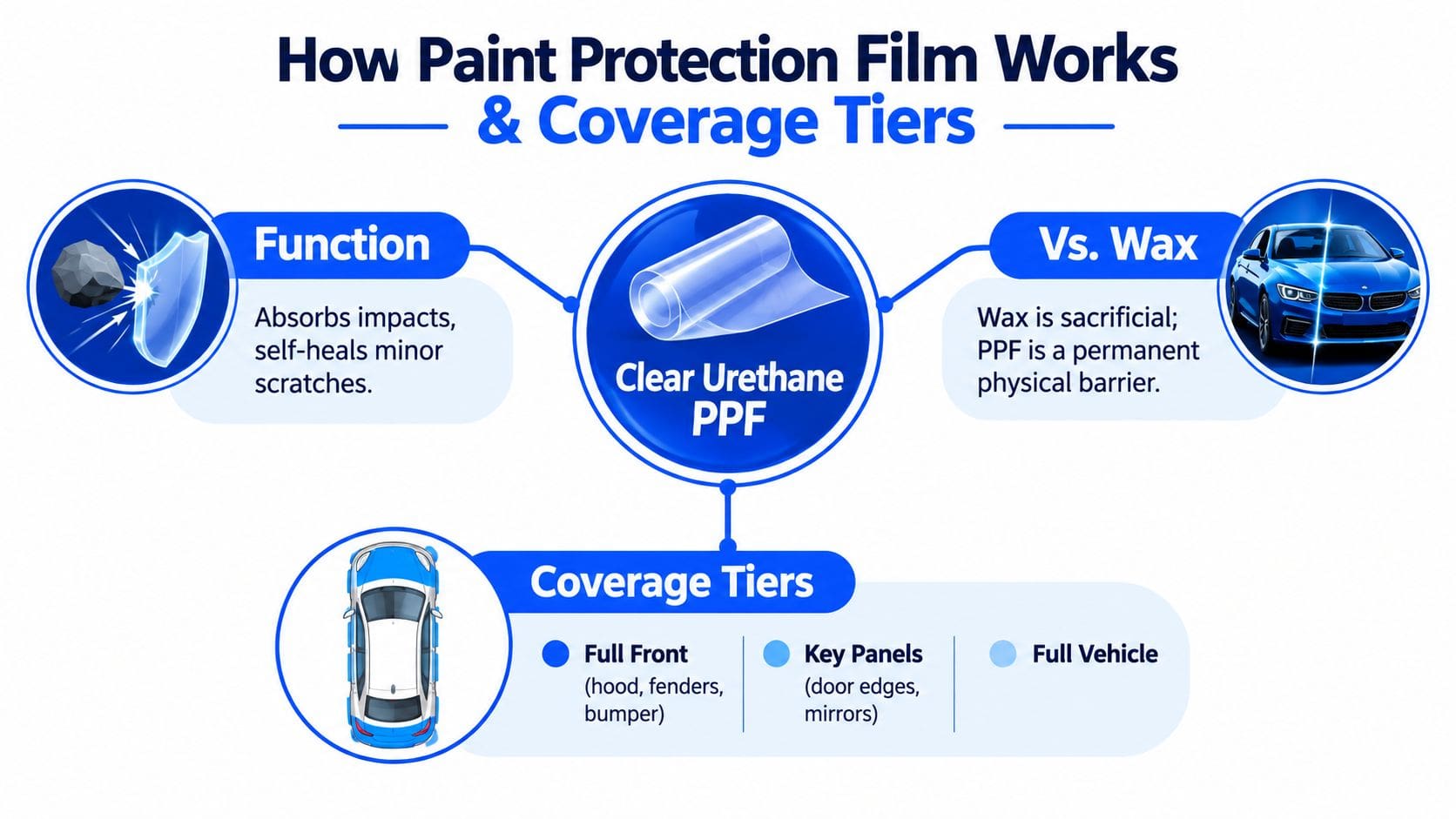
Paint protection film, usually called PPF, is a clear or colored urethane layer installed over painted panels. The film takes the abuse that would otherwise reach the paint, including road debris, light scratches, and everyday abrasion. Some premium films include a self-healing top layer that can reduce the appearance of minor surface marks when exposed to suitable heat.
A useful beginner analogy is a phone. A screen protector shields the part most likely to get scratched, while a full case protects the corners and body too. Partial-front PPF works like the screen protector. Full-body PPF is closer to using the complete case.
Partial front coverage
A partial package generally targets the leading areas most exposed to road debris. Depending on the shop and pattern, it may include:
- Leading hood section: Usually a strip across the front portion of the hood.
- Front bumper: The bumper receives direct impacts and often has complex contours.
- Mirror caps: These face airborne debris and can show wear quickly.
- Leading fender sections: Some kits include only the forward portion rather than the full fender.
This package can be a sensible starting point when the budget is limited. The trade-off is a visible transition line and less protection behind the covered area.
Full front coverage
A standard full-front package generally covers the entire hood, full front fenders, front bumper, mirrors, and often headlights. The exact list should appear in writing because headlights, lower bumper sections, and small adjacent panels may be treated as add-ons by some installers.
Full-front protection is popular because it covers the primary impact zone without requiring film across every painted surface. The guide to vehicle areas worth protecting with PPF can help you think through vulnerable panels before requesting a quote.
Full-body and modular protection
Full-body PPF adds doors, quarter panels, roof sections, trunk areas, rockers, and other painted surfaces. It offers the broadest protection, but it also adds material, cutting, positioning, edge finishing, and inspection time.
Many owners don't need an all-or-nothing decision. A full front combined with rockers, door edges, A-pillars, or a trunk ledge can create a modular package suited to the vehicle's real exposure. A truck that throws gravel along its sides may benefit from rocker protection more than a small sedan used mainly for local errands.
PPF also differs from wax and ceramic coating. Wax sits on the surface and offers temporary appearance and environmental protection. Ceramic coating forms a chemical layer that improves water behavior, gloss, and cleaning, but it isn't a substitute for an impact-absorbing film.
What Determines Your Auto Paint Protection Film Cost
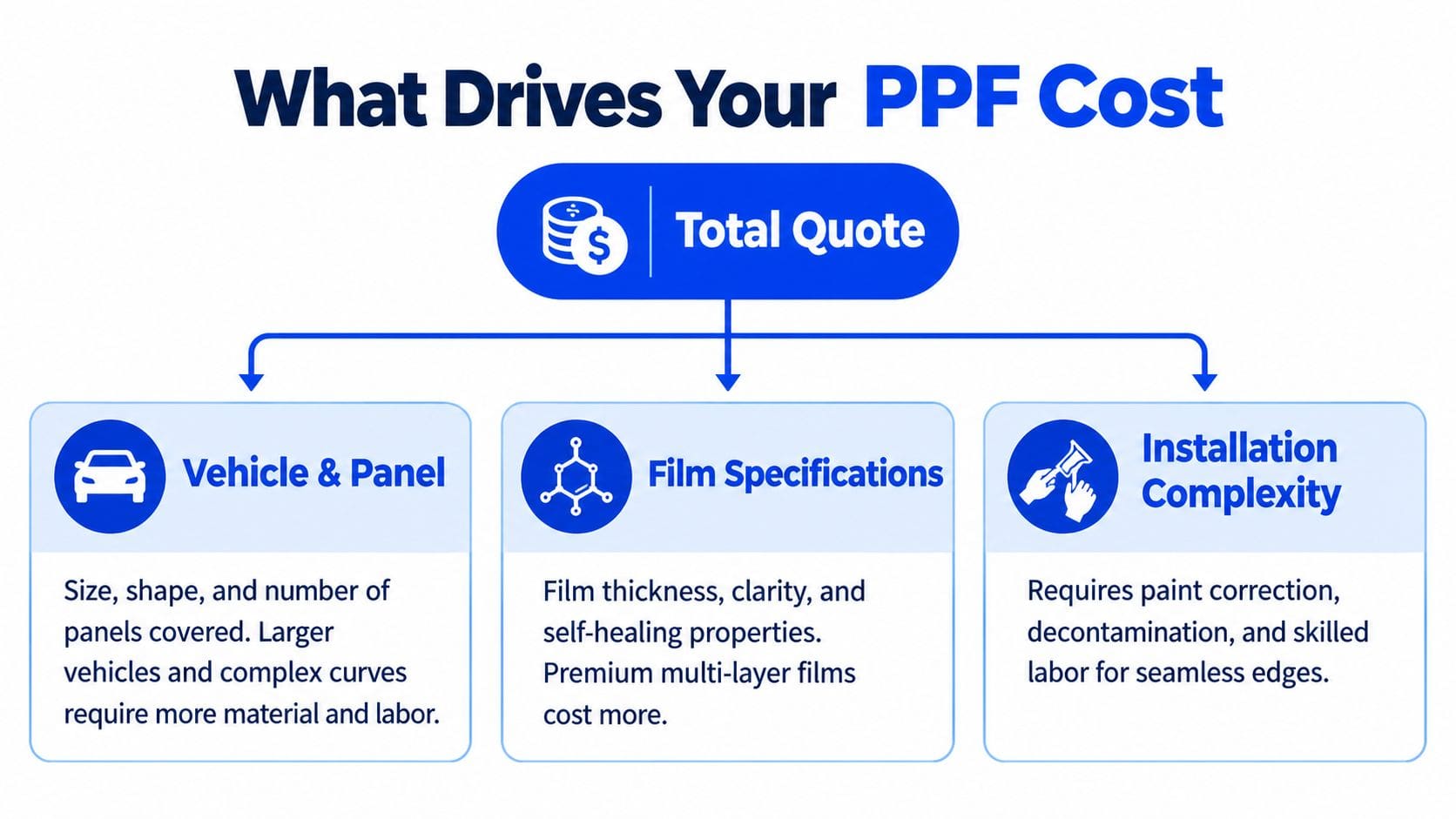
A quote for PPF reflects the vehicle, the coverage selected, and the hours required to install it cleanly. The roll of film is only one part of the cost. Preparation, pattern work, positioning, edge finishing, inspection, and the installer's risk all affect the final price.
1. Surface area and panel count
More coverage uses more film and requires more handling. One industry guide places installed film at about $2 to $12 per square foot, with premium self-healing film toward the higher end. That helps explain why a full-size truck, three-row SUV, or large electric vehicle can cost more than a compact sedan with a similarly named package. The installed PPF cost guide explains this square-foot pricing approach.
A full-front package also involves several separate sections. Film must be positioned across the bumper, hood, fenders, mirrors, and, when included, headlights. Each panel brings its own seams, tension, corners, and edges to manage.
2. Vehicle shape and panel complexity
A flat hood is relatively straightforward. A bumper with deep recesses, tight corners, parking sensors, grille openings, and sharp body lines demands slower, more precise work. Complex panels increase the risk of stretch marks, fingers, lifting, trapped moisture, or visible distortion when installation is rushed.
Large SUVs and trucks combine broad panels with greater surface area. Some European performance cars add compound curves that require careful pattern selection and exact positioning. In a Hilliard shop, the same coverage tier can therefore take very different amounts of time from one vehicle to another.
3. Film chemistry and finish
Film chemistry affects material cost and installation behavior. Manufacturer-side data cites TPU material at about $10.85 per square meter, compared with about $7.05 per square meter for PVC. TPU, or thermoplastic polyurethane, is commonly used in premium applications because it supports the flexibility and self-healing characteristics associated with higher-grade PPF. These material figures are discussed in PPF market cost analysis.
Gloss usually matches factory paint most closely. Matte and satin films change the vehicle's appearance, while color PPF adds a styling function. The selected finish can change the material price and may require more care during installation.
4. Labor and preparation
Labor frequently has a greater effect on the final ticket than the raw film. One 2026 job-costing guide estimates 20 to 35 labor hours for a full-body installation at $75 to $100 per hour, putting labor alone at approximately $1,500 to $3,500 for a premium job. The PPF labor and material breakdown provides that estimate.
Before application, paint must be clean, smooth, and free of bonded contamination. A newer vehicle may need washing and decontamination. A used vehicle may require polishing to reduce swirls or haze, while existing chips and scratches can remain visible beneath clear film.
5. Edges, trim, and pattern finishing
Your estimate should state whether edges are wrapped, tucked, or left at the pattern boundary. Wrapping can make film less noticeable, but it may require extra material, access, and careful trim removal.
Ask whether the quote includes door edges, rockers, A-pillars, headlights, lower bumper areas, and difficult recesses. Those details often explain why two packages with similar names have different prices. A clear panel list lets you compare quotes by actual work instead of by package label.
Typical Price Ranges by Coverage and Columbus Area Expectations
National guides organize PPF around coverage tiers, but the names aren't perfectly standardized. One shop's partial front may include mirror caps and a larger hood section, while another may define it more narrowly. Use the ranges as planning figures, then verify the panel list for your exact vehicle.
Independent 2026 pricing guides place partial-front installations around $600 to $1,500, full-front coverage around $1,500 to $3,500, and full-vehicle coverage around $5,000 to $8,500 or more. Other guides show partial-front pricing near $900 to $1,500, full front near $1,800 to $3,500, and full body reaching $5,000 to $12,000 or more for larger vehicles, premium film, and higher labor markets. These differences show why a single “average PPF price” can mislead buyers. See the multi-region PPF cost guide for the wider comparison.
PPF Price Ranges by Coverage Tier
| Coverage Tier | Panels Included | Typical Installed Price |
|---|---|---|
| Partial front | Leading hood section, front bumper, mirror caps, and sometimes forward fender sections | $600 to $1,500 (pricing reference) |
| Full front | Complete hood, full fenders, bumper, mirrors, and often headlights | $1,500 to $3,500 (coverage reference) |
| Full body | Painted exterior panels across the vehicle, with package details varying by shop | $5,000 to $8,500 or more (coverage reference) |
How Columbus quotes tend to vary
Hilliard and Columbus buyers should expect the same general cost structure seen in other established markets. Local pricing still changes with the vehicle mix, the shop's labor model, the film selected, and whether the vehicle arrives clean and paint-ready.
A compact sedan with a straightforward bumper may land toward the lower side of a tier. A large SUV, truck, Tesla, or BMW with complicated bumper geometry can move higher because the installer handles more film and more difficult contours. A quote that includes paint correction, wrapped edges, headlights, or rocker panels should not be compared directly with one that excludes them.
Matte PPF commonly costs 10% to 25% more than comparable gloss film. Current guides place full-front matte installations around $2,000 to $4,000 and full-vehicle matte coverage around $5,000 to $9,000 or more. Color PPF can price differently depending on region and kit format. See the matte PPF cost discussion before treating a finish upgrade as a simple cosmetic choice.
Track packages, rocker coverage, and add-on panels let owners spend protection money where driving conditions justify it. For many daily drivers, a well-planned front and rocker package makes more sense than paying for full-body coverage that protects low-risk panels.
PPF vs Ceramic Coating Cost and Protection Compared
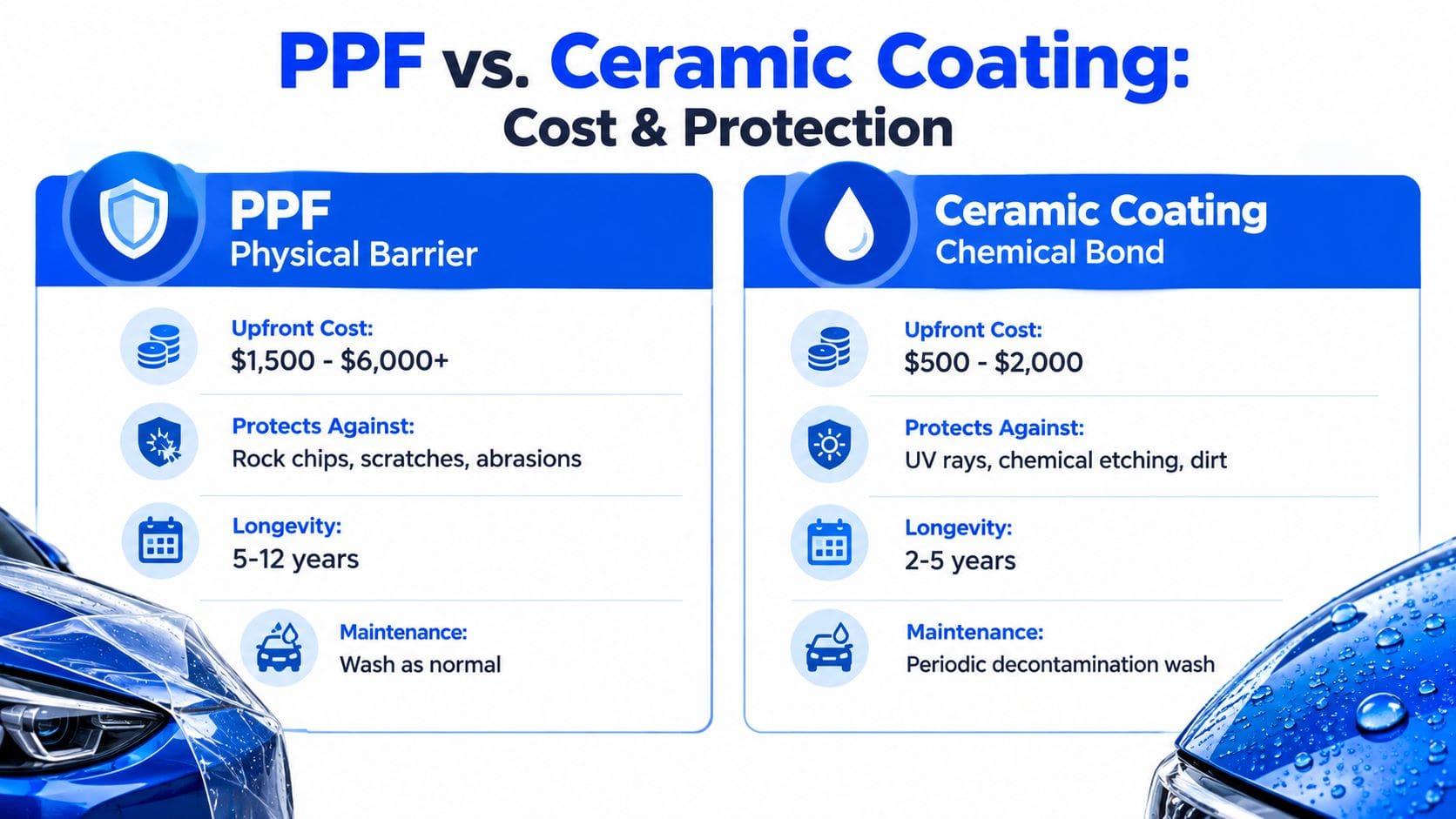
PPF and ceramic coating solve different problems. PPF provides a physical layer between the road and the paint. Ceramic coating creates a bonded surface layer that helps with gloss, water behavior, UV exposure, chemical contamination, and easier washing.
Ceramic coating won't stop a stone from chipping paint. PPF won't provide the same broad hydrophobic cleaning behavior by itself. Some owners combine them by applying PPF to impact-prone panels and ceramic coating over the film and remaining painted surfaces, provided the products and installation process are compatible.
Choose based on the damage you want to prevent
| Your priority | More suitable starting point | Why |
|---|---|---|
| Highway rock chips | PPF on the front impact zones | The film acts as a physical barrier |
| Easier washing and stronger gloss | Ceramic coating | The coating changes surface behavior |
| Preserving a high-value or new vehicle | Targeted or expanded PPF | It protects the areas most likely to receive impact |
| Broad appearance and maintenance improvement | Ceramic coating | It covers more exterior surfaces without wrapping every panel |
| Maximum layered protection | PPF plus ceramic coating | Each product addresses a different type of exposure |
For a Columbus daily driver, ceramic coating may be the better first conversation if the main complaints are water spots, dirt adhesion, and washing effort. If the hood and bumper already show highway chips, PPF should be considered before coating because a coating won't reverse that vulnerability.
Owners comparing PPF and ceramic coating should also consider the vehicle's finish. Gloss PPF keeps a factory-style appearance, while matte or satin film can change the look. Ceramic coating generally enhances the existing finish rather than changing it.
Lionheart Detailing offers both ceramic coating packages in Columbus and paint protection film services, so a local consultation can focus on the vehicle's exposure instead of forcing a single product onto every customer. The right answer may be PPF alone, ceramic alone, or a carefully selected combination.
Installation Warranty Maintenance and ROI You Should Expect
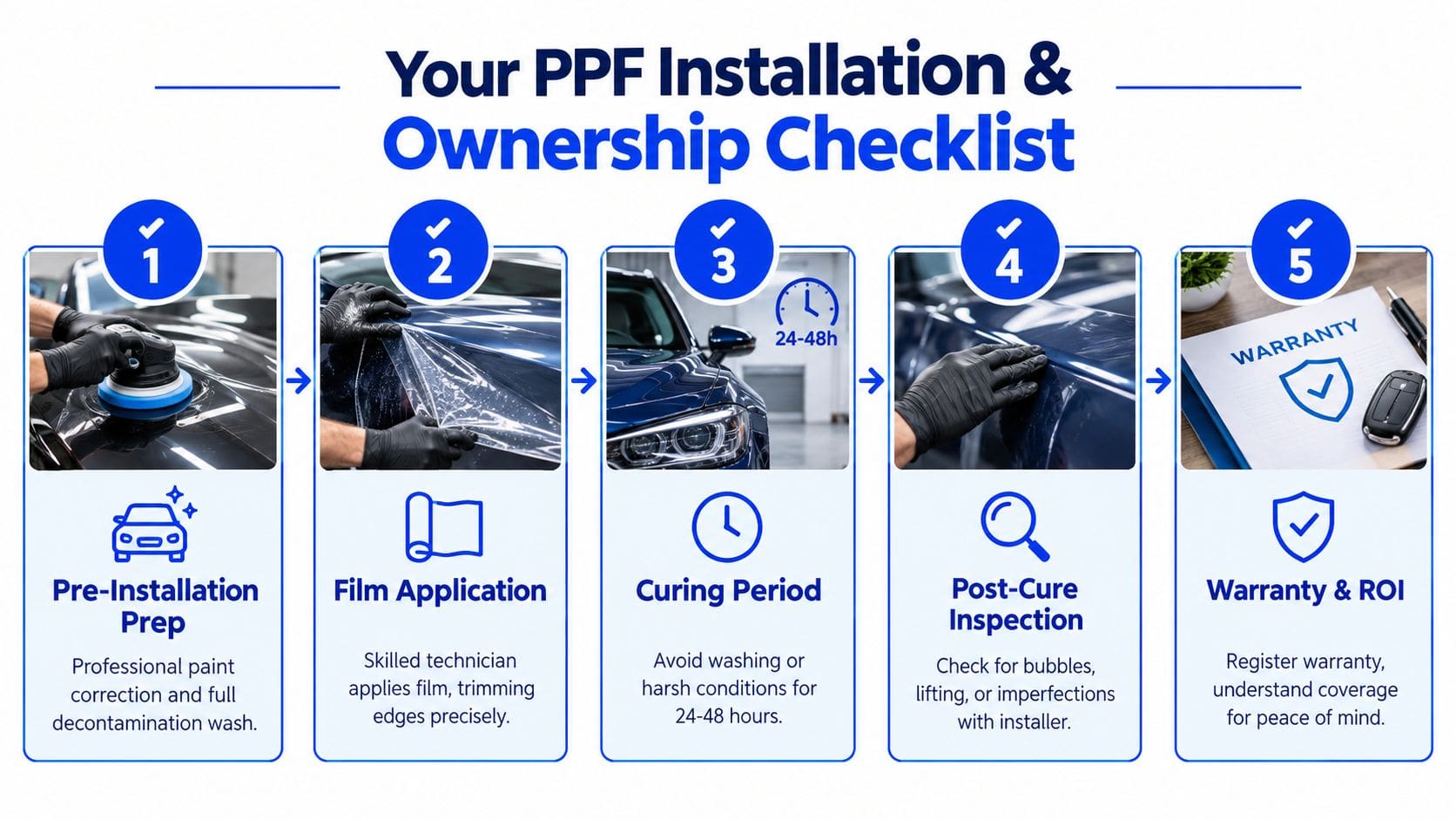
A durable PPF installation begins with the vehicle's condition, the installer's preparation, and the complexity of the panels being covered. Film applied over bonded contamination, heavy residue, or neglected paint can trap defects beneath the surface. A proper quote should account for inspection, preparation, film handling, and the labor required to finish each panel cleanly.
What the installation process should include
- Vehicle inspection: The installer records existing chips, scratches, repainted areas, sensitive trim, sensors, and other conditions that may affect the work.
- Preparation: Washing and chemical or mechanical decontamination remove particles that can interfere with adhesion.
- Paint correction when needed: Polishing can improve clarity and remove suitable surface defects, but deep damage still requires separate repair.
- Pattern selection and application: The technician positions the film, controls solution and tension, and trims or wraps edges with care.
- Final inspection: The shop checks for lifting, bubbles, contamination, and uneven edges before delivery.
A plotter and digital pattern system can improve consistency, but software does not replace hands-on judgment. Bumpers, recesses, badges, sensors, and trim often require adjustments during installation. Review this guide to choosing a PPF installer in Columbus before approving a shop.
Pickup, curing, and maintenance
Follow the installer's care instructions after pickup. The film needs time to settle, and early washing, aggressive pressure, harsh chemicals, or picking at an edge can create preventable problems.
For routine care:
- Use clean wash media: Dirt trapped in a wash mitt can mark the film's top layer.
- Avoid sharp tools at edges: A pressure washer or towel can catch a lifted corner.
- Use compatible products: Avoid abrasive compounds unless the film manufacturer approves them.
- Inspect vulnerable areas: Check bumper corners, wheel-arch edges, mirror caps, and rockers during regular washes.
- Address lifting promptly: Small edge issues are easier to correct before contamination gets underneath.
Warranty terms vary by brand and product line. One manufacturer-backed example includes a 10-year warranty, with an extended 12-year warranty available when paired with a specific top coat and registration requirement. The PPF lifespan and warranty guide explains that example. Focus on the actual terms, including coverage for yellowing, cracking, bubbling, adhesive failure, registration requirements, exclusions, and approved maintenance.
Thinking about return on investment
PPF makes sense when avoiding visible damage, preserving original paint, and reducing future repair decisions matter more than a direct financial return. Its value is strongest on high-impact panels and vehicles where maintaining the original finish carries real importance.
A modular plan can improve the value equation. Add rockers or A-pillars when driving conditions expose those areas, rather than automatically wrapping every panel. Matte and color PPF can also suit owners who want an appearance change, but the premium represents customization as well as protection.
Conclusion and Next Steps with Lionheart Detailing
The right auto paint protection film cost depends on the coverage you choose and the work included in the estimate. Partial front PPF can protect the leading impact zones at a lower entry price. Full-front coverage offers broader protection for the hood, fenders, bumper, mirrors, and often headlights. Full-body PPF provides the widest coverage, but it requires substantially more material, preparation, labor, and inspection.
Before approving a quote, ask for a panel-by-panel description. Confirm whether the price includes paint correction, decontamination, edge work, headlights, rockers, A-pillars, door edges, and warranty registration. Then compare film grade and finish, not just the total.
For drivers in Hilliard, Dublin, Powell, Upper Arlington, and the wider Columbus area, driving habits should guide the package. A highway commuter may prioritize the full front. A truck owner may need rocker protection. A luxury or performance vehicle owner may prefer broader coverage, matte film, or PPF combined with ceramic coating for easier maintenance.
Lionheart Auto Detailing & Protection provides PPF, ceramic coating, paint correction, and detailing through its Hilliard shop and mobile service model. The shop is located at 4402 Weaver Court North, Suite 204, Hilliard, Ohio. Bring your vehicle, driving routine, and priorities to the conversation, and ask for a quote that makes every included panel clear.
If you're comparing Columbus PPF prices, Lionheart Detailing can help you select practical coverage for your vehicle, from targeted front protection to expanded packages and ceramic coating support. Contact the team to discuss your paint condition, driving habits, and the installation details behind your quote.