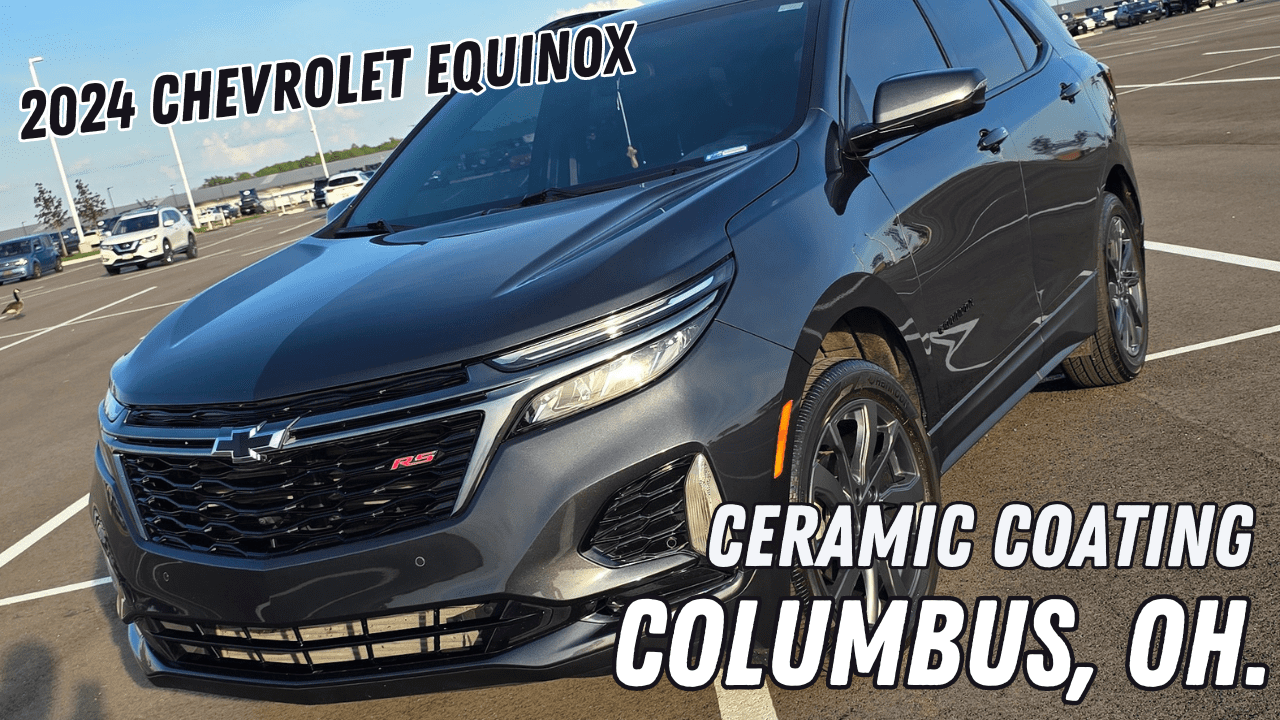
You just bought a car, or maybe you've had the same one for a few Ohio winters and the paint doesn't look as crisp as it used to. Now the question comes up in the driveway, at the shop counter, or after a late-night scroll through shiny before-and-afters, ceramic coating vs wax. One sounds old-school and affordable, the other sounds like the modern answer, but the actual choice depends on how long you're keeping the car, how you wash it, and whether you want quick shine or long-term protection.
For a lot of Columbus drivers, this isn't a theory question. It's about whether the car will be a lease return in a couple years, a daily driver through salt season, or a garage-kept weekend toy that still sees dust, pollen, and bird droppings. The answer changes with the ownership plan, because wax and coating solve different problems, and they age very differently.
Table of Contents
- Why Drivers Are Comparing Ceramic Coating and Wax Right Now
- What Wax and Ceramic Coating Are
- Durability, Hardness, and Protection Compared
- The Real-World Cost Over 2 to 5 Years
- Which Option Fits Your Driving Habits and Ownership Plans
- How a Professional Ceramic Coating Is Actually Applied
- How Ohio Winters and Road Salt Change the Equation
- Choosing the Right Protection and Getting Started
Why Drivers Are Comparing Ceramic Coating and Wax Right Now
A lot of people walk into the shop thinking they need one answer for every car. Then they hear the first real-world detail, and the decision gets more interesting. A short-lived wax can make sense for a car you'll trade soon, while a chemically bonded ceramic coating changes the maintenance conversation for years, not weeks, especially when the car lives in sun, rain, slush, or salted roads.
The ownership question matters more than the product label
The reason this comparison keeps coming up is simple. People want to know whether they're paying for shine, durability, or both. The gap matters because wax is typically described as lasting 4 to 8 weeks per application, while ceramic coating is commonly marketed at 2 to 5 years, or even 2 to 7 years depending on product quality and installation conditions, which changes the maintenance cycle from about 6 to 13 reapplications per year to a multi-year protection plan. That contrast is spelled out in the comparison sources used here, along with the stronger protection profile people associate with coatings, including a reported 9H to 10H pencil hardness rating and far better resistance to UV and environmental fallout (MotorHeadz).
That's why the question shows up now more than it did a few years ago. Cars are more expensive to repaint, owners keep vehicles longer, and social media makes every glossy finish look like a permanent upgrade. In reality, the right choice depends on how the car lives outside the photo.
Practical rule: If you want the paint to look good for a few weeks, wax can do that. If you want the finish to stay easier to clean for years, coating is the conversation.
What this article is really comparing
This isn't just about which one shines more on day one. It's about maintenance-adjusted ownership. A product can look better in a demo video and still cost more in labor, washes, and reapplication over time if your routine doesn't match the product.
The sections below break down what each product is, how long it lasts, what the hidden costs look like, and which one fits a lease, a daily driver, or a car you're trying to preserve in the Columbus area.
What Wax and Ceramic Coating Are
Wax and ceramic coating get grouped together because both sit on top of paint and both improve appearance, but they do different jobs. Wax is the older, simpler option. Ceramic coating is a modern protection layer that takes prep work and cures into something much more durable.
Wax in plain English
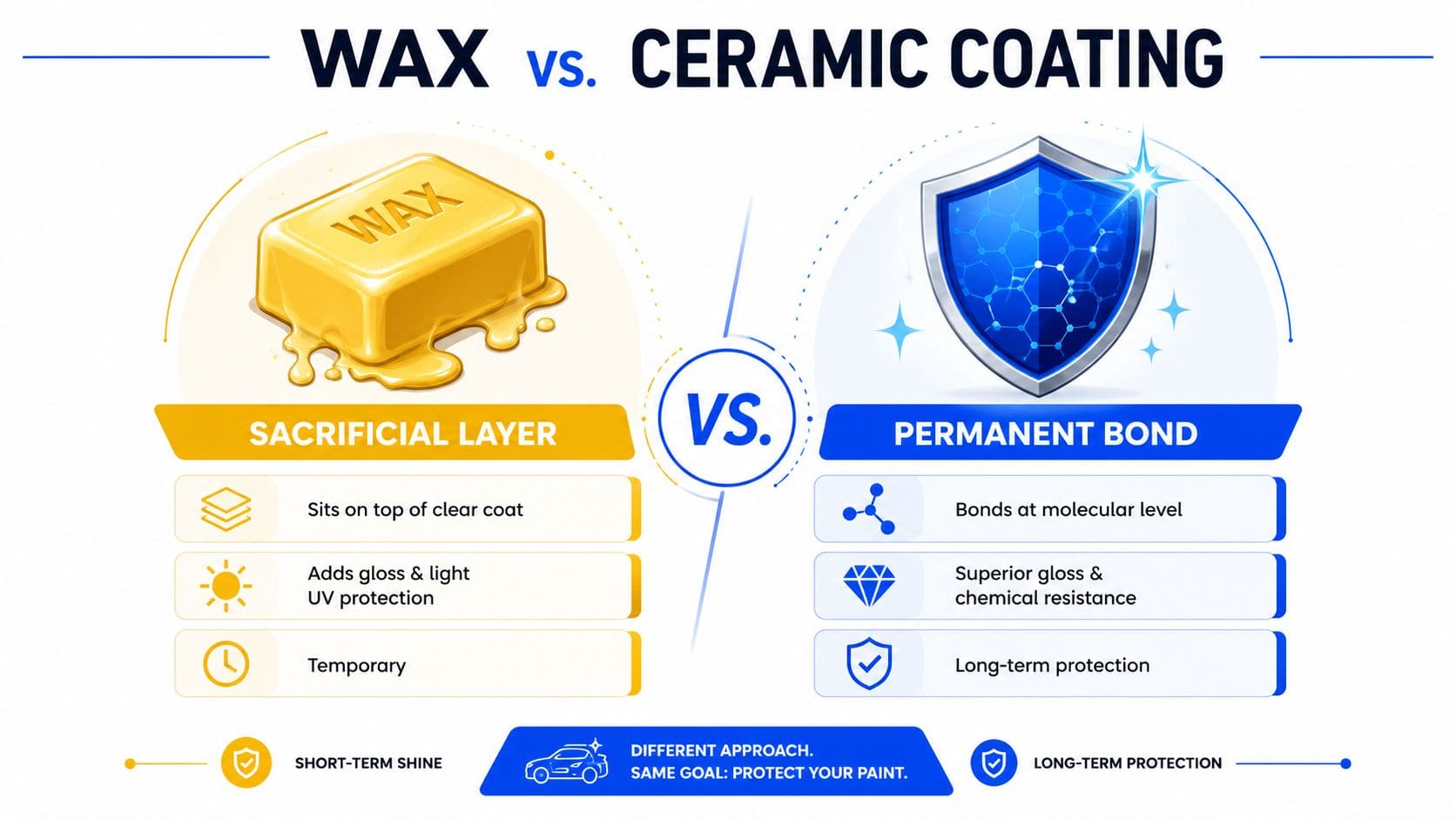
Wax is a temporary cosmetic barrier that sits on top of the clear coat. It adds gloss, helps water bead, and gives the paint a fresh look, but it is still a sacrificial film, not a bonded shell. That is why it is easy to apply, easy to remove, and also why it does not hang around long in daily use (Leno's Garage).
For a first-time customer, the main thing to understand is that wax is about quick visual payoff. It is not built to be a long-term armor layer. If the car stays in a garage, gets hand washed carefully, and you do not mind redoing protection often, wax still has a place.
Ceramic coating in plain English
Ceramic coating is usually a SiO2-based, chemically bonded layer. It needs surface prep, it needs curing, and it is meant to stay on the paint for a long time. The comparison sources describe it as a 2 to 5+ year option, but the tradeoff is that what is already on the paint before application matters a lot, because defects can get locked in once the coating cures (Chemical Guys).
That is the part many beginners miss. Coating does not erase bad paint. It preserves the paint you already have. If the finish has swirls, haze, or sanding marks, those need to be addressed first or you will seal them in.
Don't confuse the bottle labels
A lot of products are marketed as “ceramic” when they are really spray toppers, hybrid sealants, or quick-detail products with ceramic additives. Those can be useful, but they do not perform like a true professionally installed coating. The easy way to sort it out is simple, wax is the quick shine product, coating is the long-term bonded protection, and the in-between products are usually maintenance aids, not a substitute for either.
If you want the visual look of wax with the least effort, that is one path. If you want the paint to stay easier to wash and better protected over time, ceramic coating is the more serious tool.
Durability, Hardness, and Protection Compared
The cleanest way to compare these two is to look at what happens after the first wash, the third month, and the next winter. Wax is a short-cycle product. Ceramic coating is a long-cycle product. That difference matters most if you keep the car for years instead of months.
Side-by-side at a glance
| Attribute | Car Wax | Ceramic Coating |
|---|---|---|
| Lifespan | 4 to 8 weeks per application (MotorHeadz) | 2 to 5 years, with some products marketed at 2 to 7 years (Chemical Guys) |
| Maintenance cycle | Reapplication roughly 6 to 13 times per year | Multi-year protection strategy |
| Bond type | Sits on top of the clear coat | Chemically bonded layer (Chemical Guys) |
| Hardness | Basic surface protection | Reported 9H to 10H pencil hardness (MotorHeadz) |
| UV defense | Basic screening | Stronger UV resistance (Leno's Garage) |
| Chemical resistance | Limited | Better resistance to detergents, bird droppings, mineral deposits, and contaminants (Leno's Garage) |
| Water behavior | Beads water well for a short time | More hydrophobic, easier rinse and dry (Leno's Garage) |
| Main value | Fast gloss refresh | Long-term preservation |
What the hardness rating really means
The 9H to 10H discussion gets attention because it sounds like the coating is nearly indestructible. It is not. That rating points to a harder surface than wax, so it holds up better against day-to-day washing, road film, and light contamination. It still does not make the car scratch-proof.
A coating helps preserve the clear coat underneath. It does not turn a daily driver into a tank.
Shine and protection are not the same thing
Wax often gives a warm, soft gloss that people like on classics and garage-kept cars. Ceramic coating tends to leave a sharper look and keeps the surface easier to rinse clean. For a Columbus driver dealing with rain, road film, and seasonal grime, that easier cleanup matters more than a quick shine. For someone who wants a fresh look before a weekend show and does not mind reapplying product often, wax still has a place.
The Real-World Cost Over 2 to 5 Years
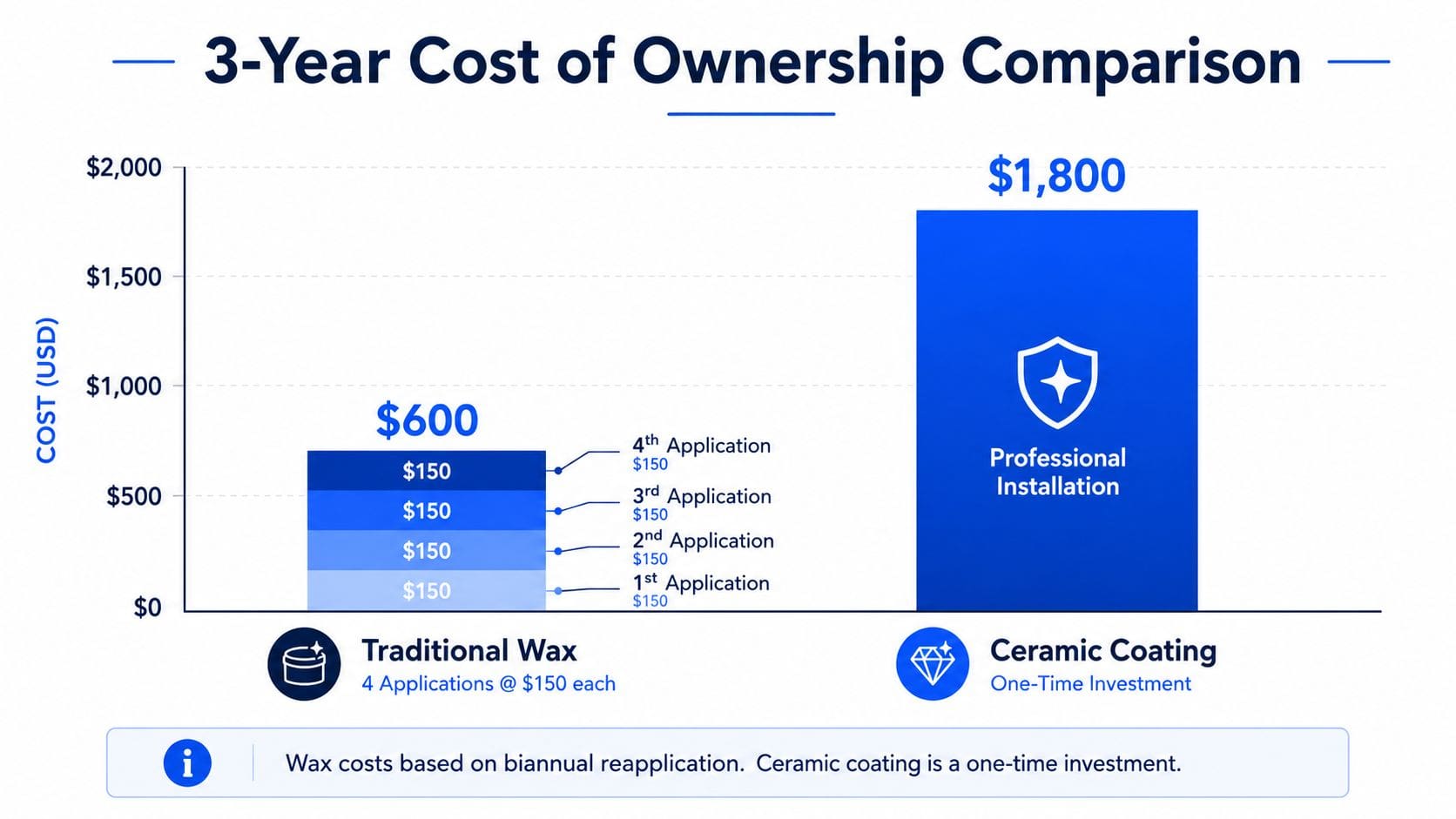
A cheap bottle of wax can look like the safer buy until you factor in how often it has to come back on the car. The true cost is not just the product on the shelf. It is the labor, the repeat visits, and the time you spend keeping up with it. Ceramic coating asks for more money up front, but the ownership math changes once you stop paying for frequent reapplication.
Why the cheap option can become the busy option
If wax only holds up for a short stretch, you end up repeating the same work over and over through the year. That means more product, more labor, and more of your schedule tied up in maintenance. If you are paying a shop each time, the total can climb quickly. If you are doing it yourself, the cash stays lower, but the time cost does not go away.
Ceramic coating shifts that burden to the front end. The install is not just a wipe-on product job. A proper prep stage includes washing, decontamination, paint correction, and a panel wipe before the coating goes on, and that prep is part of why professional installs cost more. Skip that step, and you can trap swirls, haze, and old defects under the coating. A quick-and-cheap install can leave you with an expensive finish that still looks tired.
If you want a broader breakdown of protective options, this wax versus sealant versus ceramic versus PPF guide is a useful starting point.
Real-world durability is often shorter than the label
Consumer coatings do not always live up to the marketing claims on the bottle. In practice, durability depends on weather, washing habits, and how the car is used. Some coatings hold up better than others, and professional installs usually last longer than off-the-shelf products, but none of them are set-and-forget.
That is the part many buyers miss. A coating still needs regular washing, and rough wash methods can leave marks on coated paint. It is a better protection system, not a free pass to ignore the car.
The hidden costs people forget
- Paint correction: If the paint is already swirled or hazy, the prep work takes longer.
- Wash habits: Tunnel brushes and harsh washing can shorten the useful life of protection.
- Rework risk: A bad wax job is easier to fix than a bad coating job.
- Ownership horizon: If the car is leaving your garage in a few years, full correction and coating may not bring back enough value.
For a shorter ownership window, wax can make practical sense because the up-front spend stays low and the commitment is lighter. Once you plan to keep the vehicle long enough to benefit from fewer repeat applications, ceramic coating starts to win on total cost and convenience. The better choice is the one that fits how you drive, how you wash, and how long you expect to own the car.
Which Option Fits Your Driving Habits and Ownership Plans
The fastest way to choose is to match the product to the car's life. I tell people to stop thinking in abstract terms and look at the actual use case. Lease, daily driver, or weekend car, each one points in a different direction.
The short-term owner
If the car is a lease return or a short-term flip, wax or a simpler sealant is usually the more practical move. You get gloss and decent protection without paying for heavy correction on paint you're not keeping. That's especially true if the car already has visible swirls or the finish needs work you won't get back in resale value.
The long-term keeper
If you're keeping the car 3+ years, ceramic coating starts to make more sense, because the ownership window is long enough to benefit from the longer durability and easier washing. That's where a proper install pays off in Columbus traffic, weather, and seasonal grime.
The garage-kept weekend car
A garage-kept car is a little different. If it sees light miles but you want the paint preserved with fewer wash cycles, coating is still attractive because it gives long-term protection with less maintenance between cleanings. Wax can still look gorgeous on a weekend toy, but it asks for more frequent reapplication.
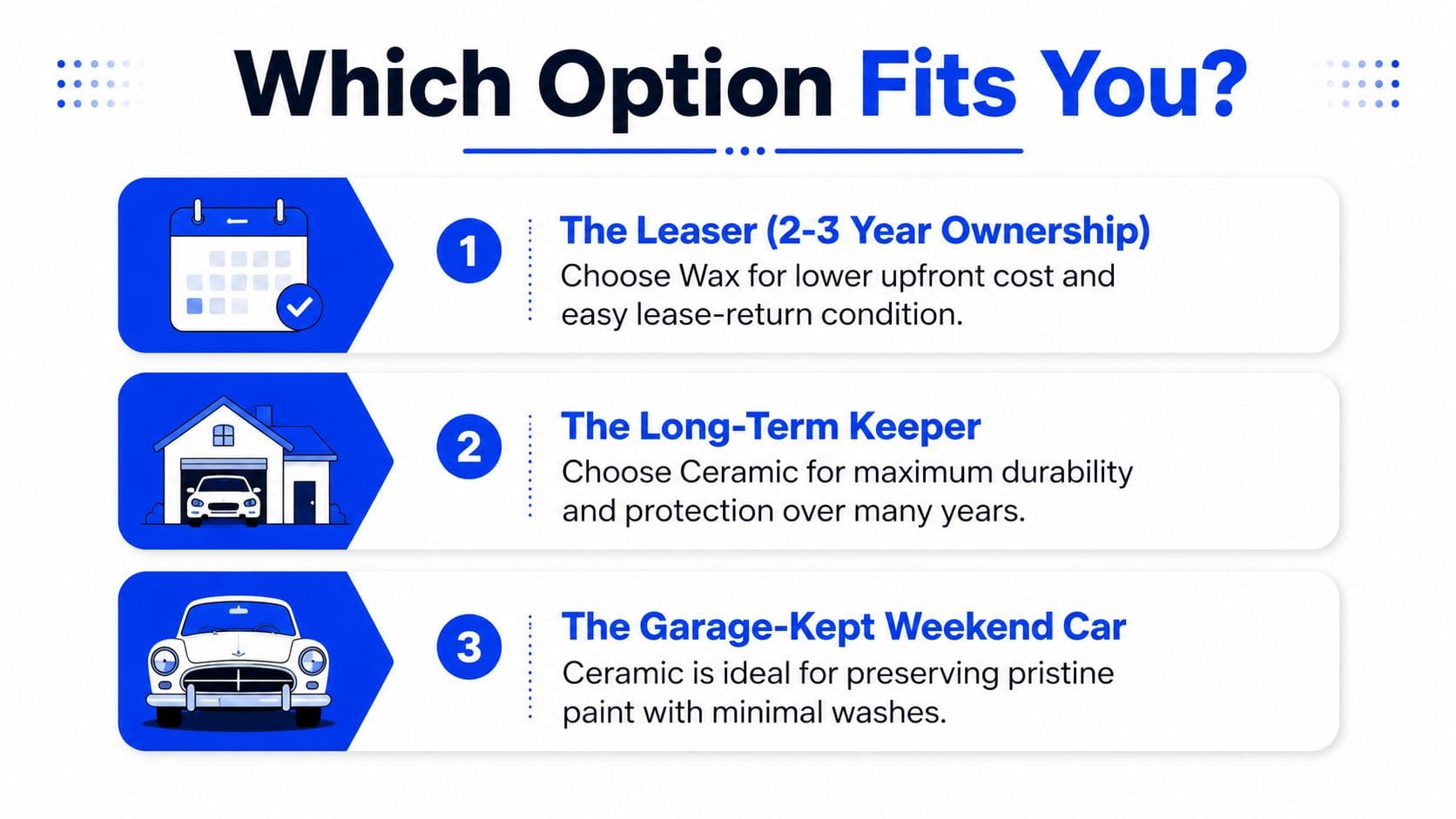
Pick wax if the car is leased, you want lower upfront cost, you like redoing protection often, or the paint condition doesn't justify major prep.
Pick ceramic coating if you're keeping the car for years, want easier washing, and care about preserving gloss through regular use.
For more detail on how wax, sealant, ceramic, and PPF differ, see the comparison page at wax vs sealant vs ceramic vs PPF.
How a Professional Ceramic Coating Is Actually Applied
A good coating job starts long before the bottle comes out. The coating itself is only the last step, and if the prep is sloppy, the finish will show it. That's why professional installs are built around cleaning, correction, and a controlled application process.
The prep work that actually matters
The car gets washed first, then decontaminated so the paint is clean enough to work on. That usually includes iron removal and clay work to pull embedded contamination out of the clear coat. After that, paint correction removes swirls and haze so the coating bonds to a finish that looks right.
Then comes the panel wipe. That step strips polishing oils and residue so the coating can bond properly. If a shop skips that part, the coating may still go on, but it won't bond the way it should.
Mobile or in-shop, the process stays the same
Lionheart Auto Detailing & Protection works both through a fully equipped mobile unit and at its Hilliard location, so the install can happen at home, at work, or in-shop depending on the job. The location-based setup matters because coating work benefits from a controlled environment, especially when weather is unpredictable in central Ohio. For a look at the service structure, the professional ceramic coating vs DIY ceramic coating in Columbus page lays out the difference in the actual world.
What happens after application
Once the coating is applied, cure time matters. The first 24 to 48 hours are the most important period for keeping the car dry and away from harsh contamination, because that's when the coating is setting up. Even after that, the coating still benefits from careful washing instead of tunnel brushes or aggressive chemicals.
If the car already has defects, don't rush the coating to save time. Prep is what separates a finish that looks right from one that just looks shiny.
How Ohio Winters and Road Salt Change the Equation
Ohio weather isn't gentle on paint. Salt, slush, freeze-thaw cycles, and humid summers all hit the surface in different ways, and that's where the product choice becomes less theoretical. Around Columbus and Hilliard, the protection layer has to survive more than just sunlight.
Winter is where wax falls behind fast
Wax gives some barrier protection, but salt and winter wash cycles tend to wear it down quickly. Once that sacrificial film is gone, the clear coat takes the abuse directly. Ceramic coating handles those conditions better because it's more chemically resistant and hydrophobic, so winter grime and slush are easier to rinse away (Leno's Garage).
That doesn't mean the coating makes winter irrelevant. It just means the paint has a more resilient surface between washes.
Local habits matter as much as the product
During salt season, washing more often is smart. That matters whether the car is coated or waxed. The big mistake I see is people assuming a coating means they can ignore wash technique. Tunnel brushes in places around Dublin, Westerville, and Worthington can still leave swirls on coated paint, and contaminated wash water can make the finish look tired fast.
For Columbus-area weather specifics, the local guide on how Columbus, Ohio weather affects your car paint and how ceramic coatings helps is worth a read if you're trying to understand why our climate is so hard on finishes.
Common Ohio mistakes: waiting too long between winter washes, using harsh brushes, skipping drying towels, and assuming any protection product is maintenance-free.
If you're choosing based on local conditions alone, ceramic coating has the edge for drivers who keep cars through multiple seasons. Wax still works, but it asks for more frequent attention when the roads are salty and the weather keeps changing.
Choosing the Right Protection and Getting Started
If the car is short-term or leased, wax or a simpler sealant is usually the practical answer. If you're keeping the vehicle for years, driving it through Ohio weather, and want the paint easier to wash, a professional ceramic coating makes more sense. The middle ground comes down to paint condition, budget, and how much effort you're willing to put into maintenance.
A few common questions come up every time. Coated cars still need regular washing, usually with careful hand-wash technique. You can put wax over a coating as a maintenance booster, but that's not the same as replacing the coating itself. If the coating starts feeling less hydrophobic after a year or two, that doesn't always mean it failed, it may need proper cleaning or a maintenance product rather than a full redo.
For directions, reviews, and the Hilliard shop location, use the Lionheart Auto Detailing & Protection Google Business profile. If you want a recommendation for your specific car, whether it needs Hilliard ceramic coating, Columbus ceramic coating, Hilliard auto detailing, or even Columbus PPF or Hilliard paint protection film alongside paint care, Lionheart can look at the paint, the driving habits, and the ownership plan before you book.
Lionheart Detailing offers professional ceramic coating, paint correction, PPF, and full detailing for Columbus-area drivers who want real protection, not just a shiny finish for the weekend. If you're deciding between wax and coating, visit Lionheart Detailing to explore the options and reach out for a mobile appointment or an in-shop visit at 4402 Weaver Court North, Suite 204, Hilliard.