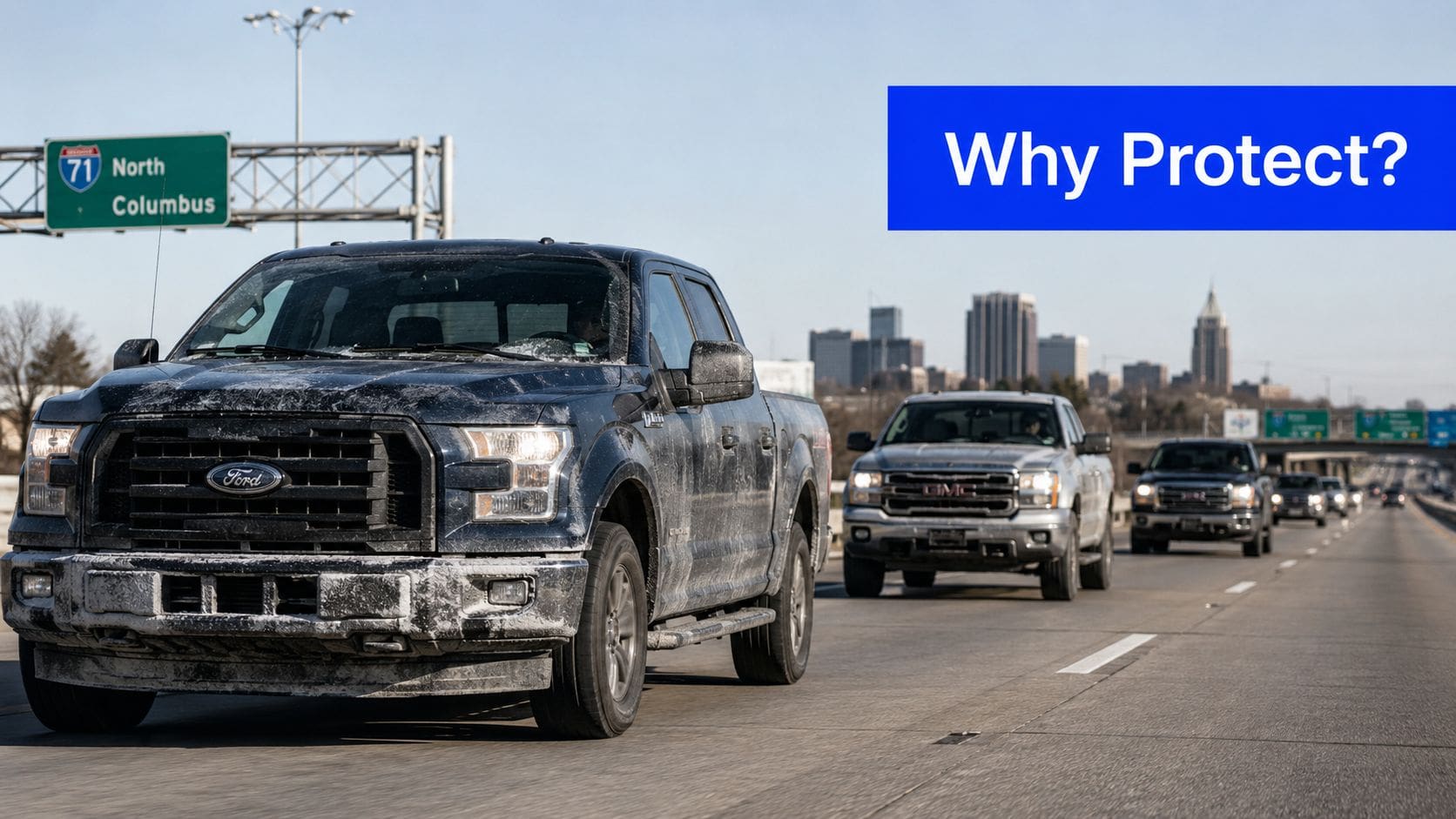
You're driving north on I-71 after a weekend job, and the truck looks fine from ten feet away. Up close, the hood has tiny chips, the bumper is dotted with bug marks, and the rocker panels are carrying a gray film of salt and road grit. That's a familiar Columbus, Ohio truck problem, especially for owners who commute through construction zones, tow regularly, or use a pickup at worksites.
PPF for trucks in Columbus, Ohio makes the most sense when you treat it as a zone-by-zone protection decision. You don't automatically need a full-body wrap. You need the right panels protected for the way your truck spends its time on roads around Hilliard, Dublin, Powell, Upper Arlington, and the wider Columbus metro.
Table of Contents
- Why Columbus Truck Owners Are Looking at PPF
- What Paint Protection Film Actually Does
- Best PPF Coverage Zones for Trucks
- PPF Cost for Trucks in Columbus
- How to Choose a Columbus PPF Installer
- Pairing PPF with Ceramic Coating and Tint
- Common Mistakes and When to Book a Pro
Why Columbus Truck Owners Are Looking at PPF
A pickup that looks clean from the driver's seat can show a different story after a week on Columbus roads. I-71 and I-270 traffic, winter residue, construction zones, and jobsite gravel put repeated wear on the hood, bumper, mirrors, front fenders, and rocker panels. The truck's large painted surfaces make chips and stains especially visible, including across broad hoods and tall bedside panels.
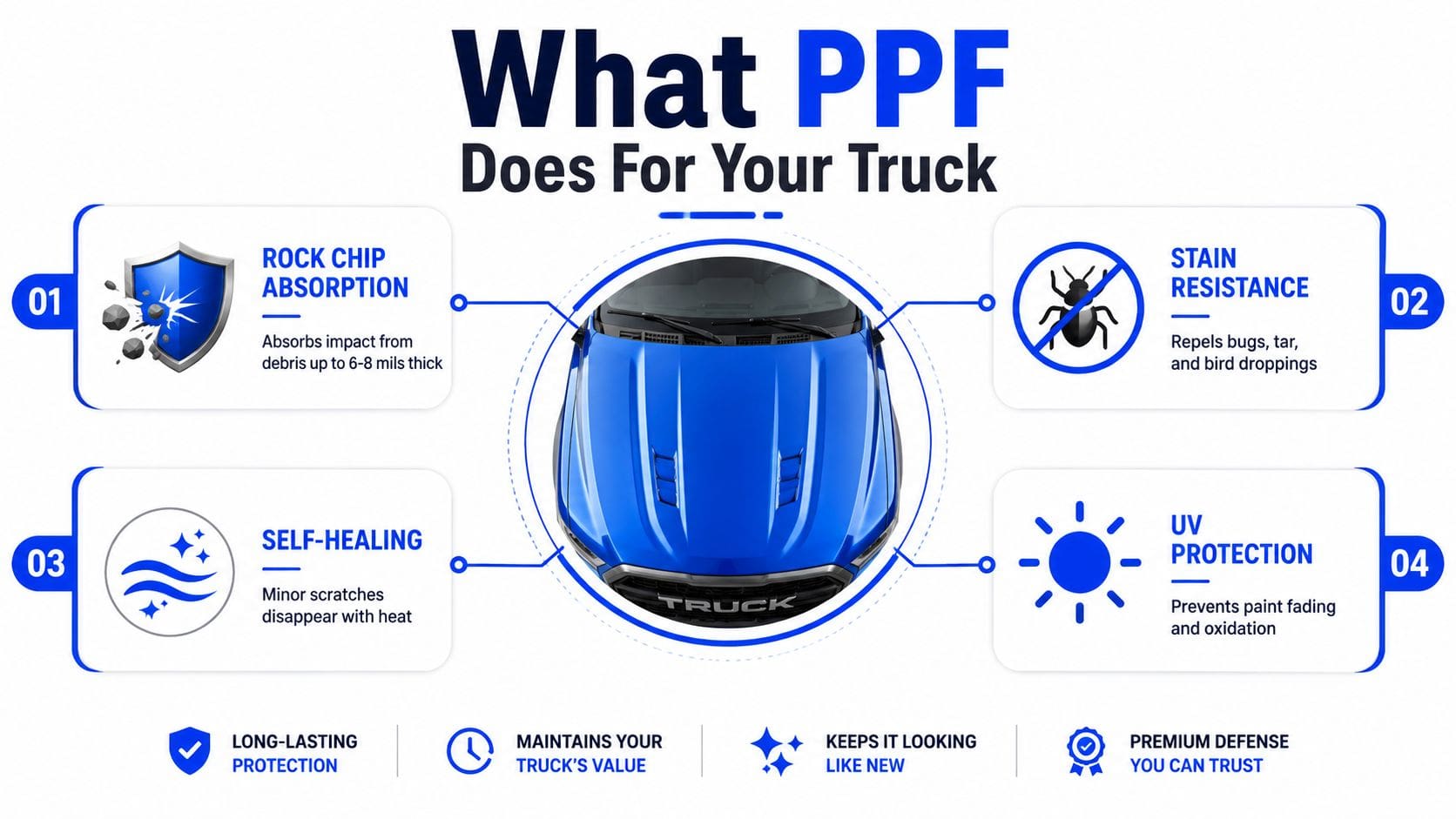
Paint protection film, or PPF, is a sacrificial barrier. It absorbs abuse that would otherwise reach the factory finish, helping defend against scratches, stone chips, stains, UV exposure, and other environmental wear. That protection suits a high-trim truck, yet it also makes sense for a work truck that must stay presentable for years.
Industry forecasts reflect growing demand for vehicle protection. One forecast places the global PPF market at USD 502.6 million in 2024 and USD 726.6 million by 2030, with a projected 6.6% CAGR from 2025 through 2030, according to Mordor Intelligence's paint protection film market forecast. Another estimates USD 1,092.7 million in 2025 rising to USD 1,549.4 million by 2030, at a projected 7.2% CAGR, as reported by Straits Research.
My recommendation: If your truck regularly uses Columbus highways, protect the front end before chips accumulate. PPF is easier to justify as paint preservation than as a cosmetic luxury.
One forecast projects North America as the fastest-growing region, with an 8.4% CAGR from 2026 through 2034, compared with a 5.8% global pace, according to Straits Research. The same source estimates automotive applications represented 62.5% of global PPF demand in 2025. For truck owners, the practical takeaway is straightforward: choose coverage by exposure zone, preserve the paint where it takes the most punishment, and protect resale appeal without automatically wrapping the entire body.
What Paint Protection Film Actually Does
PPF is a thermoplastic polyurethane film applied directly over painted surfaces. Think of it as a transparent, flexible shield rather than a polish or a coating. It helps defend against rock chips, scratches, road debris, bug damage, road tar, stains, UV exposure, and other environmental wear, as described in Grand View Research's PPF market analysis.
It doesn't work like wax. Wax sits on the surface and adds temporary slickness. Ceramic coating chemically bonds to the surface and improves water behavior, cleaning, and UV resistance. PPF provides the physical impact layer that those products can't replace on a truck's leading edges.
How the film protects the finish
A typical professional installation involves a clear film with a pressure-sensitive adhesive. The installer cleans and prepares the panel, positions the film with the correct mounting solution, then uses controlled squeegee strokes to remove solution and set the adhesive. Some modern films have self-healing topcoats, which can reduce the appearance of light surface marks when exposed to heat from sunlight or warm water.
The film's finish matters, too. Gloss PPF keeps the original paint appearance close to factory condition. Matte or satin film changes the visual character of the truck while adding protection, but it can make future paint matching and repair decisions more specialized.
What PPF can and can't do
PPF can absorb many minor impacts and reduce staining from bugs, tar, and road residue. It won't stop a severe collision, repair deep gouges, or make a neglected truck maintenance-free. A film-covered panel still needs safe washing, prompt removal of aggressive contamination, and periodic inspection.
Manufacturer guidance for 3M Series 100 lists the film at 7.5 mil thick and provides a 10-year warranty in the United States and Canada, with protection against stone chips, scratches, bug damage, road tar, and UV exposure, according to Truck Custom's technical overview. Warranty terms depend on the exact product, installation, and maintenance conditions, so always read the specific documentation for the film installed on your truck.
Best PPF Coverage Zones for Trucks
A smart truck owner starts with impact patterns, not package names. The hood, bumper, mirrors, headlights, and front fenders face the most direct road debris. Rockers and door edges see a different type of abuse, including gravel kicked up by tires, work boots, tools, and tight jobsite parking.
For most Columbus commuters, I'd start with the front bumper, full hood, full front fenders, and mirrors. A truck that regularly hauls materials or works around construction sites may justify rocker panels, door edges, handle cups, bed rails, and the upper tailgate. A weekend off-road truck needs a broader conversation because the damage doesn't stay confined to the nose.
For a useful panel-by-panel breakdown, review these paint protection film coverage areas.
| Package | Panels Covered | Best For | Cost Tier |
|---|---|---|---|
| Partial front | Bumper, exposed hood area, and front fender sections | Highway commuters who want the highest-impact zones covered | Lower |
| Full front | Full hood, full fenders, bumper, mirrors, and often headlights | Daily drivers, newer trucks, and owner-operators | Moderate |
| Worksite protection | Full front plus rockers, door edges, handle cups, and selected bed areas | Trucks used around tools, trailers, and construction sites | Moderate to high |
| Full body | All painted exterior panels selected for coverage | Long-term ownership, show-quality preservation, and trucks with extensive exposure | Highest |
Match coverage to actual use
- Commuter truck: Choose full-front coverage if you spend most days on I-71, I-270, or other high-speed routes.
- Towing truck: Add mirrors, rocker panels, and front door edges if the truck regularly travels with a trailer or through gravel access roads.
- Work truck: Prioritize rockers, door edges, bed rails, and the upper tailgate because tools and cargo create damage that front-end film won't address.
- Off-road truck: Consider broader rocker, bedside, and lower-door coverage. Mud and grit can scrape panels long before you notice the damage.
- Show or high-trim truck: A full-body installation offers the most consistent appearance, but only makes sense if preserving every painted surface is a real priority.
I don't recommend full-body PPF because it's available. On many trucks, full-front coverage delivers the strongest return, while targeted side and bed protection handles the owner's specific use.
PPF Cost for Trucks in Columbus
Truck PPF pricing depends mainly on coverage, panel complexity, film type, and preparation. For Columbus buyers comparing a partial front, full front, or complete wrap, the quote should identify every covered panel instead of using a vague label such as “truck package.”
The following ranges are the practical planning figures specified for this market:
| Coverage Package | Typical Price Range | Panels Included |
|---|---|---|
| Partial front | $900 to $1,400 | Hood section, front fenders, bumper |
| Full front | $1,600 to $2,200 | Full hood, fenders, bumper, mirrors, headlights |
| Full body | $5,500 to $8,500 | Most or all painted exterior surfaces |
You can compare broader details about paint protection film cost before requesting Columbus quotes.
What changes the price
Truck shape is a major factor. An F-250 grille and bumper assembly can require more careful pattern work than a simpler half-ton pickup. Tundra hood contours, Tacoma bedside angles, tow mirrors, embossed trim, and sharply shaped rocker panels all affect labor and material use.
Film selection also changes the estimate. Standard clear film, self-healing film, and matte film aren't interchangeable products. Ask for the manufacturer, product line, warranty terms, and finish in writing.
Paint preparation deserves equal attention. If the truck has oxidation, heavy swirls, old adhesive, or scratches that need polishing, prep work may be added before the film goes on. PPF doesn't erase defects. It can preserve whatever is underneath it, including defects you should have corrected first.
How to compare Columbus quotes
- Match the panel list: Confirm whether “full front” includes mirrors, headlights, the complete hood, and complete fenders.
- Verify the film: Get the brand and exact product line, not just “premium PPF.”
- Ask about prep: Find out whether washing, decontamination, paint correction, and final inspection are included.
- Review warranty handling: Confirm who registers the warranty and what maintenance requirements apply.
- Check add-ons: Ask about removal of old film, extra edge wrapping, difficult trim, and specialty finishes.
The lowest number usually reflects less prep, fewer panels, less edge wrapping, or a different film. Compare like for like before deciding.
How to Choose a Columbus PPF Installer
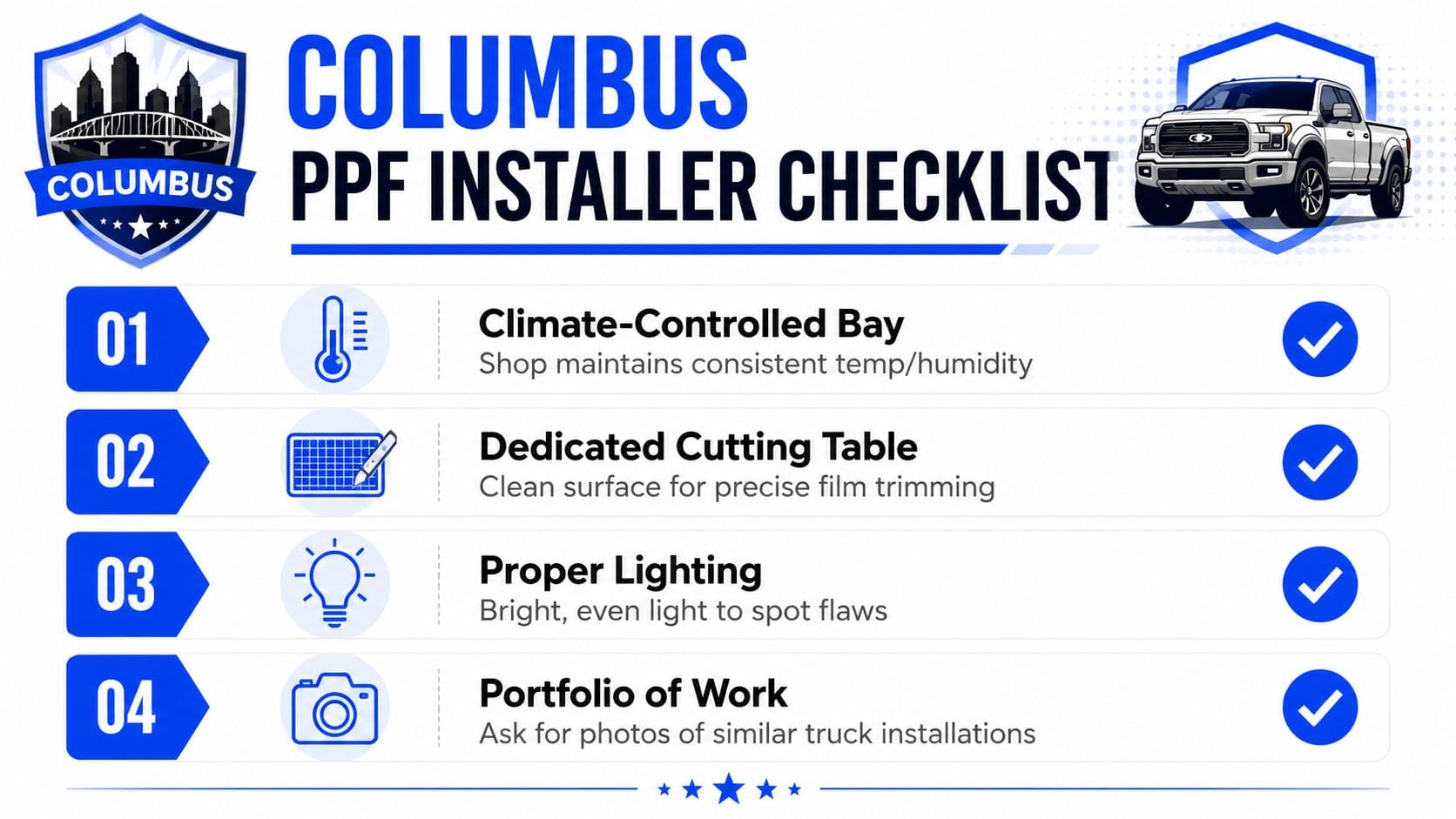
A clean truck PPF installation starts before the film touches the paint. Visit the shop if possible. You should see a controlled work area, consistent lighting, clean surfaces, and enough room to open truck doors and position large panels without rushing.
Inspect the installation environment
A climate-controlled bay helps the installer manage film behavior, adhesive response, and solution evaporation. Bright, even lighting exposes dust, fingers, trapped moisture, uneven tension, and edge issues during the job rather than after delivery.
A dedicated cutting table matters because installers need a clean, stable surface for handling patterns. Many professional shops use pre-cut patterns from manufacturers such as XPEL, SunTek, or 3M. Pattern systems reduce the need to place a blade directly against factory paint, although custom trimming may still be appropriate in selected areas.
Ask how the installer handles edges
Truck panels have large flat sections and complicated transitions. Ask whether the installer wraps accessible edges, where seams land, and how the shop approaches tow mirrors, door handles, bed rails, and bumper contours. A clean pattern with poor edge finishing can still collect dirt and lift.
Look at the installer's recent truck work, not only sports cars and luxury sedans.
Confirm the paperwork
Before booking, request:
- Film identification: Brand, product name, finish, and warranty period.
- Coverage list: Every panel included, including partial hood or fender boundaries.
- Prep description: Decontamination, polishing, trim removal, and final inspection.
- Warranty process: Registration responsibility, exclusions, and maintenance requirements.
- Turnaround details: Drop-off time, expected completion, and post-install care instructions.
Red flags include a quote with no film brand, a vague “front package,” no photos of similar trucks, and an installer who can't explain edge care. Mobile detailing can work well for cleaning and some protection services, but intricate truck PPF needs a properly equipped environment. Lionheart Detailing offers PPF installation and operates from a Hilliard shop location, with service coverage across the Columbus metro.
Pairing PPF with Ceramic Coating and Tint
PPF, ceramic coating, and window tint solve different problems. PPF handles physical impact. Ceramic coating adds a hydrophobic, UV-resistant surface that makes washing easier. Tint manages cabin heat, glare, and privacy. Treating them as competing products leads to poor decisions.
The usual sequence is paint correction first, PPF second, ceramic coating third. The film needs a clean, properly prepared surface. Once the PPF has settled according to the manufacturer's care instructions, a compatible ceramic coating can be applied over the film and the remaining painted panels.
Ceramic coating won't stop a highway stone from chipping a truck hood. It can help release bugs, salt residue, and road film during washing, but it isn't a substitute for impact protection. For that reason, I wouldn't choose ceramic-only protection for a truck's front end if the truck spends serious time on Columbus highways.
Decide where the coating goes
Some owners coat the entire truck for a consistent finish and easier maintenance. Others coat only the uncovered painted panels and PPF-covered zones that need extra slickness. The right choice depends on your budget, washing habits, and whether the truck is primarily a daily driver, work vehicle, or showpiece.
Professional ceramic coatings are valued for hydrophobic behavior and UV resistance. One industry source says professional-grade coatings typically remain effective for about three to five years under demanding UV exposure before noticeable performance loss, while accelerated testing can show degradation after 500 to 1,000 hours, according to Luxury Car Care's ceramic coating durability discussion.
For the cab, tint can improve comfort for crews, families, and anyone leaving tools inside the truck. Ohio rules require the windshield to transmit at least 70% of light and front side windows to be 50% VLT or lighter, while back side windows and the rear window may be any darkness, according to this Ohio window tint law guide. Check the legal configuration before choosing dark front glass.
For owners comparing the services, this guide to combining ceramic coating and window tint provides a useful starting point.
Common Mistakes and When to Book a Pro
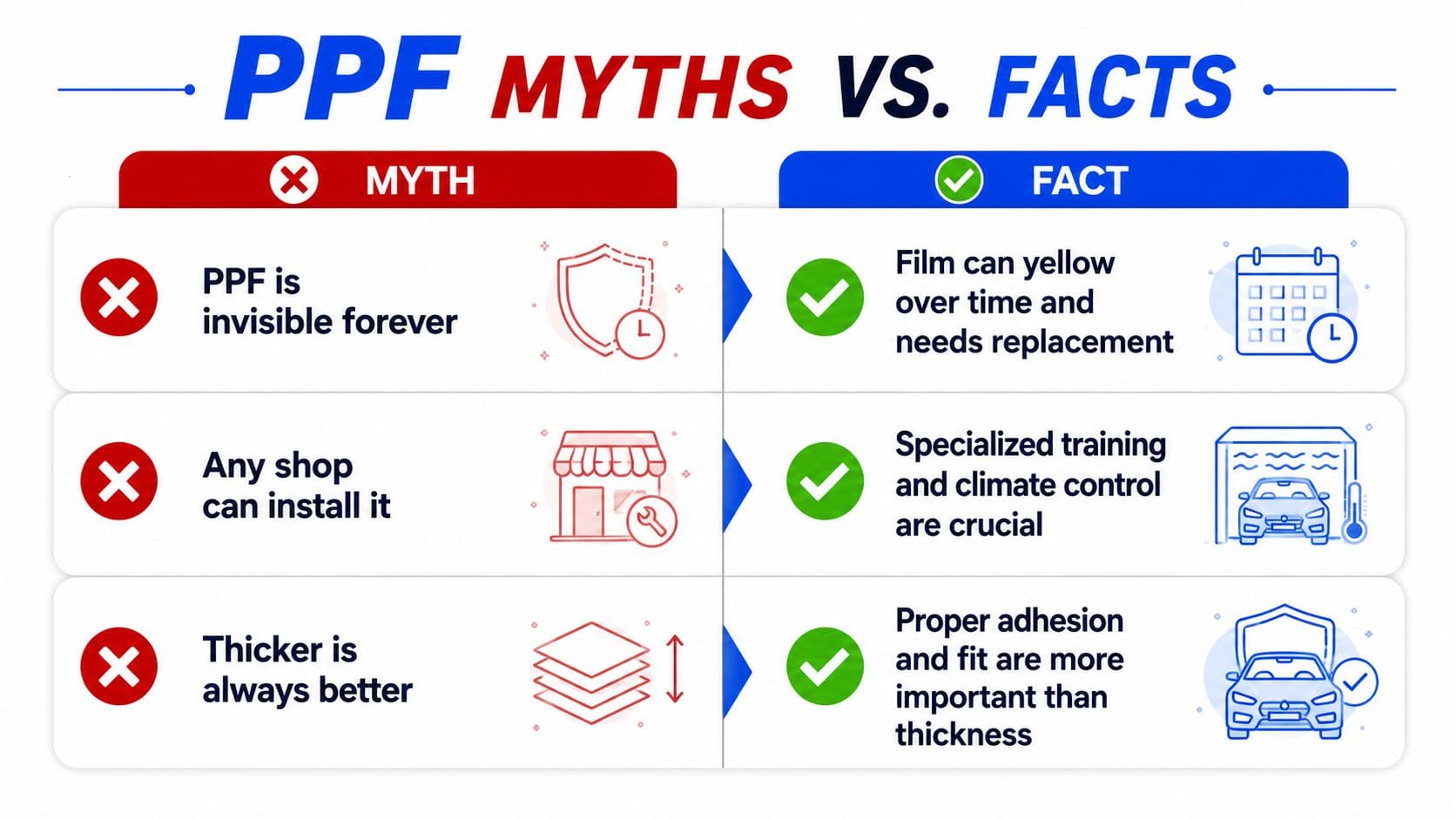
PPF isn't magic, and it isn't permanent invisibility. Film can show edges, collect contamination, lift, or require replacement. Installation quality matters more than choosing the thickest product.
The most expensive mistake is installing film over paint that needed correction. Swirls, haze, oxidation, and embedded contamination remain visible beneath clear film. A professional should inspect the finish and explain what needs polishing before installation.
Three mistakes I see repeatedly
- Assuming any wrap shop can install PPF: Vinyl wrapping and PPF installation use different handling, stretching, solution control, and edge-finishing skills.
- Choosing thickness over fit: A poorly bonded or badly fitted film can fail at the edge regardless of its thickness. Manufacturer guidance emphasizes controlled methods, approved stretching, and heat-setting where required.
- Treating PPF as a replacement for washing: Salt, bugs, tar, and grime still need safe removal. Contamination left against edges can make lifting and staining more likely.
The technical sequence matters. For a reliable installation, the panel should be washed and degreased, clayed, wiped with 99% isopropyl alcohol, and fully soaked with the correct mounting solution before the film is squeegeed from the center outward. 3M's guidance calls for edge heat-setting at about 82°C, or 180°F, followed by waiting about 15 minutes before applying pressure, as outlined in 3M's PPF installation guidance.
Know when professional help pays off
Book a professional inspection when:
- Winter residue remains: Salt and slush have dried around seams, rockers, and lower edges.
- The paint has deep scratches: The installer should determine whether polishing or repair must happen first.
- You see lifting or trapped debris: Don't press down loose edges or apply random heat.
- The truck has heavy bug contamination: Aggressive scraping can damage both film and paint.
- You're planning new coverage: Existing damage should be documented before selecting zones.
- The film looks discolored or damaged: Replacement may be more sensible than trying to polish through a failed layer.
A quick wash is enough for routine dirt. A detail appointment makes sense when contamination, salt, or paint defects have built up. PPF replacement becomes the practical choice when the film has widespread failure, deep damage, or a finish that no longer meets your expectations.
Lionheart Detailing offers truck-focused PPF installation, ceramic coating, paint correction, window tint, and detailing for owners across Columbus, Hilliard, Dublin, Powell, and nearby communities. Visit Lionheart Detailing to discuss the panels that take the most abuse, compare protection options, and schedule professional service.