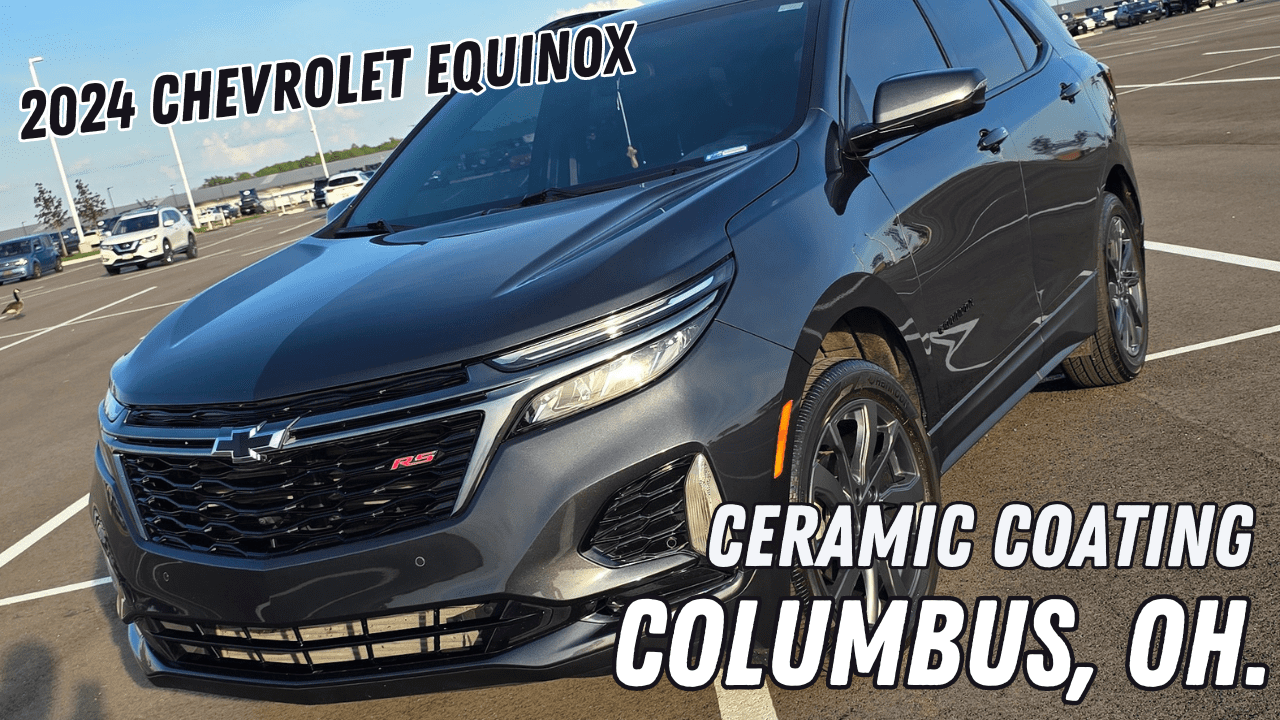
You pull up to the gas station wash, look at the menu, and hesitate. The basic wash is fast. The upgraded wash promises “shine” and “protection.” Your car is dirty, you’re busy, and the tunnel is right there.
That’s when the question arises: Do car washes ruin paint? Sometimes, yes. But the honest answer depends on the type of wash employed, the frequency of its use, and existing protective layers on your paint, especially if you’ve invested in wax, sealant, a ceramic coating, or even PPF.
From a detailer’s point of view, the biggest mistake isn’t washing your car. It’s assuming every wash is equally safe because they all use soap and water. They’re not. Some methods damage paint by physically grinding dirt into the clear coat. Others avoid contact but use aggressive chemicals that can strip protection and shorten the life of coatings. If you’re searching for ceramic coating near me, comparing Hilliard auto detailing options, or trying to protect a newer vehicle in the Columbus area, that distinction matters.
Many new car owners often misunderstand how paint damage occurs. Visible scratches get the attention. Hidden chemical wear usually doesn’t, at least not until the paint looks flat, protection stops beading, or the finish no longer feels slick after a wash.
Table of Contents
- That Moment of Doubt at the Car Wash Entrance
- The Hidden Damage Uncovered How Car Washes Cause Swirls
- Comparing Your Options Automatic Brush vs Touchless vs Hand Wash
- How to Spot Car Wash Damage on Your Own Vehicle
- The Ultimate Defense Protecting Your Paint Before a Wash
- The Lionheart Approach to a Safe and Brilliant Shine
That Moment of Doubt at the Car Wash Entrance
If you’ve stood in line at a drive-through wash wondering whether convenience is worth the risk, your instincts are good. The wrong wash can leave your paint looking worse over time, even if the car comes out clean for the moment.
Most drivers judge a wash by what they can see right away. Did the dirt come off? Did the wheels look better? Did the car dry without obvious streaks? Paint damage doesn’t usually announce itself that quickly. It shows up later under sunlight, parking lot LEDs, or your phone flashlight when the finish starts looking hazy, webbed, or dull.
What makes the answer more complicated
There isn’t one single “car wash” category. You’re usually choosing between three very different systems:
- Brush tunnel washes that physically touch the paint
- Touchless washes that rely on pressure and stronger chemicals
- Hand washing done either correctly or poorly
That’s why two people can use the phrase “automatic wash” and mean two completely different risk levels.
Practical rule: If a wash has to clean quickly at high volume, something gives. Usually it’s either paint safety or protection longevity.
For someone new to detailing, the safest way to think about it is simple. Paint damage usually comes from either abrasion or chemicals. Brush washes lean hard toward abrasion. Touchless washes avoid that contact but can lean hard toward chemical stripping. A careful hand wash, using the right tools and process, is still the standard I’d trust most for preserving gloss and reducing long-term correction work.
If your vehicle already has a coating, if you’re considering Columbus ceramic coating, or if you’re planning Hilliard paint protection film for a newer car, wash choice becomes even more important. Protection helps. It doesn’t give a free pass to bad maintenance.
The Hidden Damage Uncovered How Car Washes Cause Swirls
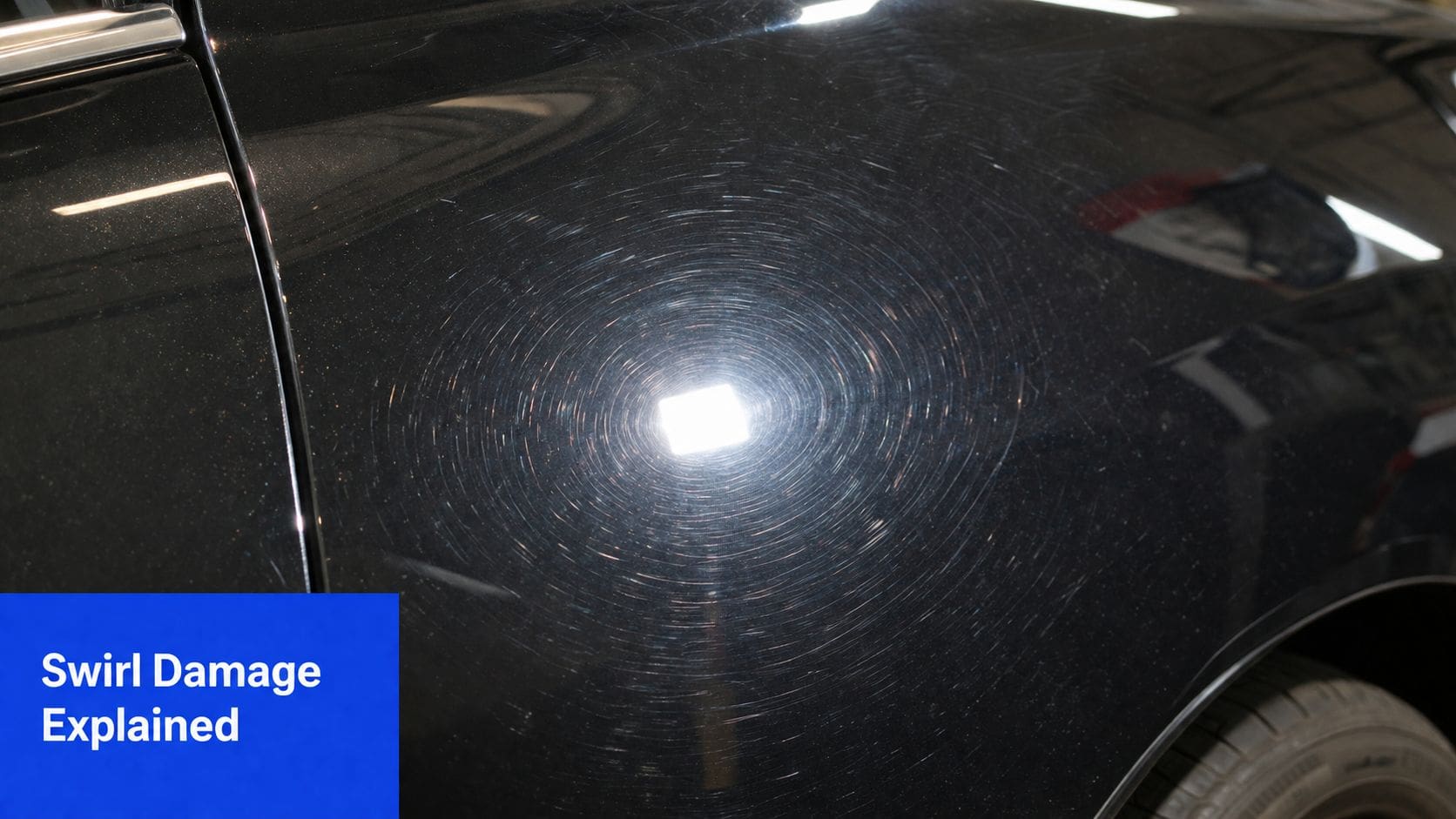
Swirl marks are one of the most common problems detailers correct. They’re not deep gouges most of the time. They’re fine scratches spread across the clear coat in a pattern you notice when light hits the panel from the right angle.
Why swirl marks happen
The easiest way to understand swirl marks is to think about washing a piano with a dirty sponge. The soap isn’t the issue. The grit trapped in the sponge is. Once that grit moves across a glossy surface, it leaves behind a pattern of tiny scratches.
That’s what happens in many tunnel washes. Automatic car washes with spinning brushes introduce thousands of micro-scratches known as “swirl marks” into the clear coat by dragging abrasive dirt trapped in the brushes across the paint, effectively acting like fine sandpaper that cumulatively causes thousands of dollars in damage over time, as described in this discussion of brush wash swirl damage.
When those scratches build up, the paint stops reflecting light cleanly. Dark colors show it fastest, especially black, blue, and gray. The finish starts to look tired even when it’s freshly washed.
A lot of owners don’t realize the wash media isn’t only touching their car. It has already touched many vehicles before theirs. Dirt from previous cars gets embedded into cloth strips or brushes. That’s the problem. The system keeps moving, but the contamination doesn’t magically disappear between each pass.
If your paint already has this kind of damage, professional swirl mark removal and paint correction can usually improve it significantly, but correction removes defects by refining the clear coat. It’s better to avoid adding them in the first place.
Chemical damage is quieter but real
Physical scratching gets most of the attention because it’s easier to photograph. Chemical wear is subtler. It shows up as reduced gloss, weak water behavior, trim discoloration, and a finish that never quite looks protected.
Weakening of the clear coat can happen when inconsistent chemical dilutions in automatic systems erode that outer protective shell. Over time, that can leave the paint cloudy and more vulnerable to defects and environmental wear, as described in this explanation of clear coat weakening in automatic washes.
A wash can make a car look clean today and still shorten the life of the finish over months.
That’s why people get confused. They judge the result right after the blower finishes. Paint damage is cumulative. It usually builds one rushed wash at a time.
Signs the damage is already building
A car may be headed in the wrong direction if you notice:
- Sunlight haze: The paint looks gray or cloudy instead of crisp and glossy.
- Spider-web patterns: Circular light scratches show up around overhead lights.
- Reduced slickness: Clean paint feels rougher than it used to.
- Flat reflections: Sharp reflections start looking blurry around the edges.
That doesn’t always mean the paint is ruined. It does mean your wash method deserves a closer look.
Comparing Your Options Automatic Brush vs Touchless vs Hand Wash
Not every dirty car needs the same answer. Some owners need speed. Some are trying to preserve a brand-new finish. Some have coatings and assume touchless is always the safe middle ground. It isn’t that simple.
Automatic brush wash
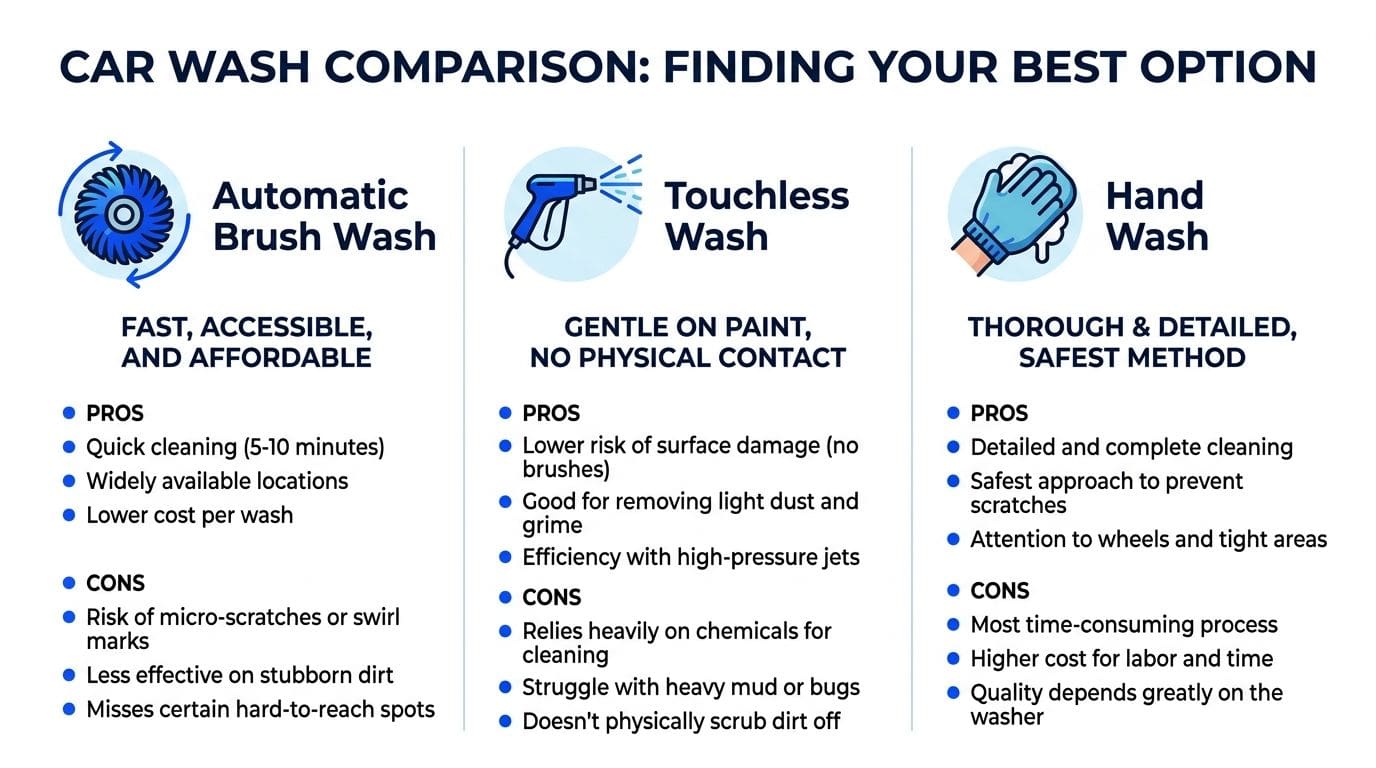
Brush washes are convenient. They’re fast, common, and they usually remove visible grime well enough for the average commuter. The trade-off is direct contact with the paint, and that contact is exactly where the risk lives.
Recent industry statistics state that over 50% of automated car wash facilities cause measurable paint damage within six months of regular use, and note that approximately 29,000 automatic car washes operate across America. The same source explains that contaminated soft cloths and spinning brushes drag embedded grit across paint and that these systems are effectively damaging finishes on every visit because abrasive dirt can’t be fully cleaned between cars. That summary comes from this industry discussion of automatic wash paint damage.
Brush systems are the least forgiving option for soft black paint, freshly corrected paint, and vehicles that owners care about long term. They can also be rough on professionally coated vehicles because the friction wears the surface protection down faster.
Touchless wash
Touchless sounds safer because nothing physically rubs the paint. That part is true. You avoid the brush-induced marring covered above. The hidden cost is chemistry.
Touchless automatic car washes, often perceived as safer, utilize high-pressure sprayers combined with harsh chemicals with pH levels up to 11.0, which accelerates oxidation and strips away modern protective waxes, leaving paint vulnerable to sun exposure, according to this analysis of touchless wash chemical risk.
For a neglected daily driver in winter, a touchless wash may be the better emergency compromise than a brush tunnel. But if your goal is maintaining gloss and preserving wax, sealant, or a coating, repeated exposure to high-pH detergents isn’t something I’d treat casually.
Many owners of coated cars make the wrong assumption. They think “no touching” means “safe for coatings.” It only means lower abrasion risk. It does not mean lower chemical risk.
If your car has protection on it, the wrong touchless wash can clean the surface while slowly removing the thing you paid to keep there.
Hand wash
A proper hand wash is still the method I’d put at the top for paint preservation. That doesn’t mean every hand wash is safe. Poor technique at home can scratch paint too. A dirty mitt, one bucket, dropped towels, or cheap brushes can create defects just as surely as bad tunnel equipment.
Done correctly, though, hand washing gives you control over contamination and pressure. You can pre-rinse. You can use a dedicated pH-neutral soap. You can swap wash media if it gets dirty. You can avoid pushing grit from rocker panels onto upper doors and hood paint.
A safe hand wash usually includes:
- A real pre-rinse: Knock loose dirt off before touching the surface.
- Quality wash media: A clean microfiber wash mitt is safer than brushes or old sponges.
- The two-bucket method: One bucket for soap, one for rinsing the mitt.
- Top-down washing: Clean the roof, glass, hood, and upper panels before lower dirty areas.
- Good drying tools: Use clean microfiber drying towels, not bathroom towels or air drying alone.
If you’re comparing Hilliard auto detailing services or deciding whether to wash at home, this is the definitive benchmark. The gold standard isn’t just “hand washed.” It’s hand washed correctly.
Car Wash Method Comparison
| Method | Paint Safety Risk | Effectiveness | Typical Cost |
|---|---|---|---|
| Automatic Brush Wash | High risk of physical marring and swirl marks | Usually removes visible dirt well | Low to moderate |
| Touchless Wash | Lower abrasion risk, higher chemical stripping risk | Fair for light to moderate grime | Low to moderate |
| Hand Wash | Lowest risk when done properly | Best overall control and finish quality | Moderate to higher |
How I'd choose in the real world
If a customer asks for the short version, I usually put it this way:
- Choose brush wash only if appearance preservation isn't a priority
- Choose touchless only as an occasional compromise
- Choose proper hand washing if you care about gloss, resale, or coating life
That's especially relevant for owners researching Columbus ceramic coating or ceramic coating near me. The coating helps washing become easier. It does not mean every wash is now coating-friendly.
How to Spot Car Wash Damage on Your Own Vehicle
You don't need a shop light or a full inspection bay to tell whether your wash routine is hurting the paint. You can do a useful check in a few minutes with sunlight or your phone flashlight.
Use the right lighting
The best lighting for inspection is direct sun, bright parking lot lighting at night, or a concentrated phone flashlight held at an angle. Flat overcast daylight hides defects. Sharp light reveals them.
Stand close to the panel and move your head slightly as the light hits the paint. Check the hood, trunk lid, upper door panels, and black trim first. Those areas tend to show damage fastest.
What swirl damage looks like
Swirl marks usually appear as fine circular or curved lines around a light source. They don't look random. They look patterned, almost like a web. That pattern is the clue that washing caused the issue, not a single branch scrape or one isolated accident.
Deeper scratches are different. They tend to be longer, straighter, and more isolated. Swirl damage is widespread and shallow. Random isolated deeper scratches stand apart from one another.
Look for patterns, not just scratches. Wash damage usually repeats across multiple panels.
If your car is black or a darker color, the defects will show more quickly. Silver and white can hide them for longer, but they're often still there.
Quick self-check list
Run through this list the next time the car is clean:
- Check the hood first: It gets a lot of light and usually tells the truth fastest.
- Inspect around lights: Swirls reveal themselves around overhead LEDs and sunlight reflections.
- Look at side panels from an angle: Straight-on views hide a lot.
- Feel the paint after washing: If it feels rough, contamination may still be sitting on the surface.
- Compare upper and lower panels: If lower doors look much duller, your wash media may be carrying road grit upward.
A few practical mistakes tend to create or worsen damage:
- Using the same towel everywhere: Wheels, lower panels, and paint should never share drying towels.
- Skipping the pre-rinse: Dry dust and grit need flushing before contact.
- Trusting “soft cloth” marketing: Soft material loaded with dirt still scratches.
- Ignoring trim and badges: These trap grime that can drag across paint while drying.
This quick inspection won't replace a professional evaluation, but it will tell you whether your current routine is helping or hurting.
The Ultimate Defense Protecting Your Paint Before a Wash
The best way to deal with wash damage is to reduce how vulnerable the paint is before the wash ever starts. That's where coatings and film become useful. They don't make a car invincible, but they give the finish a much better chance of staying cleaner, glossier, and easier to maintain.
What ceramic coating actually does
A professional ceramic coating adds a sacrificial layer over the factory clear coat. In practical terms, that means the surface usually stays slicker, releases dirt more easily, and handles routine washing better than bare paint.
That's why people searching for Hilliard ceramic coating or Columbus ceramic coating are usually after more than shine. They want easier maintenance and a better buffer between the paint and everyday contamination.
But coatings have a limit, making the touchless wash discussion particularly important. Most content conflates car washes broadly but fails to distinguish the specific chemical degradation risk of touchless automated washes on ceramic coatings: while touchless systems avoid physical swirl marks, their high-pH alkaline detergents actively shorten the lifespan of hydrophobic ceramic coatings by stripping the silica layer, as noted in this explanation of touchless wash effects on ceramic coatings.
That means a coating is not permission to run through any touchless system you find. The chemistry still matters. A coated vehicle benefits most from maintenance washes built around pH-neutral products and careful drying.
For owners comparing options, this overview of whether paint protection film is worth it is useful alongside coating research because coatings and film solve different problems.
Where paint protection film fits
PPF protects against a different kind of threat. Instead of focusing on water behavior and easier washing, Columbus PPF and Hilliard paint protection film are about physical abuse. Rock chips, abrasive contact, and road debris are where film earns its keep.
Film doesn't replace smart washing either. If you scrub contaminated surfaces with bad media, you can still mar the top layer. But film gives you more physical resilience on impact-prone areas like the front bumper, hood edge, mirrors, and rocker panels.
For many owners, the strongest setup is simple:
- Ceramic coating for easier maintenance and chemical resistance
- PPF for physical impact zones
- Correct hand washing to preserve both
That combination makes the car easier to live with. It does not remove the need for good habits.
Protection still needs the right wash habits
The cars that stay looking sharp the longest usually follow the same pattern. They're protected early, washed carefully, and inspected before defects pile up.
If you want a practical maintenance approach, keep it simple:
- Use pH-neutral soap: This matters more on coated vehicles than most owners realize.
- Wash in the shade when possible: Hot panels make soap and water behave badly.
- Keep separate tools: One set for paint, another for wheels and lower grime.
- Dry with fresh microfiber towels: Dirty drying towels undo good washing.
- Treat touchless washes as occasional, not automatic: Convenience should be the backup plan.
A ceramic coating from a shop such as Lionheart Auto Detailing & Protection can make regular maintenance easier and improve how contamination releases from the paint, but it still needs coating-safe washing if you want the protection to last as intended.
The Lionheart Approach to a Safe and Brilliant Shine
The simplest answer is still the right one. If you care about how your vehicle looks and what it will be worth later, your wash method matters. A lot.
What works in the real world
For most owners, the safest plan isn't complicated:
- Hand wash correctly whenever possible
- Use touchless only when convenience matters more than perfection
- Avoid brush tunnels if preserving the finish is a priority
- Protect the paint before damage starts
- Fix defects early before they become your new normal
That approach works whether you drive a daily commuter, a weekend car, or a newer vehicle you want to keep looking sharp in Hilliard and the greater Columbus area.
A clean car should still have crisp reflections, good gloss, and protection that behaves the way it should. If the car gets clean but the paint keeps getting duller, the wash process is costing you something.
Safe washing protects more than appearance. It helps preserve the finish you already paid for.
When professional correction makes sense
If your car already shows spider-web swirls, haze, or loss of clarity, a proper paint correction can often restore a surprising amount of gloss. That's especially true if the damage is mostly in the upper portion of the clear coat and hasn't progressed into more serious failure.
After correction, maintenance becomes the key. Good paint can be ruined again by bad habits just as quickly as it was improved by machine polishing.
If you're deciding whether long-term protection makes sense after correction, this guide on whether ceramic coating is worth it can help frame the next step.
If your vehicle has swirl marks, weak water behavior, or you're trying to choose the right protection for a newer car, Lionheart Detailing can help you sort out the practical options. Whether you're looking into ceramic coating, paint protection film, or full detailing in Hilliard and the Columbus area, reaching out for a professional assessment is a smart place to start.