You just picked up your vehicle after a fresh PPF install, and the paint looks exactly how you hoped it would. Glossy, clean, protected, and finally shielded from the little things that beat up a finish every day. Then the next question hits almost immediately. What do I wash this with, and how do I avoid messing it up?
The importance of that question is often underestimated. PPF is tough in the ways that count, but it still has a surface that can be dulled, scratched, stained, or stressed by the wrong cleaner and the wrong technique. The biggest mistakes usually don't come from abuse. They come from normal car-care habits people learned on unprotected paint, then carry over to film.
A good paint protection film cleaner isn't just about getting dirt off. It's about removing contamination without dragging grit, softening bugs without scrubbing, and keeping edges, clarity, and the film's top layer in good shape. That's especially important as more owners invest in film. The global paint protection film market is projected to reach USD 1,549.4 million by 2030, growing from USD 1,092.7 million in 2025. More installed film means more people need to know how to maintain it correctly.
Table of Contents
- Protecting Your Investment The Right Way
- Your Essential PPF Cleaning Toolkit
- The Professional Two-Bucket Wash Method for PPF
- Safely Removing Bugs Tar and Other Stains
- Drying Enhancing and Ceramic Coating Synergy
- Your PPF Maintenance Schedule and When to Call a Pro
Protecting Your Investment The Right Way
A lot of new PPF owners feel the same tension. They know the film is there to protect the paint, but they also worry that one bad wash could leave swirls or lift an edge. That concern is valid. Film gives you a sacrificial layer over the paint, but it still needs the right kind of care.

Why new PPF owners get nervous
The first wash after installation is where many people start second-guessing everything. They stand in the garage with whatever soap is already on the shelf, a sponge from an old wash kit, and a towel that's been through the laundry a hundred times. On regular paint, that setup was already less than ideal. On Hilliard paint protection film or Columbus PPF, it's where avoidable damage starts.
The reason is simple. PPF has a softer surface layer than many people expect. That top layer is designed to preserve appearance and help the film perform, but it can still show poor wash habits. Dry wiping dust, rubbing bug splatter, or blasting water directly into a film edge can all create problems that have nothing to do with the quality of the installation.
Practical rule: If a cleaning step adds friction before it removes contamination, it's the wrong step for PPF.
What proper cleaning actually protects
A proper paint protection film cleaner routine protects more than gloss. It helps preserve clarity, keeps the film from looking dull over time, and reduces the chance of edge stress from bad washing. It also protects your money. Film is an investment, and once you've made it, the maintenance side matters just as much as the install side.
That's why customers who are researching Hilliard auto detailing or comparing long-term care options often benefit from understanding the ownership trade-offs up front. If you want a balanced look at what film does well and where it requires commitment, this breakdown of paint protection film pros and cons is worth reading.
Here's the honest version of what works and what doesn't:
- What works: Gentle washing, film-safe chemistry, clean microfiber, and patience.
- What doesn't: Household cleaners, aggressive scrubbing, brush washes, and “it'll probably be fine” shortcuts.
- What matters most: Every step should reduce the chance of micro-scratching, edge lifting, or topcoat degradation.
If you keep that framework in mind, the rest gets much easier.
Your Essential PPF Cleaning Toolkit
It's common to overcomplicate products and underthink tools. For PPF, the opposite approach works better. Keep the product lineup simple, and get very picky about what touches the film.
Use this and skip that
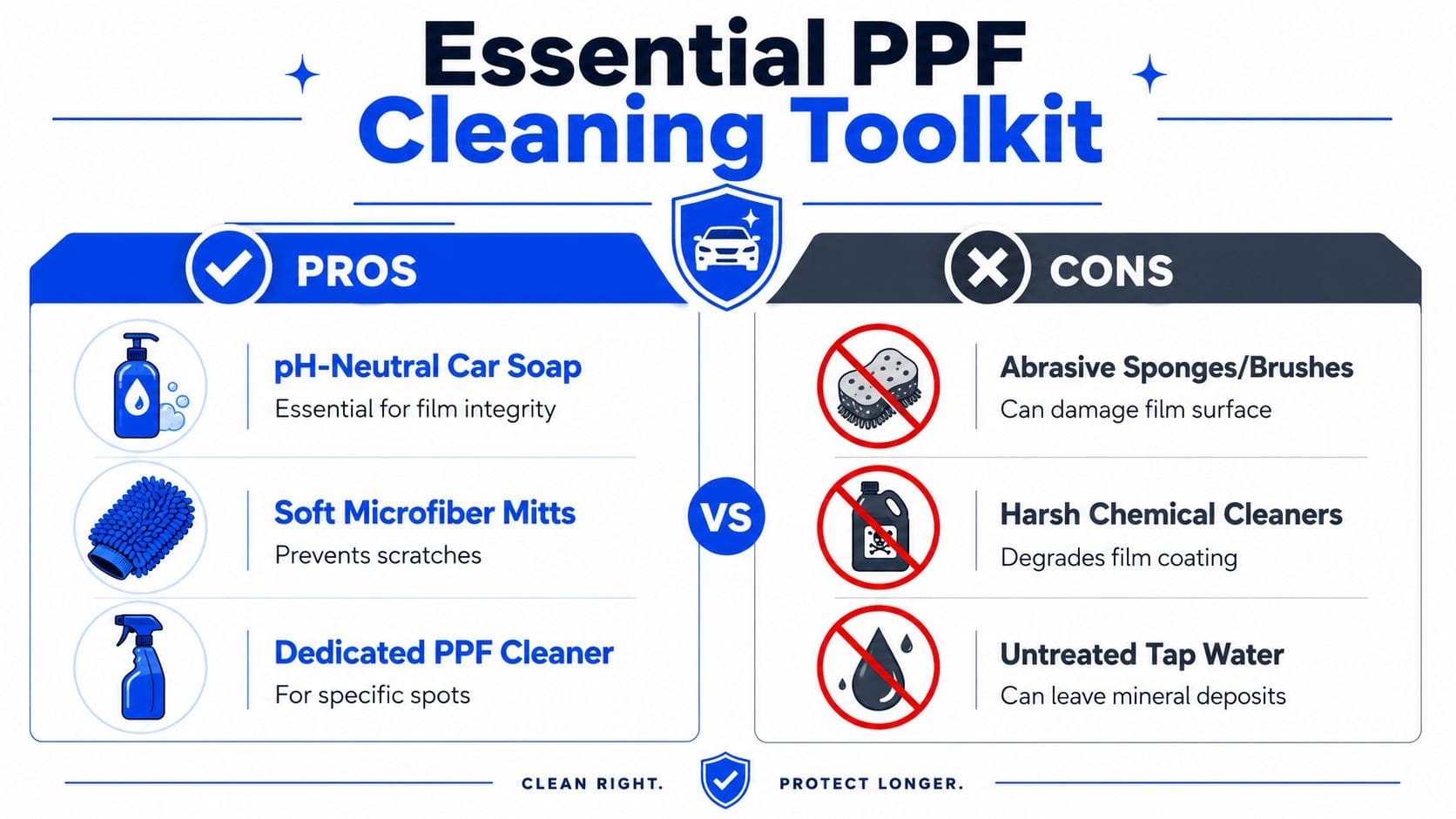
The baseline recommendation is clear. When washing paint protection film, always use a pH-neutral car soap with a soft microfiber or lambswool wash mitt, and the two-bucket wash method is explicitly recommended to prevent trapped grit from scratching the PPF surface.
That sentence packs in most of what matters.
pH-neutral means the soap is formulated to clean without being overly harsh in either direction. In practical terms, it helps you wash away dirt and road film without stripping or stressing the film's top surface the way stronger cleaners can. For a new PPF owner, that's the safest starting point.
Your core kit should include:
- Two wash buckets with grit guards: One holds your soap solution. The other is only for rinsing the mitt. Grit guards help keep debris at the bottom instead of back in your mitt.
- A soft microfiber or lambswool wash mitt: A mitt carries suds and glides better than a cheap sponge.
- Plush microfiber drying towels: For film, thicker and softer is better. Technical guidance recommends microfiber towels with 500 GSM or higher for drying, using a pat-dry approach instead of dragging the towel across the surface.
- A dedicated PPF-safe spot cleaner: Useful for bugs, bird droppings, fingerprints near edges, and fresh grime.
- Clean secondary microfiber towels: Separate from wheels, glass, or interior use. Cross-contamination ruins more finishes than bad soap does.
A lot of DIY owners searching for ceramic coating near me or Hilliard auto detailing already own plenty of towels and chemicals. That doesn't mean those products belong anywhere near film.
Why the right towel and soap matter
The word I'd focus on is lubricity. You don't need to speak like a chemist to understand it. Lubricity is what helps your mitt move across the film with less drag. Less drag means less chance of grinding dirt into the surface.
What to avoid is just as important:
| Tool or product | Why it causes problems on PPF |
|---|---|
| Rough sponges | They trap grit and hold it against the surface |
| Stiff brushes | They add concentrated friction and can mark the top layer |
| Harsh detergents | They can strip or stress the film surface |
| Solvent-heavy cleaners | They can interfere with hydrophobic behavior and topcoat health |
| Random old towels | They often contain embedded debris or hardened fibers |
A clean mitt with the right soap is safer than a “strong” cleaner with the wrong towel. Most PPF damage during washing comes from contact, not from dirt itself.
If you're the kind of owner who likes to handle some maintenance yourself, but wants a realistic view of what's manageable and what usually goes sideways, this guide on DIY paint protection film considerations gives helpful context.
One more practical point. Keep a dedicated set of wash media just for upper painted and filmed panels. Don't reuse anything that has touched wheels, exhaust residue, or lower rocker grime. A paint protection film cleaner can only do so much if the towel is the problem.
The Professional Two-Bucket Wash Method for PPF
This is the wash process that protects film because it removes contamination in stages. That's the whole idea. You don't ask your mitt to do the job your rinse should've already handled.
Start with a real pre-rinse
Before the mitt ever touches the vehicle, rinse it thoroughly. That step knocks off loose dust, sand, pollen, and road grit. If you skip this and go straight to hand contact, you're asking the wash mitt to drag contamination over the film.
Pressure washing is fine for PPF when you do it correctly. PPF can be pressure washed using a minimum 40-degree wide spray pattern nozzle held at least 12 inches away from the surface to prevent hydrodynamic pressure from lifting the film's edges. That distance matters. So does your angle.
Use common sense around edges, seams, badges, and wrapped corners. Spray across them, not directly into them.
Wash one panel at a time
Once the vehicle is pre-rinsed, work in small sections. A single door, half a hood, or one fender at a time is a good rhythm. That keeps soap from drying on the surface and lets you monitor what the mitt is picking up.
Here's the process:
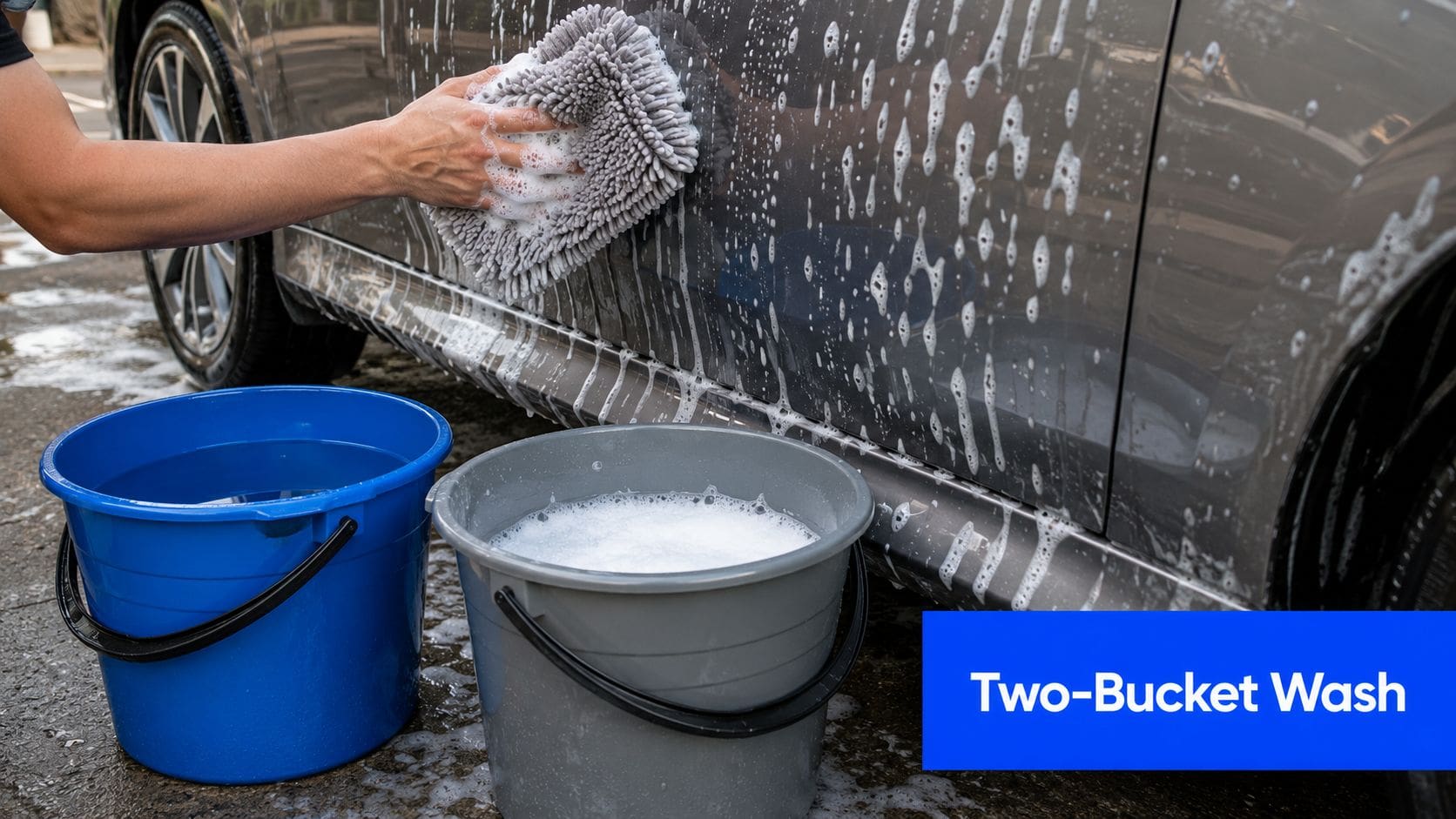
- Fill one bucket with pH-neutral soap and water.
- Fill the second bucket with clean rinse water.
- Dip your mitt in the soap bucket.
- Wash with straight-line motions, moving from top to bottom.
- Rinse the mitt thoroughly in the clean-water bucket before loading it with soap again.
- Repeat panel by panel.
Straight-line washing matters because circular scrubbing tends to create more visible swirl patterns when contamination gets trapped. Top-to-bottom also helps because the upper panels are usually cleaner than lower panels. You don't want rocker-panel grime ending up on a hood or door.
A few professional habits make this safer:
- Use light pressure: Let the soap and mitt do the work.
- Flip the mitt often: A fresh side lowers the chance of dragging collected grit.
- Save the dirtiest areas for last: Lower bumpers, behind wheels, and rocker panels carry the worst contamination.
- Watch your environment: Cleaning is safest in moderate conditions. Guidance for PPF care points to air temperatures between 60–80°F with no direct sunlight as the sweet spot for avoiding premature drying and streaking.
Wash technique matters more than wash speed. The faster approach often creates the slower correction job later.
Rinse and dry without creating new damage
After washing, do a complete rinse from top to bottom. Soap left behind isn't harmless. Residue can attract fresh dirt and leave the finish looking cloudy.
Then inspect before drying. Look at the leading edges of the hood, front bumper corners, mirror caps, and any high-impact areas. If something still looks stuck, don't grind on it with the towel. Handle it as spot contamination later.
For customers around Columbus ceramic coating and Hilliard ceramic coating services, this is usually the point where they realize why a “normal car wash” habit doesn't always translate well to film. PPF rewards controlled, repeatable technique. It punishes rushed contact.
Safely Removing Bugs Tar and Other Stains
The worst thing you can do with bug splatter, tar, or bird droppings is attack them dry. That instinct is understandable. You want the mess gone now. But scrubbing a stuck contaminant off film usually damages the area around the contaminant before the stain itself even lets go.
Stop scrubbing and let chemistry work
A proper paint protection film cleaner routine uses chemical action before mechanical action. That means the cleaner softens, loosens, or dissolves the contamination first. Your towel or mitt should only finish the job gently.
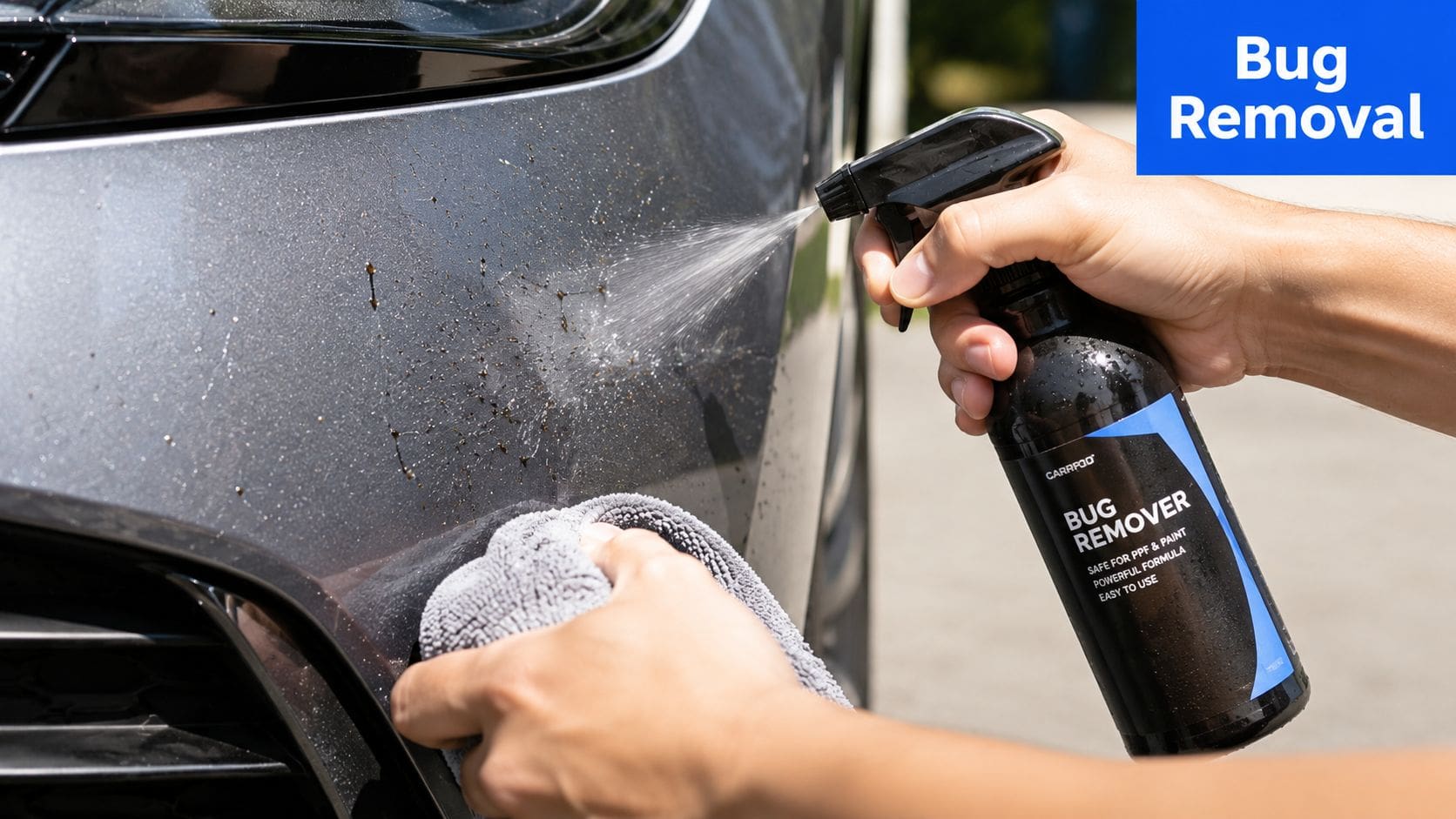
The often-missed pre-lube step is of utmost importance. A critical spot-cleaning step is the pre-lube protocol, where a dedicated PPF-safe cleaner or lubricant is sprayed before any physical contact to lift contaminants and prevent a towel from dragging grit across the film.
That one habit prevents a lot of the haze and light marring people assume is just “normal wear.”
Spot cleaning methods that are actually safe
For common contamination, use the mildest effective option first.
- Bug splatter and bird droppings: Spray a PPF-safe bug remover or a soap mixture onto the spot and let it dwell for 30–60 seconds. Then wipe gently with a soft microfiber.
- Tar or adhesive residue: Use a cloth lightly dampened with a 15–30% isopropyl alcohol solution. Dab instead of rubbing hard.
- Hard water spots: Use a 50:50 distilled white vinegar-to-water mixture on a towel, apply sparingly, and wipe gently.
- General fresh grime between washes: Mist the area first with a film-safe detail spray or cleaner before touching it.
A few trade-offs are worth knowing:
| Contaminant | Safer approach | Risky approach |
|---|---|---|
| Bugs | Dwell with bug remover or soap mix | Scraping with fingernails |
| Tar | Light IPA solution on towel | Strong solvent poured directly on film |
| Water spots | Vinegar and water on towel | Abrasive polish or aggressive rubbing |
| Dusty fingerprints | Lubricated wipe with microfiber | Dry wipe with a shop towel |
The more stubborn the contaminant is, the less you should rely on pressure from your hand.
There's also a product category to avoid. Petroleum-based degreasers and stronger solvents can interfere with the film surface if they sit too long. Even if they seem effective in the moment, they can create a duller, less healthy-looking surface over time.
If a stain doesn't respond after a couple of controlled attempts, stop. Repeating the same aggressive wipe usually doesn't improve the result. It just widens the damaged area.
Drying Enhancing and Ceramic Coating Synergy
A careful wash can still end badly during drying, when people reach for the nearest bath towel, wipe too hard, and put fresh marks into film they just cleaned correctly.
Why drying is where many good washes go wrong
PPF should be dried with soft, clean microfiber towels, and the safest motion is usually patting or blotting, not dragging. Technical guidance for film care calls for microfiber drying towels with 500 GSM or higher, specifically to reduce friction on the top layer.
That matters because drying is contact on a mostly clean but not perfectly sterile surface. If there's one missed speck left behind, dragging a towel across a large panel can still create faint marks. Blotting lowers that risk.
A practical drying order looks like this:
- Start with mirrors, trim edges, and emblems: These areas drip later.
- Blot broad flat panels: Hood, roof, trunk, and doors.
- Use a blower for crevices if you have one: A cordless leaf blower or dedicated dryer is excellent for touch-free water removal.
- Keep towels fresh: Once a towel gets saturated or picks up debris, swap it out.
One thing I tell new owners is that drying towels should feel boringly clean. If a towel has ever fallen on the garage floor, touched a dirty lower panel, or been washed with lint-heavy household items, it shouldn't touch film.
How sealants and ceramic coating help PPF
Once the film is clean and dry, you can add a maintenance layer on top. That might be a PPF-safe detail spray or sealant designed to improve slickness and make routine cleaning easier. It won't make bad washing safe, but it can reduce how much grime sticks and help your towel glide more smoothly.
For owners considering longer-term protection, ceramic coating over PPF can make a real difference in upkeep. Film care guidance notes that applying a ceramic coating over installed PPF is an advanced way to extend hydrophobic behavior and reduce washing frequency, though compatibility matters and professional application is the safer route.
That's why a lot of owners looking for Columbus PPF also end up researching Columbus ceramic coating or Hilliard ceramic coating. The two systems can complement each other well when they're chosen correctly. The film absorbs impact and abrasion. The coating helps with water behavior, washing ease, and day-to-day cleanup.
If you already have coated film or you're comparing maintenance expectations, this article on how to wash a ceramic coated car helps clarify where the routines overlap and where they differ.
What ceramic coating won't do is make neglect harmless. You still need proper wash media, proper chemistry, and proper spot-cleaning habits. It makes maintenance easier. It doesn't excuse poor technique.
Your PPF Maintenance Schedule and When to Call a Pro
Consistency beats intensity with film care. You don't need a complicated routine. You need a routine you'll stick to.
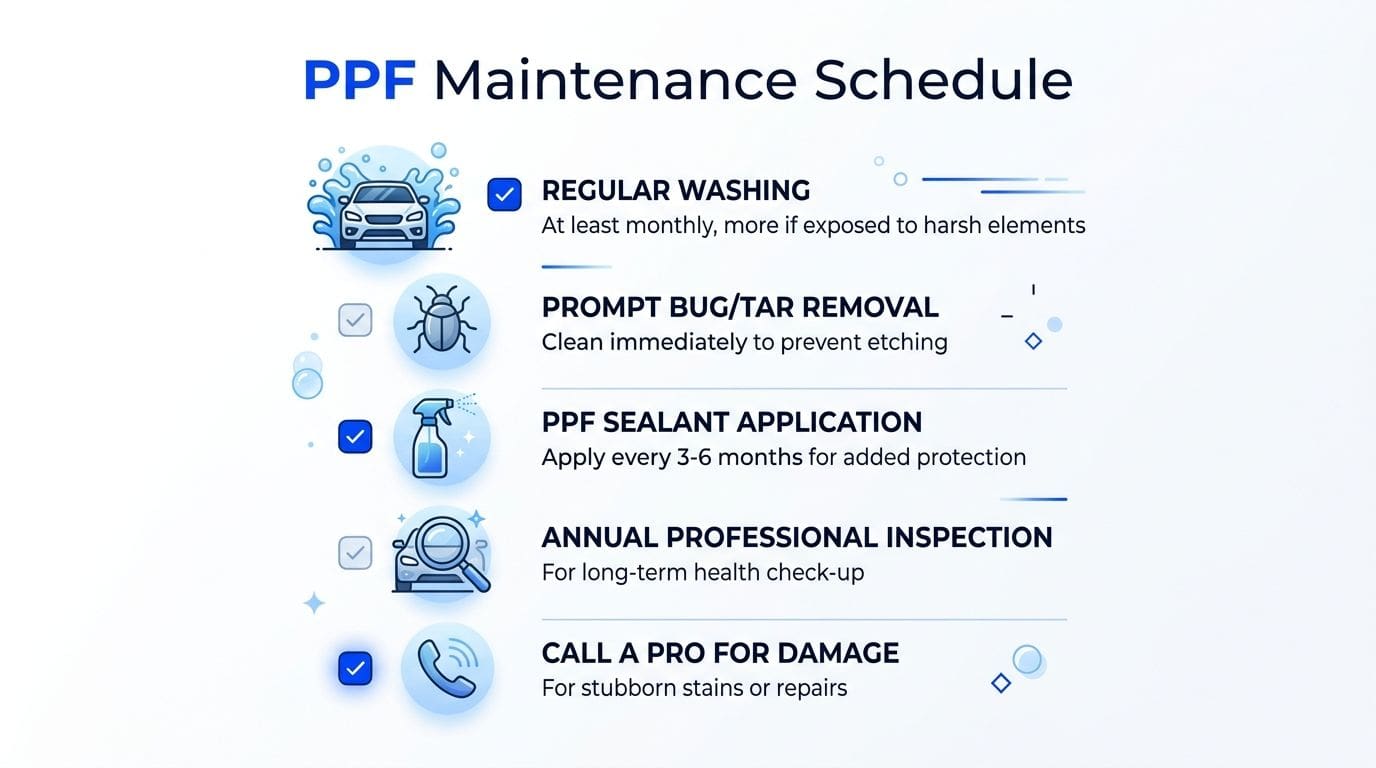
A realistic routine for Ohio driving
That's a solid baseline. In Ohio, some vehicles need more attention than others. A garaged weekend car and a daily-driven SUV running through winter slush live very different lives.
A practical maintenance rhythm looks like this:
- Monthly full wash: Minimum standard for most vehicles.
- More often in winter or bug season: Salt, bug residue, and baked-on road film get harder to remove if you let them sit.
- Quick spot cleanup as needed: Especially for bugs, bird droppings, and fresh tar.
- Visual checks after washing: Look at edges, high-impact panels, and any area that seems dull or different.
Signs it is time for professional help
DIY care is fine for routine cleaning. It stops being the smart move when you see signs that point to film damage instead of surface dirt.
Call a pro if you notice:
- Edge lifting: Don't press it down and hope for the best.
- Persistent staining or hazing: Especially after safe cleaning attempts.
- Scratches that don't improve: If the mark remains visible after normal heat exposure and time.
- Discoloration or unusual texture: That can point to chemical damage or contamination.
- Questions about product safety: If you aren't sure a cleaner belongs on PPF, stop before testing it.
For people searching Hilliard auto detailing, Hilliard paint protection film, or ceramic coating near me, the best long-term results usually come from a mix of owner maintenance and occasional professional inspection. That's not about upselling. It's about catching small issues before they become replacement issues.
A clean, healthy film should still look clear, stay slicker than bare paint, and clean up without a fight. When it stops doing those things, the answer usually isn't to scrub harder.
If you want help keeping your film, coating, or paint looking right, reach out to Lionheart Detailing. Whether you need professional washing advice, Hilliard ceramic coating, Columbus PPF care, or full correction and protection services, the team can help you protect your investment without guesswork.