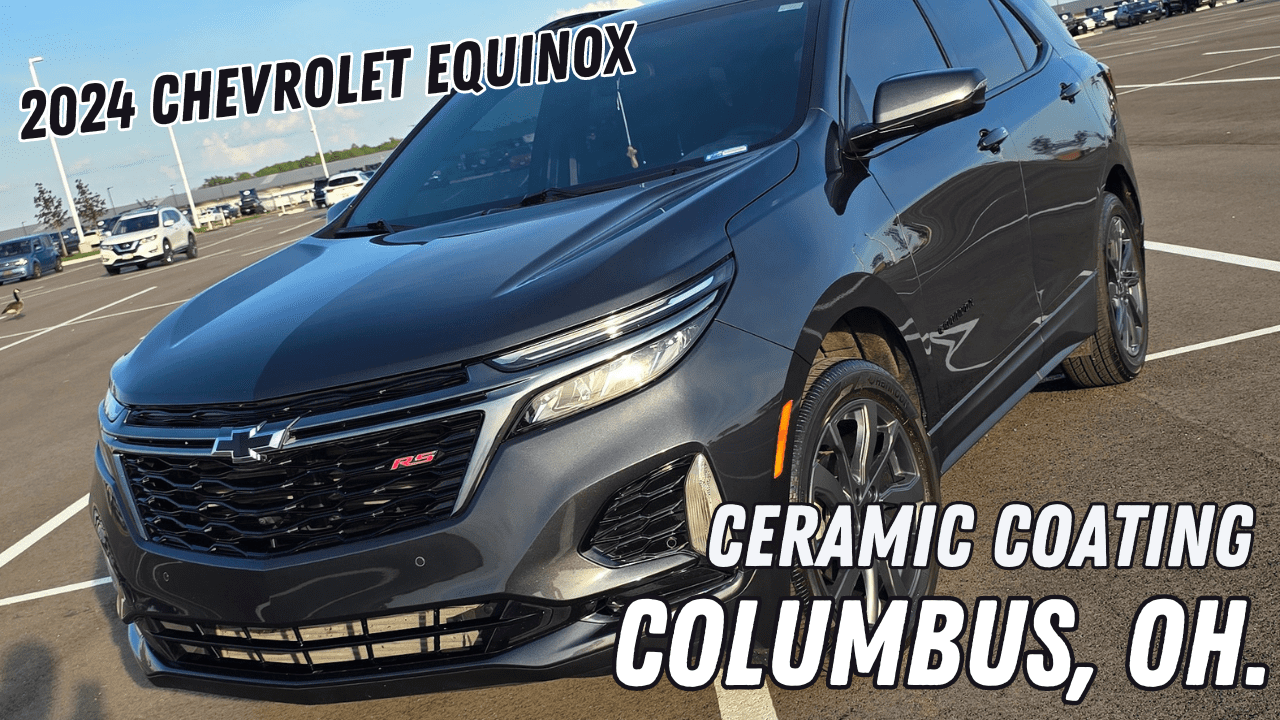
You've just finished a summer commute across Columbus, and the steering wheel is too hot to touch. The cabin feels bright, the glass creates glare, and the darker tint on a friend's SUV looks tempting. Then you start comparing window tint packages Columbus Ohio and run into VLT, ceramic film, infrared rejection, factory glass, and Ohio's legal limits.
The right package isn't automatically the darkest one. A well-selected film should match your vehicle, driving habits, privacy goals, nighttime visibility, and the performance you want. This guide focuses on the measurements and installation details that matter after the car leaves the shop.
Table of Contents
- Why Columbus Drivers Care About the Right Tint Package
- Understanding Ohio Window Tint Laws and Legal Packages
- How Tint Film Types Affect Heat Control
- What Professional Window Tint Installation Includes
- Choosing a Tint Package by Vehicle Type and Use Case
- DIY Tint vs Professional Installation Tradeoffs
- Next Steps for Columbus Tint and Protection Services
Why Columbus Drivers Care About the Right Tint Package
A Columbus driver can experience several different problems during one ordinary day. A morning trip through Hilliard may bring low-angle glare, an afternoon drive on I-270 can leave the cabin uncomfortable, and a late return through Dublin or Upper Arlington makes nighttime clarity important. Tint affects each of those situations differently.
Darkness changes appearance and privacy, but it doesn't tell you how much heat the film rejects. Visible Light Transmission, or VLT, describes how much visible light passes through the glass and film together. Heat control depends on additional film properties, especially infrared performance and solar energy management.
Clinical research helps explain why tint can affect more than styling. One evaluation found UVA transmission through tint films ranging from 0.1% to 7.1%, and measured infrared heat reductions of about 6 to 12°C with a heat lamp and 5 to 10°C in sunlight. Those findings are reported in the published evaluation available through PubMed's clinical research record.
The practical tradeoff
A darker dyed film may give you the appearance you want, but a lighter ceramic film can provide stronger heat control while preserving more usable visibility. That distinction matters for someone who drives before sunrise, carries children, or regularly enters parking garages and shaded streets.
Think of tint as one part of a broader vehicle-care plan. Window film manages solar load and glare inside the cabin. Ceramic coating helps protect exterior surfaces and simplify washing, while PPF addresses impact and abrasion on vulnerable painted areas. If you're comparing those services, review our ceramic coating packages in Columbus and paint protection film options separately rather than treating them as interchangeable upgrades.
Practical rule: Choose tint by the comfort and visibility problems you want to solve, then use darkness as one part of the decision.
Understanding Ohio Window Tint Laws and Legal Packages
Ohio compliance depends on the finished glass assembly, not merely the label on the film roll. Factory privacy glass, existing aftermarket film, and the new film all contribute to the final visible light transmission. A film advertised at a particular VLT can produce a different result on two vehicles because their original glass isn't identical.
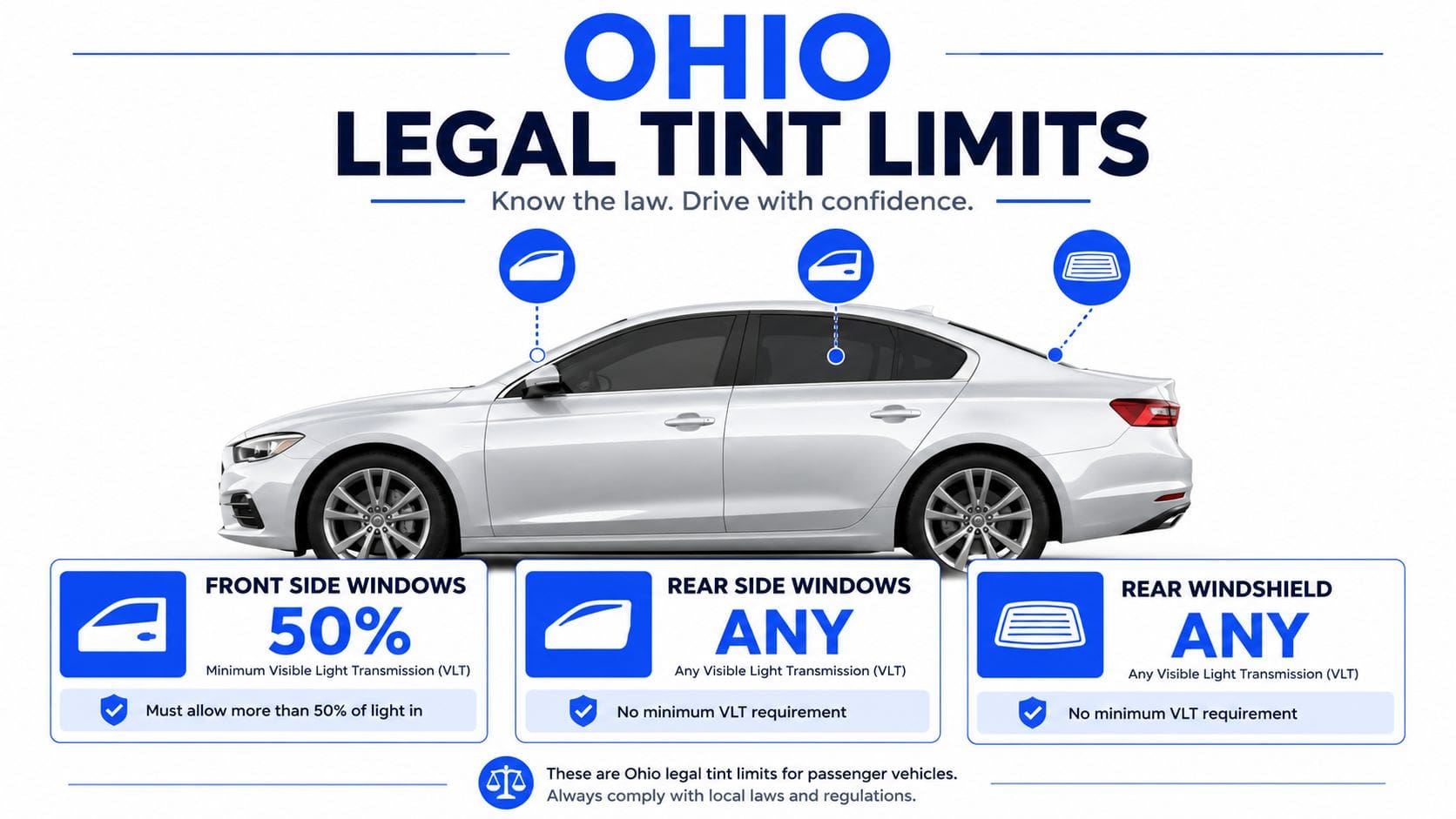
Ohio's driver- and passenger-side front windows must allow at least 50% of visible light through. Ohio Administrative Code Rule 4501-41-03 also identifies a windshield minimum of 70% light transmittance, plus or minus 3%, and a minimum of 50% light transmittance, plus or minus 3%, for the driver's immediate left and right side windows. The rule also prohibits red or yellow tint in those locations. You can review the wording in the Ohio Administrative Code tint rule.
The windshield has a separate restriction. Ohio permits a non-reflective top strip above the AS-1 line or the top 5 inches, whichever is closer to the top. The windshield's general minimum is 70% light transmittance, and Ohio code defines transmittance as the percentage of total light allowed to pass through the material. That means a full windshield tint package isn't the same thing as a legal brow.
How to buy a compliant package
Before approving a quote, ask the installer to inspect the existing glass and verify the combined VLT after installation. A product specification sheet is useful, but it isn't a substitute for measuring the vehicle. This is particularly important on newer vehicles with factory-tinted glass.
Rear glass has more flexibility than front glass. Independent legal summaries state that rear side and rear windows may be any darkness on SUVs, vans, and trucks, while the windshield and front-side restrictions still apply. If the rear window is tinted below 50% transmissivity, the vehicle must have outside rear-view mirrors on both sides, as outlined in this Ohio rear-window tint summary.
For a plain-language explanation of how the rules affect package selection, see Ohio window tint laws and legal limits explained simply.
How Tint Film Types Affect Heat Control
Film type affects cabin comfort, glare, appearance, and long-term durability, not just shade. Dyed, hybrid, and ceramic products can look similar from outside, yet their heat performance and signal compatibility may differ considerably.
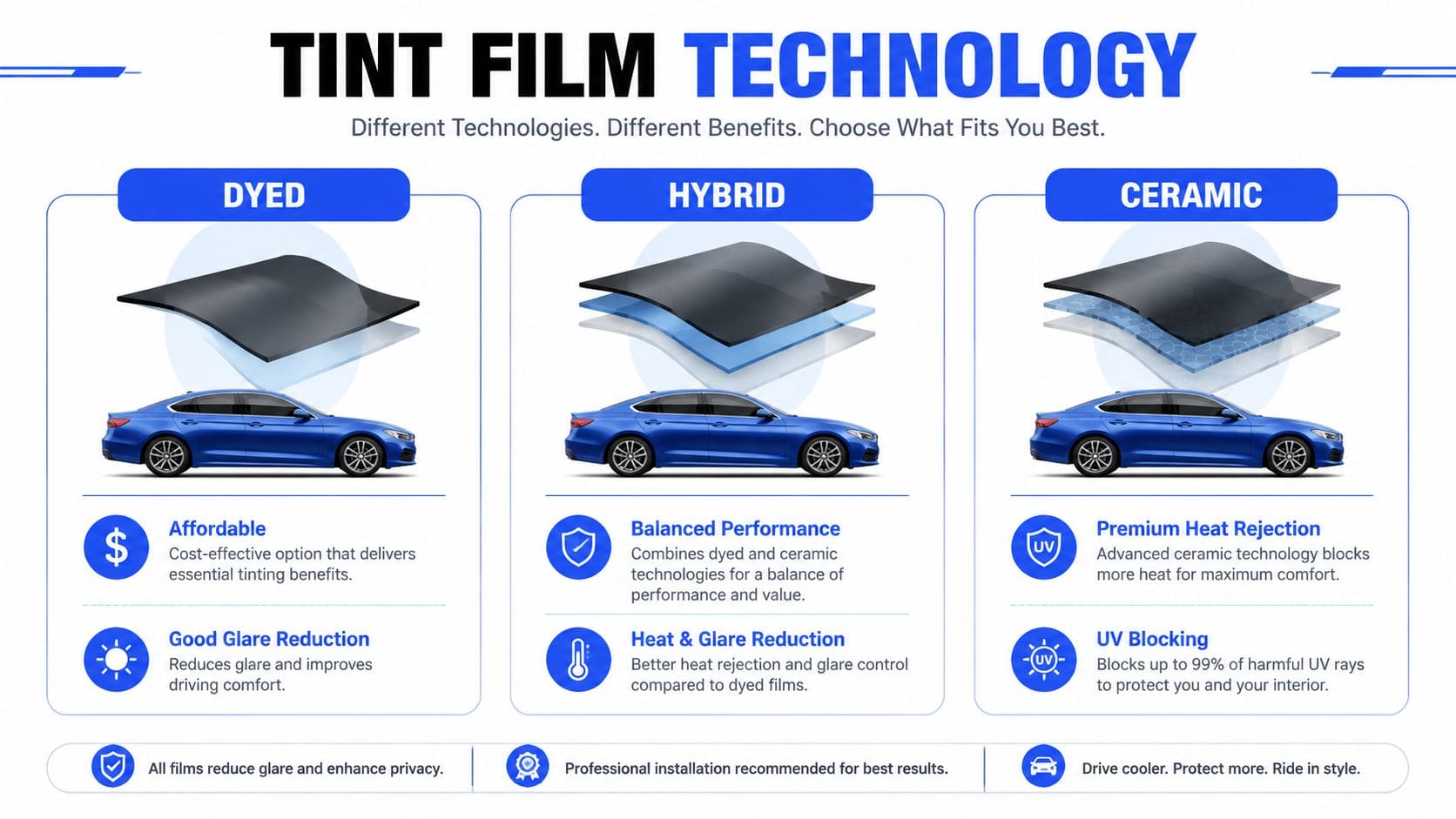
Dyed film is commonly selected for privacy, appearance, and glare reduction. It can create a darker look, but drivers focused on heat control should review its performance documentation before choosing it. Lower-quality dyed film may also be more likely to fade or change color over time.
Hybrid film combines dyed and metalized construction. It can provide a middle ground for appearance, glare reduction, and heat performance. Ask whether the product is compatible with radio, phone, GPS, and toll signals, then review measured heat-rejection information rather than assuming all hybrid films perform alike.
Ceramic film uses nonmetallic ceramic particles to manage infrared energy without depending on a dark appearance. High-performance ceramic packages are designed to reject roughly 90% to 96% of near-infrared radiation in the 900 to 1700 nm band, according to this ceramic automotive tint guide. In Columbus, that can support a lighter legal package while reducing the hot-seat effect during summer commuting.
Heat and ultraviolet protection are different measures
UV rejection and infrared rejection cover different parts of the solar spectrum. High-quality automotive films commonly reach about 99% UV rejection, while infrared performance may range from limited heat blocking to more than 90% infrared rejection, depending on the product. This comparison of infrared and UV rejection explains the distinction.
A darkness percentage cannot describe the full package. Request the film's VLT, UV and infrared performance, optical clarity, warranty terms, and signal compatibility. A dark film with weak infrared control may feel hotter than a lighter ceramic film with stronger solar performance.
Night visibility deserves the same attention. On a Columbus side street, driveway, or unlit parking lot, clean optical quality and a sensible VLT can matter more than maximum darkness. Use the guide to the best window tint for heat rejection in Columbus summers when comparing packages for daily driving.
What Professional Window Tint Installation Includes
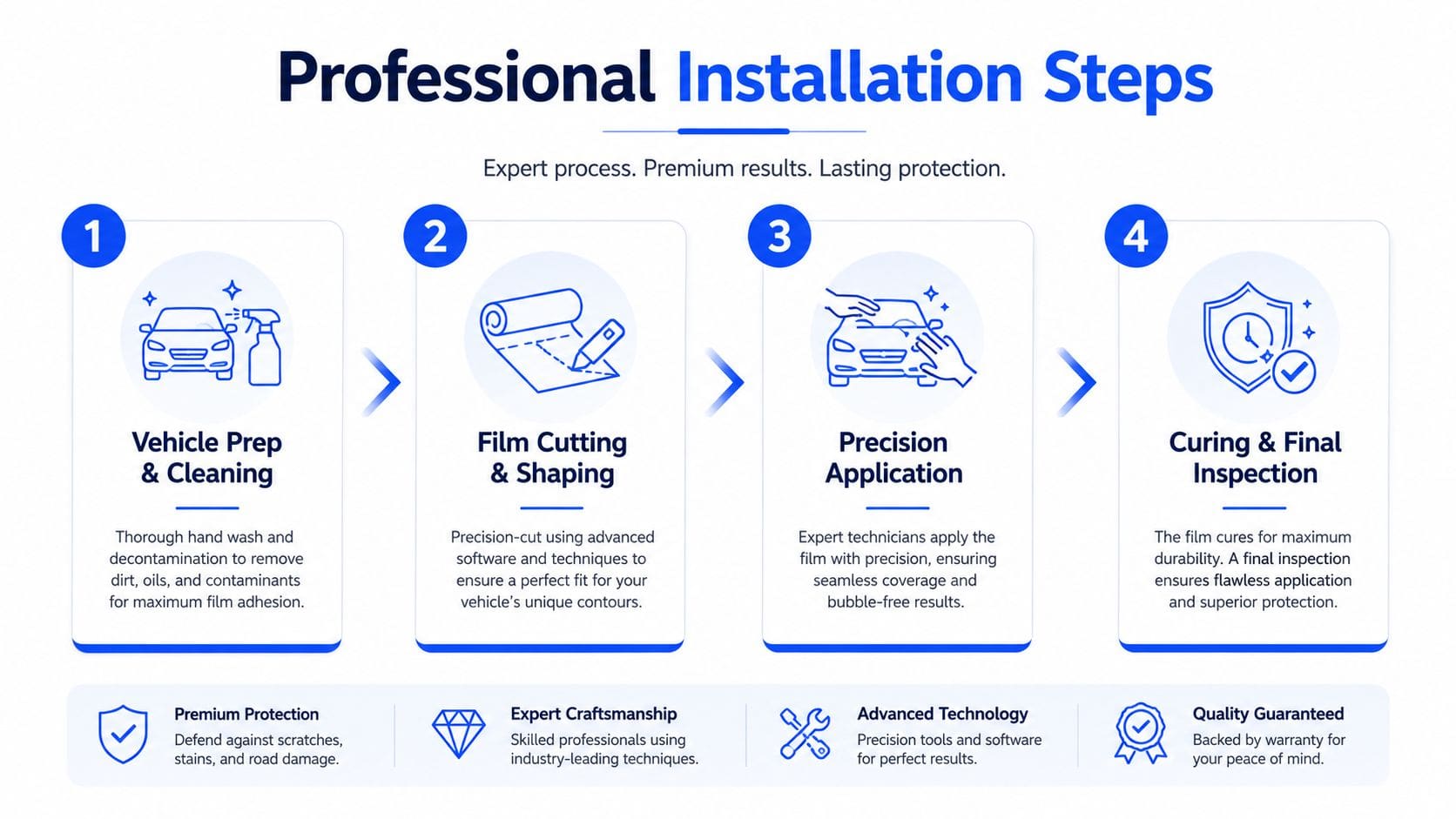
A professional package should cover more than film and a quick application. The installer needs to understand the vehicle's factory glass, the selected VLT, the window shape, and the customer's expectations for appearance and performance.
The installation sequence
Vehicle inspection comes first. The installer should look for existing film, scratches, contamination, damaged seals, and factory privacy glass. This is also the point to discuss front-window legality and whether old tint requires removal.
Glass preparation determines adhesion. Thorough cleaning removes dust, oils, adhesive residue, and particles around the edges. Even a tiny contaminant can create a visible speck or interfere with the film's bond.
Film cutting and shaping require accuracy. Each window needs a pattern or carefully measured cut, followed by shaping for curved glass. Rear windows and tight edges expose poor workmanship quickly.
Application and trimming should be controlled. The installer uses solution and professional squeegees to position the film, evacuate moisture, and set the edges. Clean trimming helps prevent lifting, while careful pressure reduces distortion and trapped debris.
Curing and inspection
Fresh film can show temporary moisture, a slightly hazy appearance, or small water pockets while it cures. The exact curing experience depends on the film, weather, glass, and installation environment, so the shop should provide specific care instructions rather than promising an immediate final appearance.
Keep the windows closed for the period the installer recommends, avoid touching the film edges, and don't judge the finished look before the shop's inspection checkpoint. A reliable installer should explain what normal curing looks like, identify anything that isn't normal, and tell you how warranty concerns are handled.
Before accepting the vehicle, inspect the edges, rear defroster area, visibility through the glass, and consistency from inside and outside. Ask whether the package includes removal of old film, VLT verification, and post-installation follow-up. Those details help you compare quotes by workmanship instead of price alone.
Choosing a Tint Package by Vehicle Type and Use Case
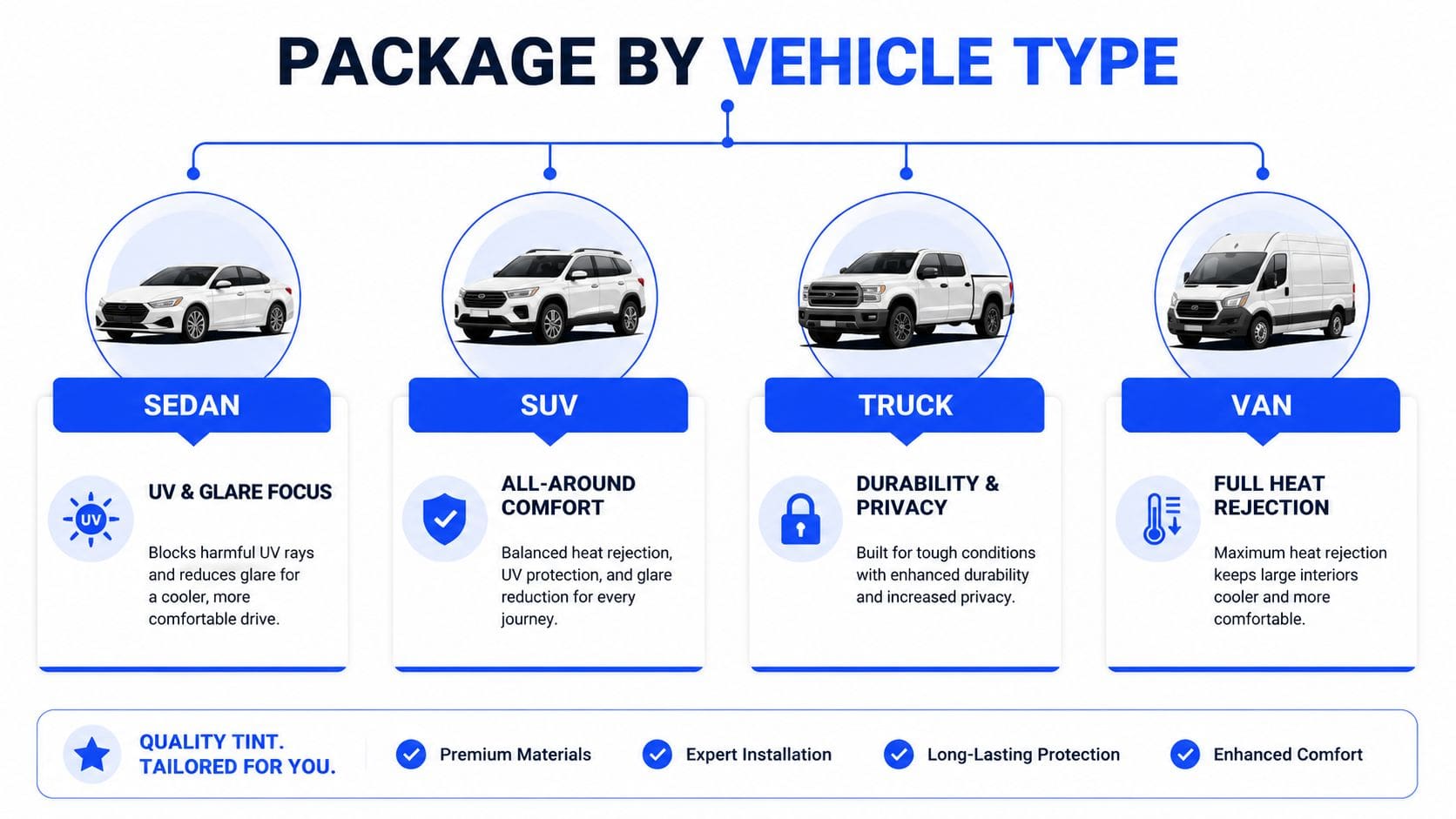
Vehicle class changes the package conversation because the glass layout and factory tint aren't the same. A sedan, SUV, truck, and van may all need a legal front-side solution, but their rear privacy, cargo, passenger, and heat-control priorities can differ substantially.
Sedans
Sedan buyers often want a consistent appearance without sacrificing nighttime visibility. Since the front side windows have to meet Ohio's combined VLT requirement, the installer should measure those windows first and then select the rear shade around the front result.
For a commuter, a ceramic front-side package focused on glare and infrared control may make more sense than choosing the darkest available film. A lighter rear match can preserve a balanced appearance, while a darker rear configuration may prioritize privacy if the vehicle and mirror setup support it.
SUVs and vans
SUVs and vans commonly have factory privacy glass in the rear. Adding another dark film without measuring the base glass can create an uneven appearance or an unexpectedly low final VLT. The rear windows have more legal flexibility, but the front side windows still need separate attention.
Families may value reduced glare and cabin comfort more than maximum darkness. A ceramic package across the usable glass can help create a more consistent experience for passengers without forcing the front windows into a questionable shade.
Trucks
Pickup owners often have different priorities for the cab, rear glass, and side windows. A truck used for job sites may need durable privacy and glare control, while a personal-use truck may be part of a larger Hilliard paint protection film or ceramic coating plan.
For a rear window tinted below 50% transmissivity, outside rear-view mirrors on both sides are required under the cited Ohio guidance. That detail matters when configuring a dark rear package, especially on trucks with limited rear visibility.
A darker rear window doesn't make an SUV package automatically suitable for a sedan. The glass, vehicle class, and final measured VLT all matter.
Luxury vehicles and Teslas deserve extra care because owners typically expect clean optical quality and a uniform appearance. The right package should complement the vehicle's interior and exterior rather than create a mismatched contrast between factory glass and aftermarket film.
DIY Tint vs Professional Installation Tradeoffs
DIY tint can appeal to an experienced hobbyist who already understands film handling, pattern cutting, heat shaping, and contamination control. It can be a reasonable project for someone prepared to accept a learning curve and redo work that doesn't meet expectations.
For most first-time buyers, professional installation offers a more predictable result. Automotive glass has curves, tight edges, moving seals, and varying factory tint. Dust, fingerprints, stretched film, poor trimming, and trapped solution can create bubbles, distortion, or edge lift that only becomes obvious after the car is back on the road.
What to compare before choosing
| Consideration | DIY installation | Professional installation |
|---|---|---|
| Glass preparation | Depends on your workspace and process | Controlled cleaning and preparation |
| Pattern accuracy | Requires careful measuring or cutting | Uses vehicle-specific measuring and shaping |
| Compliance | You must arrange your own VLT check | The installer can assess combined glass and film |
| Defects | Rework comes out of your time | The shop handles inspection and correction |
| Support | Product instructions are your main resource | You can receive care and warranty guidance |
A clean workspace matters as much as the film itself. A garage with airborne dust, poor lighting, or limited room makes it harder to see contamination before the film sets. Professional shops also have the tools and experience to handle curved rear glass without creating excessive distortion.
Where DIY commonly falls short
The false saving usually appears after the installation, when a customer has to remove bubbling film, correct a crooked edge, or replace a package that creates poor visibility. It can also be difficult to confirm whether the final front windows satisfy Ohio's combined VLT rule without the right meter and a proper measurement process.
If you're comparing an installer, ask to see finished edges and clarify the shop's cleaning standards, curing instructions, inspection process, and warranty procedure. A professional package should include communication about what the film can do, what it can't do, and how to care for it after installation.
Tint can also be coordinated with paint correction, ceramic coating, or PPF, but those services protect different surfaces. Don't let a bundled quote hide the film type or the exact work included.
Next Steps for Columbus Tint and Protection Services
Start with your use case, not a shade number. Tell the installer whether you commute during bright afternoon hours, drive rural roads at night, transport children, need additional privacy, or want the vehicle to look consistent with factory glass. Those details help determine whether a basic appearance-focused film, a hybrid option, or a ceramic package makes practical sense.
Then request the information that allows a fair comparison:
- Final VLT: Ask how the installer will evaluate the factory glass plus applied film together.
- Heat performance: Request infrared rejection information, not just a darkness percentage.
- UV performance: Confirm the film's UV-blocking specification and whether it applies to the selected product.
- Optical quality: Examine the film from inside the vehicle, especially around mirrors and rear glass.
- Installation scope: Clarify removal, preparation, trimming, curing instructions, inspection, and warranty support.
- Vehicle fit: Make sure the package accounts for your sedan, SUV, truck, van, Tesla, BMW, or other specialty platform.
The best package isn't necessarily the most expensive package. It's the one that delivers the comfort, glare control, privacy, and visibility you need while remaining compatible with Ohio's rules. For owners considering a combined upgrade, this ceramic coating and window tint package guide can help you evaluate whether pairing interior comfort with exterior protection fits your priorities.
Lionheart Detailing offers professional window tinting alongside ceramic coating, PPF, paint correction, and interior detailing for drivers in Columbus and nearby communities including Hilliard, Dublin, Powell, Upper Arlington, and Westerville. The company provides service through its Hilliard shop and mobile detailing model, so customers can discuss a tint package alongside broader vehicle-care needs.
Contact Lionheart Detailing to compare legal window tint packages for your vehicle, including ceramic options focused on heat and UV performance. Their Columbus-area team can also help coordinate professional detailing, ceramic coating, and paint protection film when you want a complete protection plan.