A standard full boat detail usually runs $10 to $25 per foot, while a basic maintenance wash is typically $7 to $10 per foot. On a 25-foot boat, that puts a full detail around $250 to $625 and a basic exterior wash around $175 to $250.
That baseline helps, but it's not the whole story. Most boat owners in Columbus find that out the first time they pull a boat out of storage, wipe a hand across the hull, and realize the surface feels chalky, the seats have picked up grime, and the waterline didn't magically clean itself over winter.
Boat detailing works a lot like paint correction on a car, except the stakes are different. Marine gel coat is tougher in some ways, but it also oxidizes differently, stains differently, and punishes neglect faster. A quick wash can make a boat look better for a day. A proper detail restores gloss, protects the surface, and keeps small problems from turning into expensive restoration work.
If you're searching for boat detailing cost in Columbus, or even broader terms like ceramic coating near me, Hilliard auto detailing, or Columbus ceramic coating, the biggest mistake is assuming every boat gets the same pricing logic. It doesn't. Length matters, but condition matters more than most owners expect.
Table of Contents
- Your Guide to Boat Detailing Costs This Season
- The Price Per Foot Breakdown for Boat Detailing
- What Really Drives Your Final Detailing Bill
- Understanding Advanced Services and Their Value
- How to Save Money on Boat Detailing Without Cutting Corners
- Get a Clear Quote for Your Boat in Columbus
Your Guide to Boat Detailing Costs This Season
The most common spring scenario is simple. You uncover the boat, hook up the trailer, and tell yourself it just needs a rinse. Then the sun hits the hull, and suddenly you're looking at oxidation, streaking, dull trim, dusty compartments, and upholstery that needs more than a wipe-down.
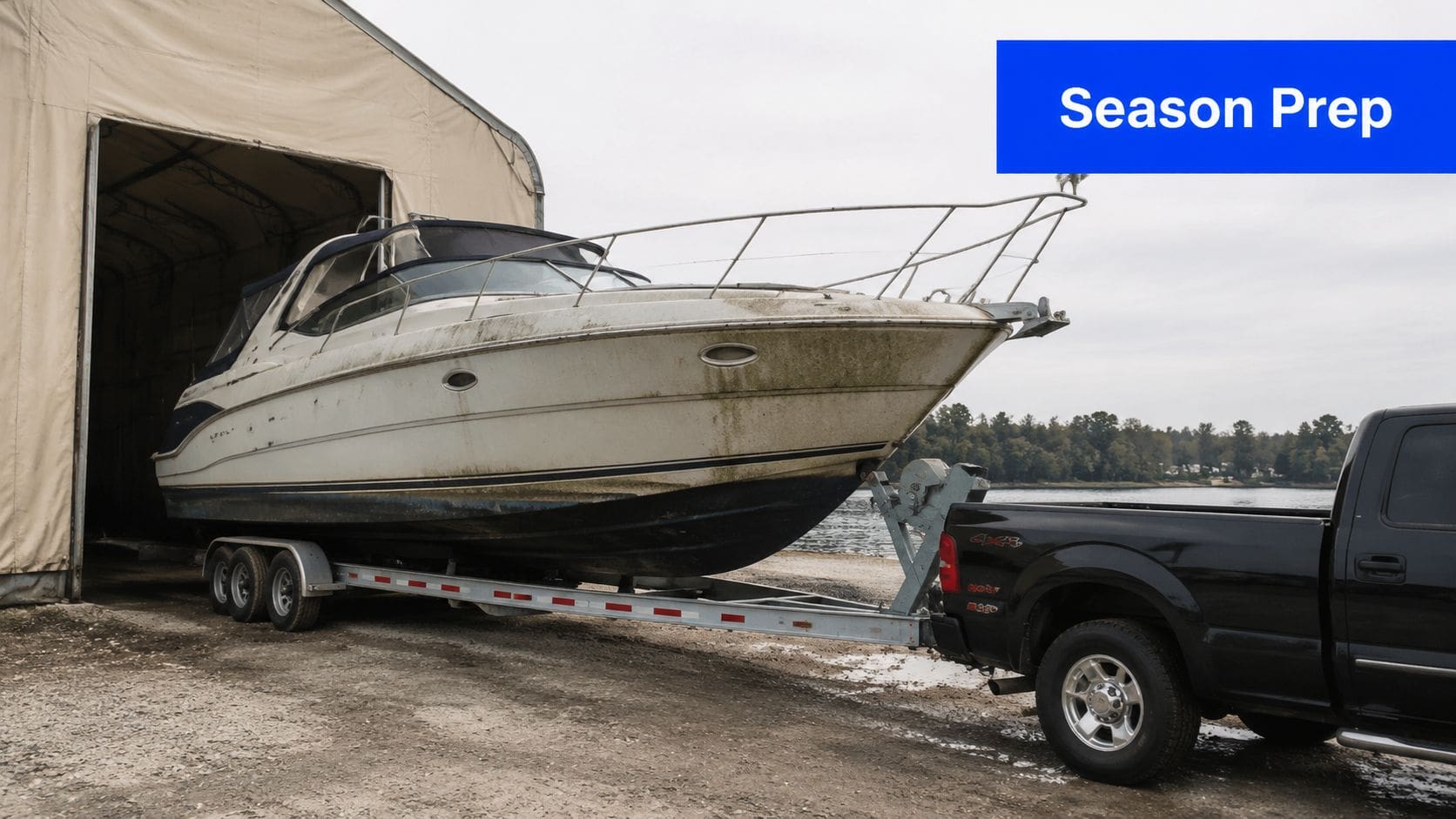
That's where most confusion around boat detailing cost starts. Owners expect one neat flat number. In real shop work, pricing usually starts with boat length, then moves quickly into labor, oxidation level, interior condition, access, and how much correction the gel coat needs before protection can even go on.
A good baseline is still useful. Across the U.S., a standard full detail that includes interior cleaning, compound, polish, and wax typically falls between $10 and $25 per foot, while a basic exterior maintenance wash lands at $7 to $10 per foot, according to this breakdown of average boat detailing pricing. If your boat is around average recreational size, that gives you a starting point before anybody touches a polisher.
What most new boat owners get wrong
A lot of people compare boats to cars and assume the detail is mostly about shine. On a car, that's often close enough. On a boat, gloss is only part of the job.
Marine surfaces deal with oxidation, waterline staining, mildew, non-skid texture, vinyl exposure, metal spotting, and storage grime. A clean-looking boat from ten feet away can still need real correction work up close.
Practical rule: If the hull feels chalky, looks hazy in direct sun, or leaves residue on your hand, you're no longer shopping for a simple wash.
That's why estimates can vary so much between two boats that are the same length. One gets regular upkeep. The other sat through storage and weather with old oxidation already building. Same length. Completely different amount of labor.
If you want to see what a professional marine service scope can look like, this boat detailing service page gives a solid reference point for the kinds of cleaning, correction, and protection boat owners typically ask for around Columbus.
The Price Per Foot Breakdown for Boat Detailing
A 24-foot boat that gets cleaned a few times a season and protected on schedule usually prices like a maintenance job. The same 24-footer, left through storage with oxidation starting on the hull and mildew settling into the vinyl, can move into correction work fast. Length matters. Neglect changes what that length costs.
Why detailers price by the foot
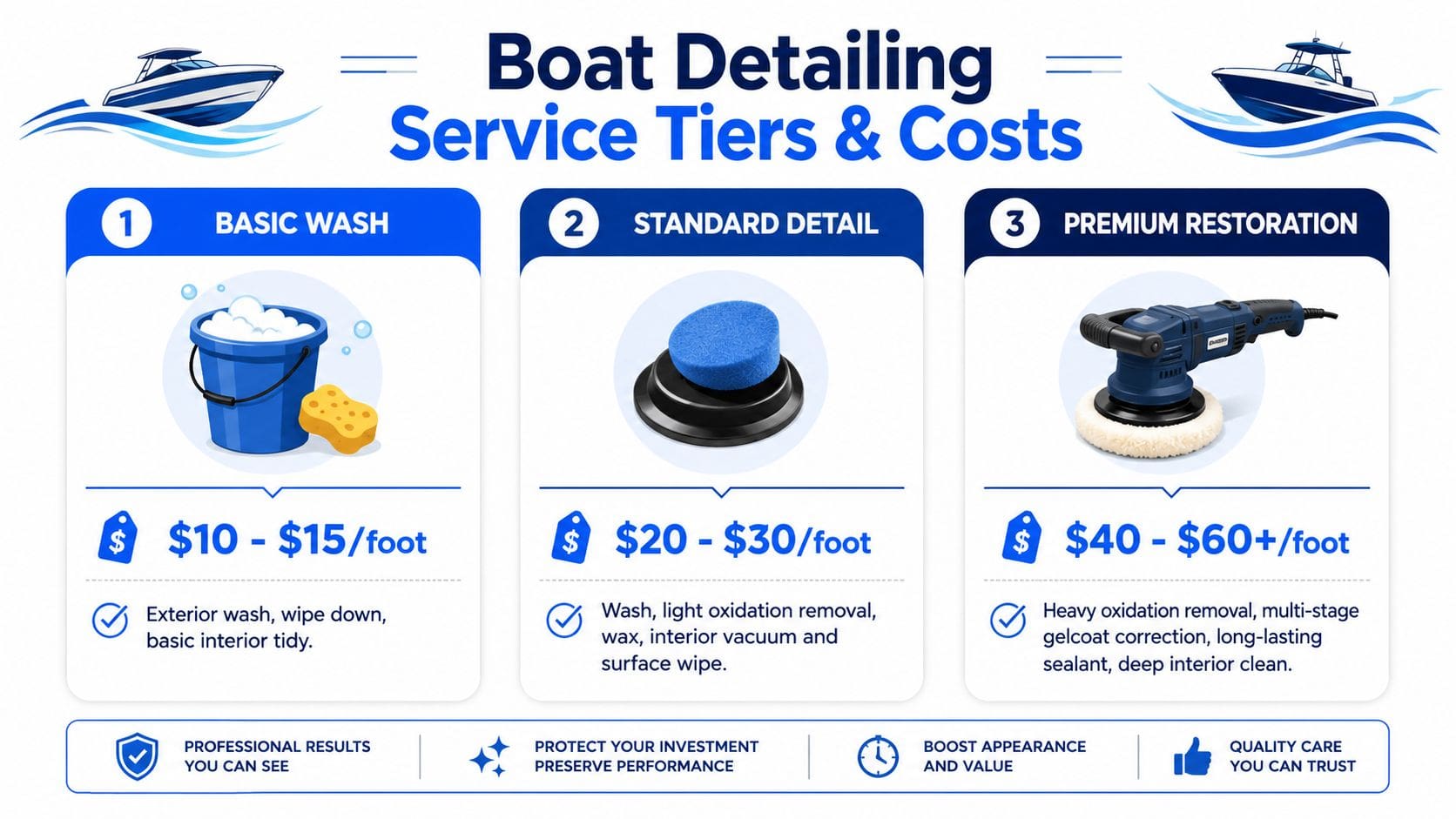
Per-foot pricing is the fastest way to set a starting range because longer boats usually bring more gel coat, more rails, more seating, more storage areas, and more time spent working around the trailer or lift. It is a practical measuring stick, not a final invoice formula.
As noted earlier, a basic maintenance wash often falls in the lower per-foot range, while a full detail with interior work, polishing, and protection lands higher. In plain terms, a wash is closer to routine upkeep. A full detail is more like combining interior reconditioning, paint correction-style machine work, and protection, except marine gel coat usually takes more time to correct than automotive paint.
That difference is where new owners miss the true budget picture. Price per foot tells you the baseline. It does not account for the neglect multiplier that starts building when oxidation, staining, and embedded grime are left in place too long.
Sample boat detailing costs by size and service level
Here's a practical planning range based on the pricing discussed above.
| Boat Length | Basic Wash & Dry (Exterior) | Full Detail (Exterior & Interior) |
|---|---|---|
| 20-foot boat | $140 to $200 | $200 to $500 |
| 25-foot boat | $175 to $250 | $250 to $625 |
| 30-foot boat | $210 to $300 | $300 to $750 |
These numbers help with seasonal budgeting, especially for boats that have been kept up. They get less useful once the surface has gone chalky, the waterline needs heavy treatment, or the vinyl has been baking uncovered. At that point, the labor is no longer scaling neatly with length alone.
Where owners get tripped up on service tiers
Service names vary a lot from shop to shop. “Wash and wax” at one shop may mean a true decontamination and protection step. At another, it may mean soap, rinse, and a quick hand-applied product over whatever oxidation is already there.
Ask what is included:
- Exterior wash only: Does it include drying, wipe-down, and waterline cleaning, or just a basic wash?
- Interior included: Are compartments, vinyl, flooring, cupholders, and helm surfaces part of the job?
- Machine work included: Is the hull getting compounded or polished, or is protection being applied over faded gel coat?
- Protection type: Are you paying for a short-term wax or a longer-lasting sealant?
A wash improves appearance for the weekend. A detail improves the condition of the boat. Restoration-level work costs more because it corrects the problems that regular upkeep would have kept smaller and cheaper.
For a real local example, this Yamaha 242 boat detailing project in Columbus shows the level of buildup and correction work owners often underestimate when they ask for a simple clean-up quote.
What Really Drives Your Final Detailing Bill
A boat owner calls and says, “It just needs a detail.” Then we see the hull in person. The gel coat is chalky, the waterline is brown, the non-skid is loaded up, and the seats have been sitting through heat, pollen, and moisture. That quote changes fast, because the work changed.
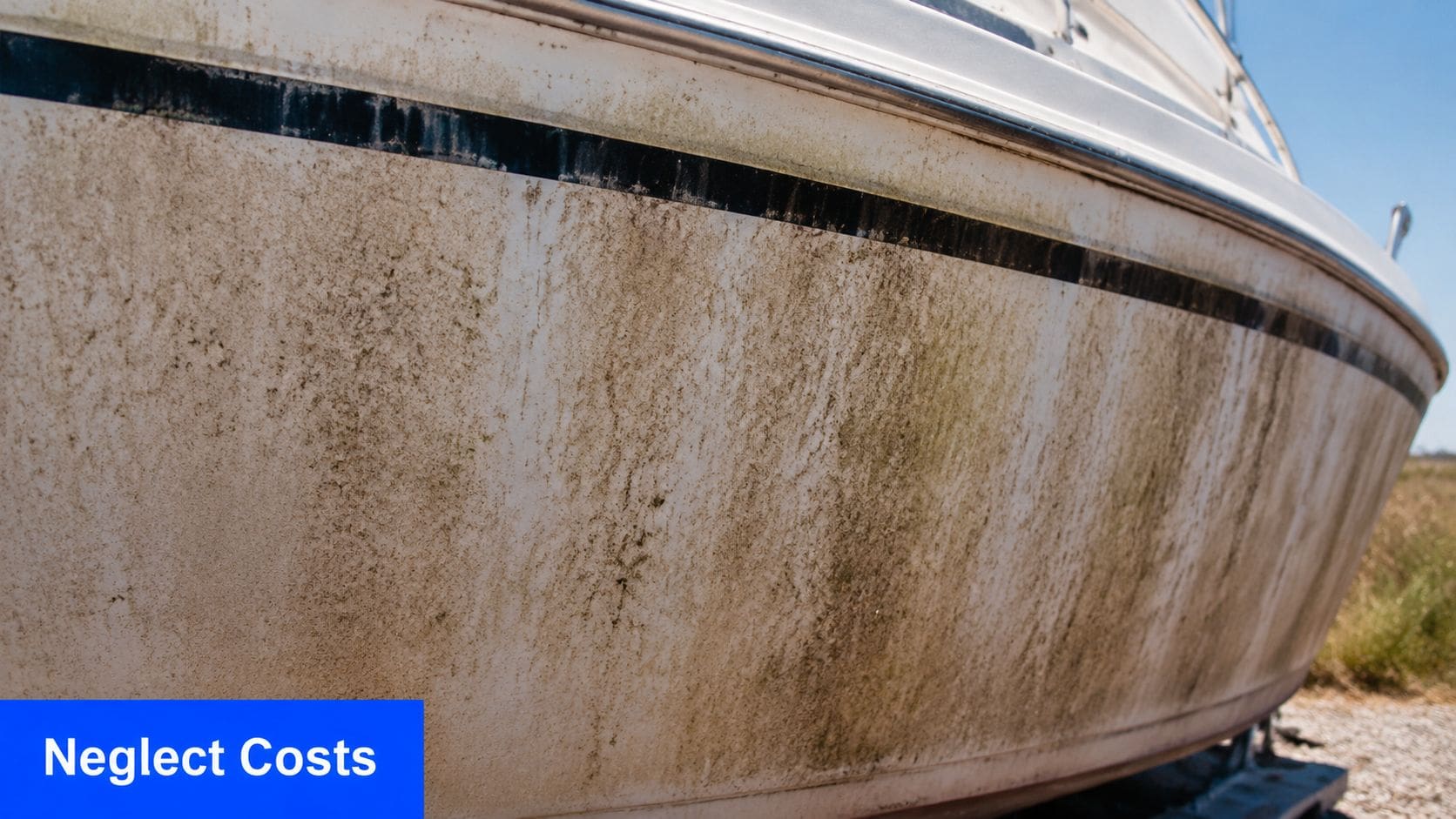
Length still matters. Condition usually decides whether the job stays in maintenance pricing or moves into correction and restoration labor.
The neglect multiplier is where budgets get blown up
The biggest cost driver is the neglect multiplier. I use that term because skipped upkeep rarely adds a small fee. It stacks labor on top of labor. Oxidation has to be cut back before protection goes on. Staining needs stronger chemistry and more dwell time. Embedded grime in textured decks and vinyl slows every step.
That is why a boat that was easy to maintain last season can become an expensive project this season. Owners tend to budget from a price-per-foot number they saw online. The actual invoice reflects hours of correction, not just boat length.
In a shop setting, this usually shows up in three ways:
- More prep work: Heavier buildup means more washing, decontamination, and re-cleaning before machine work can even start.
- More aggressive correction: Chalky or faded gel coat often needs compounding, multiple polishing steps, or targeted restoration work.
- More product and more risk management: Older surfaces, stained vinyl, and neglected trim need slower, more careful work to avoid causing damage while trying to improve them.
A good protective step keeps costs from snowballing. After correction, a longer-term option like a ceramic coating for boats and marine surfaces can reduce how quickly oxidation, water spotting, and grime come back.
The condition issues that change the quote
Final pricing usually shifts after an in-person inspection. These are the items that move a quote the most:
- Oxidation on hull sides and topsides: Faded gel coat needs correction time. Wax alone will not restore gloss.
- Waterline staining: Old mineral and tannin stains often require specialty cleaners, repeat passes, and hand work around decals or stripes.
- Non-skid texture: Textured fiberglass traps dirt deep in the pattern and takes longer to clean thoroughly.
- Vinyl and upholstery wear: Mildew, sunscreen transfer, body oils, and set-in stains can turn a quick wipe-down into a much longer interior service.
- Layout and hardware: More seating, rails, cleats, compartments, and tight transitions all increase labor time.
- How the boat is stored: Covered, accessible boats are usually faster to service than boats packed tightly into a slip or left exposed for months.
Bigger boats usually bring more complexity
Once boats get into the larger range, quotes rise for reasons that go beyond added length. There is more freeboard to correct, more vertical surface area to work safely, more hardware to clean around, and often a larger interior with compartments owners expect to be included.
That complexity matters on the clock. A simple 24-foot bowrider and a 24-foot cruiser can price very differently because the second boat has more surfaces, tighter work areas, and more places where grime collects.
What owners can do to keep the bill under control
The cheapest hour of boat detailing is the one you never have to buy later. Washes during the season, quick stain removal at the waterline, covered storage when possible, and timely protection on the gel coat all keep a maintenance job from turning into correction work.
Once the surface goes chalky, every skipped step gets paid back with interest in labor. That is the neglect multiplier in plain terms.
Understanding Advanced Services and Their Value
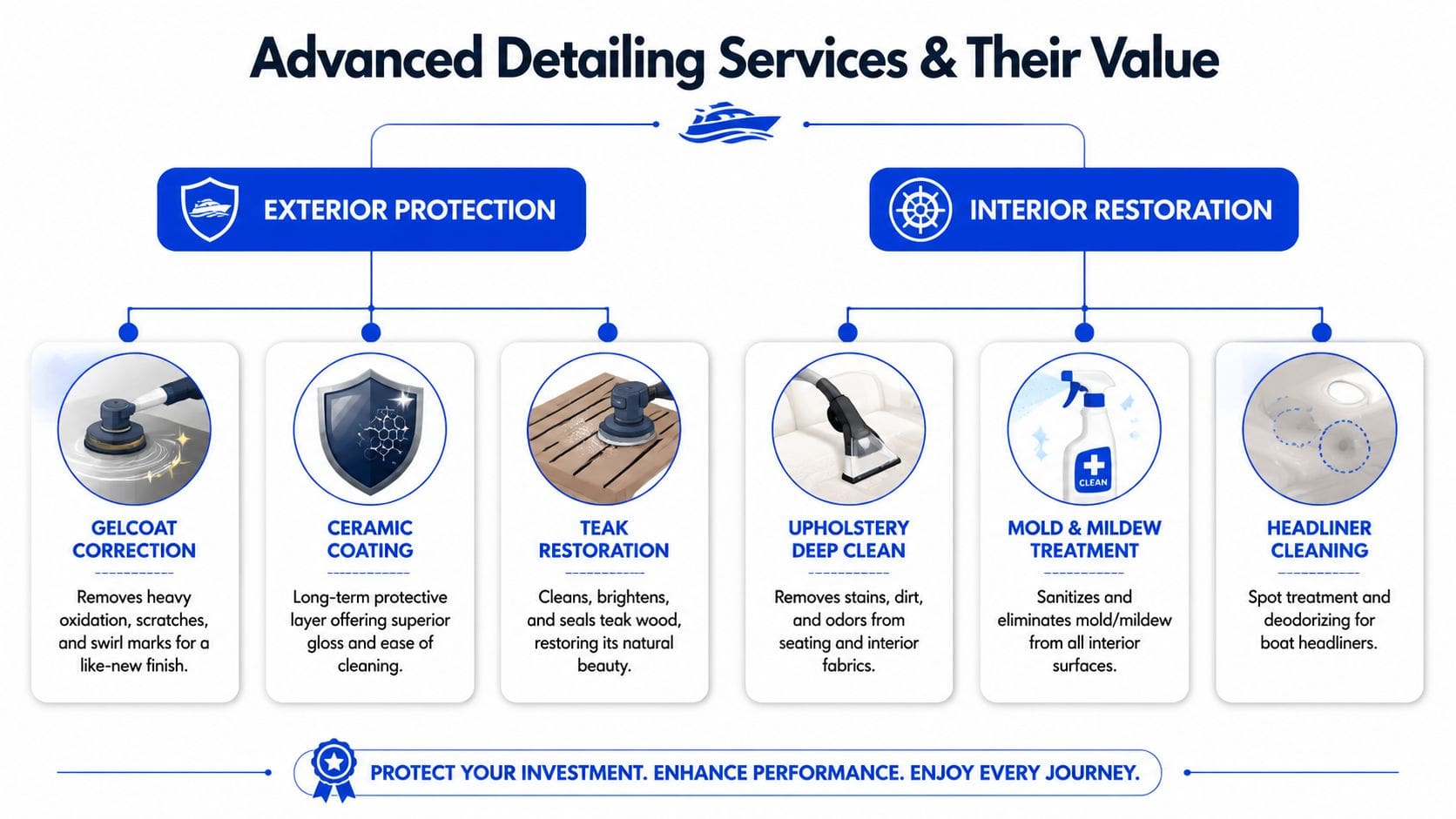
Advanced services start paying for themselves after a boat slips past simple maintenance and into correction work. I see that shift every season around Columbus. An owner puts off oxidation removal or protection for one more summer, then the same boat needs far more labor to get back to a clean, glossy finish. That is the neglect multiplier in real dollars.
Deciding Between Polishing and Heavy Correction
Polishing works for light oxidation. Once the gel coat turns chalky, patchy, or rough to the touch, the process changes.
One oxidation-removal pricing guide breaks the work into clear tiers: Light oxidation at $30 per foot, moderate oxidation at $75 per foot, and heavy oxidation at $120 per foot based on the level of correction required, from polishing to wet sanding and multi-step refinement.
That spread matters because the service is no longer just “make it shiny.” Light oxidation may respond to a one-step polish. Heavy oxidation often means sanding, compounding, polishing, cleaning compound dust out of non-skid and seams, then adding protection so the finish does not fade right back. On a neglected boat, the labor climbs much faster than the length alone would suggest.
Car owners usually understand this right away once you compare it to clear coat correction. A car with light wash marring might need a polish. A heavily neglected boat has a thicker, tougher gel coat, but it can demand far more physical correction time, especially around rails, decals, contours, and textured areas.
Why protection matters after correction
Correction restores the surface. Protection helps you keep from paying for the same correction again too soon.
A basic wash and wax can make sense on a boat that still has decent gloss and just needs maintenance. On the other hand, if the gel coat has already been corrected, stopping at bare polished gel coat is short-term thinking. Sun, water minerals, dock grime, and organic fallout start wearing on that fresh finish right away.
That is why owners ask about coatings after oxidation removal. The logic is the same as automotive protection, but marine conditions are harder on horizontal surfaces and exposed gel coat. A properly chosen protection layer can make cleanup easier, reduce how aggressively contaminants bond to the surface, and slow down the return of oxidation. It does not repair damaged gel coat by itself, and it does not replace prep work.
For owners comparing options across different vehicles and surfaces, our ceramic coating services for boats, RVs, cars, and trucks show how the protection strategy changes based on material, exposure, and maintenance goals.
Protection is the finishing step after correction. Skip it, and the next bill usually comes sooner and costs more.
How to Save Money on Boat Detailing Without Cutting Corners
The cheapest boat detail isn't usually the lowest quote. It's the one that keeps you out of restoration pricing later.
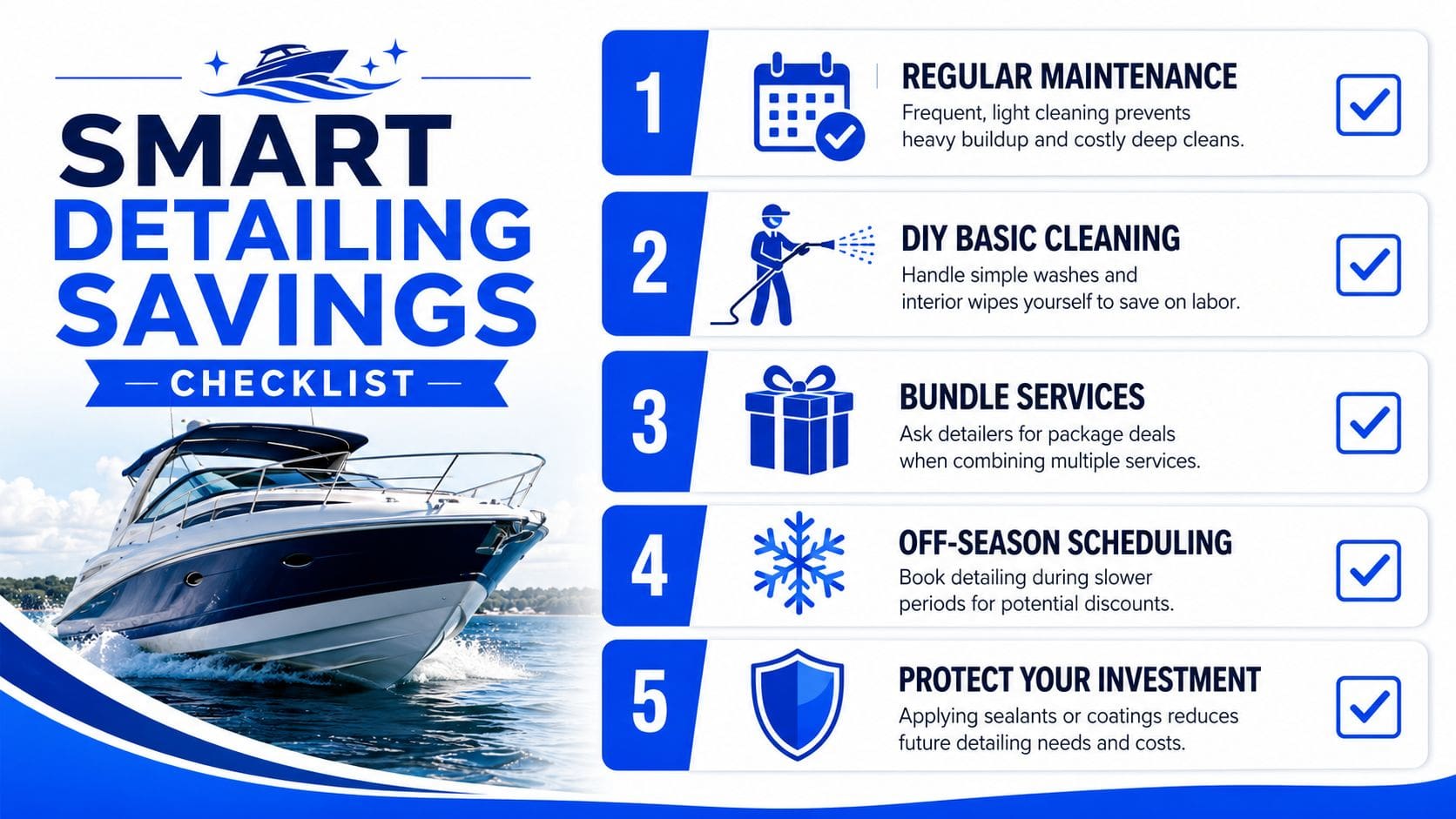
A lot of owners try to save money by waiting, or by doing a partial DIY rescue after the boat already looks rough. Sometimes that helps. Sometimes it creates more work, especially if the wrong pad, compound, brush, or cleaner gets used on gel coat, vinyl, or textured decking.
What DIY gets right and where it goes sideways
DIY can make sense for basic upkeep. If you're rinsing, wiping surfaces down, cleaning loose debris, and keeping grime from baking in, you're doing the exact kind of maintenance that lowers future detailing costs.
Where DIY gets expensive is when owners underestimate the labor and the skill involved. Verified data shows DIY equipment costs $320 to $740, and the often-overlooked labor commitment is 8 to 20 hours, based on this comparison of DIY and professional boat detailing costs. For oxidation work, those hours add up fast.
That's before mistakes enter the picture. On neglected boats, aggressive polishing without the right process can leave uneven gloss, haze, or unnecessary gel coat removal.
The cheapest ways to lower your bill before the detail starts
There are practical things owners can do before a professional detail that reduce labor without lowering quality.
- Remove personal gear: Life jackets, ropes, coolers, tackle, and loose storage items slow interior cleaning.
- Clear compartments you want cleaned: If a detailer has to unload everything first, the clock keeps running.
- Rinse off loose debris early: Leaves, dust, and surface dirt are easy to handle before appointment day.
- Be honest about condition: Good photos of the hull, deck, interior, and problem areas help set the right service level.
- Book before the boat gets bad: Maintenance pricing beats restoration pricing every time.
What not to do if you want to save money
Some cost-cutting moves backfire:
- Don't wax over oxidation. It locks poor results under fresh product.
- Don't use random automotive products on every marine surface. Some work fine, some don't.
- Don't attack non-skid with overly aggressive tools. You can clean texture without tearing it up.
- Don't wait until launch week if the boat sat all season. Last-minute panic rarely gets the most efficient plan.
If your time matters, your weekends matter, and the boat needs correction, professional work often costs less than a trial-and-error DIY redo.
This is the same kind of logic people use when they compare professional Hilliard auto detailing, Columbus PPF, or ceramic coating near me services against buying tools and trying to replicate the result at home. Maintenance DIY is smart. High-risk correction DIY is where people usually spend more than they planned.
Get a Clear Quote for Your Boat in Columbus
The short version is this. Boat detailing cost usually starts with length, but the final number depends on condition, especially oxidation and neglect.
A clean, maintained boat is usually a straightforward per-foot pricing job. A neglected boat can move into correction or restoration pricing quickly, and that's where owners get surprised. The best way to control costs is steady upkeep, early correction when needed, and protection after the surface has been properly restored.
If you're shopping around Columbus or Hilliard, ask detailers clear questions. Ask what's included. Ask whether the quote assumes light cleaning or real oxidation removal. Ask what protection is going on after correction. And ask whether they've looked at current photos or inspected the boat in person.
That simple conversation prevents most pricing surprises.
The same shop standards that matter in automotive work matter here too. Clear scope. Honest condition assessment. No shortcuts disguised as “full detail.” No protection applied over a surface that still needs correction. Whether you're comparing marine services or looking into Hilliard ceramic coating, Columbus ceramic coating, or paint protection for other vehicles, the pattern is the same. Prep determines the result.
If you want a straightforward assessment of your boat's condition, Lionheart Detailing can help with professional boat detailing, as well as ceramic coating, paint protection film, and full detailing services for vehicles in Hilliard and the greater Columbus area. Reach out for a clear quote and honest guidance on what your boat needs.